

17 Seascape Integrity Assessment: A Proposed Index for the Mediterranean Coast
267
Table 17.1 Quotation grid for Relief criterion
Physical descriptor: Nature and structure of the Relief
Lack
Max quotation
Shallow rocky bottoms and lower part of cliff
0
+ 2
Flat rocks (rocky plateau, slabs)
0
+ 2
Blocks/sparse block field
0
+ 2
Isolated large blocks
0
+ 3
Coastal or isolated pinnacles
0
+ 4
Submarine walls
0
+ 4
Faults, breaks, small hollows
0
+ 2
Rocky shoals, small overhangs
0
+ 2
Large hollows that can be visited by SCUBA divers
(caves, arches, tunnels, very large overhangs, etc.)
0
+ 5
Deep crevices
0
+ 4
Coralligenous in its physical structure
0
+ 2
Posidonia oceanica meadows as habitat
0
+ 2
Sandy areas
0
+ 2
Table 17.2 Quotation grid for Biological criterion
Biological criterion
Lack
Max quotation
Large erected species (Sea fans, axinellid sponges, alcyonids, large
bryozoans, large erected algae. . . )
0
+ 4
Colorful surfaces covered with encrusting species
0
+ 3
Diversity and global abundance of forms and colors
0
+ 3
Permanent or regular presence of abundant open water fish species
0
+ 4
Permanent or regular presence of abundant necto-benthic fish species
0
+ 2
Permanent or regular presence of abundant emblematic and/or rare fish
species (grouper, brown meager, barracuda, red coral, long-spined
sea urchin . . . )
0
+ 2
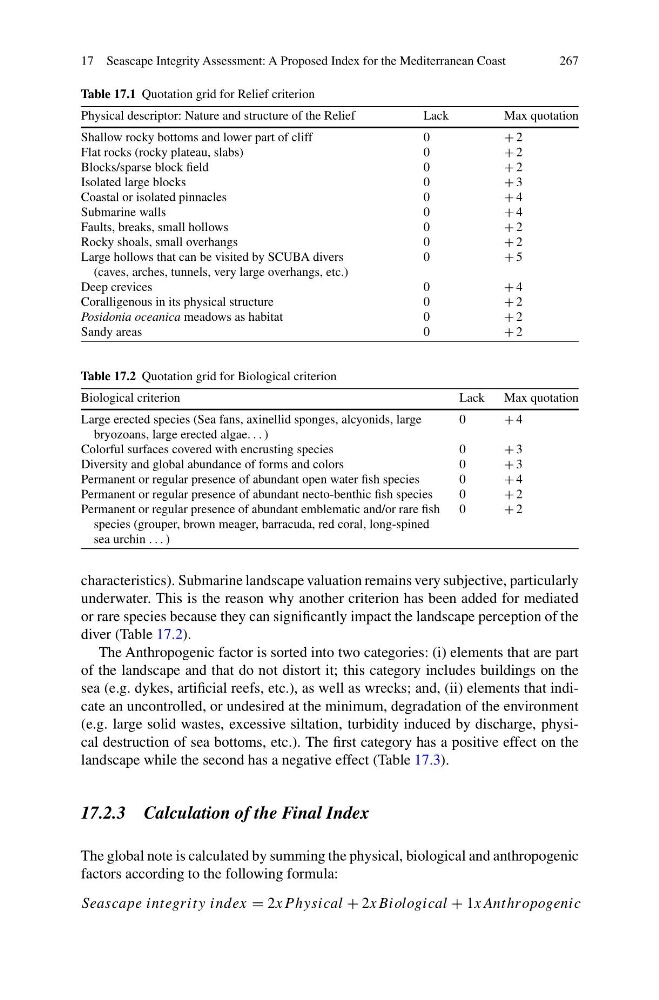
characteristics). Submarine landscape valuation remains very subjective, particularly
underwater. This is the reason why another criterion has been added for mediated
or rare species because they can significantly impact the landscape perception of the
diver (Table 17.2).
The Anthropogenic factor is sorted into two categories: (i) elements that are part
of the landscape and that do not distort it; this category includes buildings on the
sea (e.g. dykes, artificial reefs, etc.), as well as wrecks; and, (ii) elements that indicate an uncontrolled, or undesired at the minimum, degradation of the environment
(e.g. large solid wastes, excessive siltation, turbidity induced by discharge, physical destruction of sea bottoms, etc.). The first category has a positive effect on the
landscape while the second has a negative effect (Table 17.3).
17.2.3 Calculation of the Final Index
The global note is calculated by summing the physical, biological and anthropogenic
factors according to the following formula:
Seascape integrity index = 2xP hysical + 2xBiological + 1xAnthropogenic
267
Table 17.1 Quotation grid for Relief criterion
Physical descriptor: Nature and structure of the Relief
Lack
Max quotation
Shallow rocky bottoms and lower part of cliff
0
+ 2
Flat rocks (rocky plateau, slabs)
0
+ 2
Blocks/sparse block field
0
+ 2
Isolated large blocks
0
+ 3
Coastal or isolated pinnacles
0
+ 4
Submarine walls
0
+ 4
Faults, breaks, small hollows
0
+ 2
Rocky shoals, small overhangs
0
+ 2
Large hollows that can be visited by SCUBA divers
(caves, arches, tunnels, very large overhangs, etc.)
0
+ 5
Deep crevices
0
+ 4
Coralligenous in its physical structure
0
+ 2
Posidonia oceanica meadows as habitat
0
+ 2
Sandy areas
0
+ 2
Table 17.2 Quotation grid for Biological criterion
Biological criterion
Lack
Max quotation
Large erected species (Sea fans, axinellid sponges, alcyonids, large
bryozoans, large erected algae. . . )
0
+ 4
Colorful surfaces covered with encrusting species
0
+ 3
Diversity and global abundance of forms and colors
0
+ 3
Permanent or regular presence of abundant open water fish species
0
+ 4
Permanent or regular presence of abundant necto-benthic fish species
0
+ 2
Permanent or regular presence of abundant emblematic and/or rare fish
species (grouper, brown meager, barracuda, red coral, long-spined
sea urchin . . . )
0
+ 2
characteristics). Submarine landscape valuation remains very subjective, particularly
underwater. This is the reason why another criterion has been added for mediated
or rare species because they can significantly impact the landscape perception of the
diver (Table 17.2).
The Anthropogenic factor is sorted into two categories: (i) elements that are part
of the landscape and that do not distort it; this category includes buildings on the
sea (e.g. dykes, artificial reefs, etc.), as well as wrecks; and, (ii) elements that indicate an uncontrolled, or undesired at the minimum, degradation of the environment
(e.g. large solid wastes, excessive siltation, turbidity induced by discharge, physical destruction of sea bottoms, etc.). The first category has a positive effect on the
landscape while the second has a negative effect (Table 17.3).
17.2.3 Calculation of the Final Index
The global note is calculated by summing the physical, biological and anthropogenic
factors according to the following formula:
Seascape integrity index = 2xP hysical + 2xBiological + 1xAnthropogenic