

16 Reefscape Ecology Within the South Pacific
249
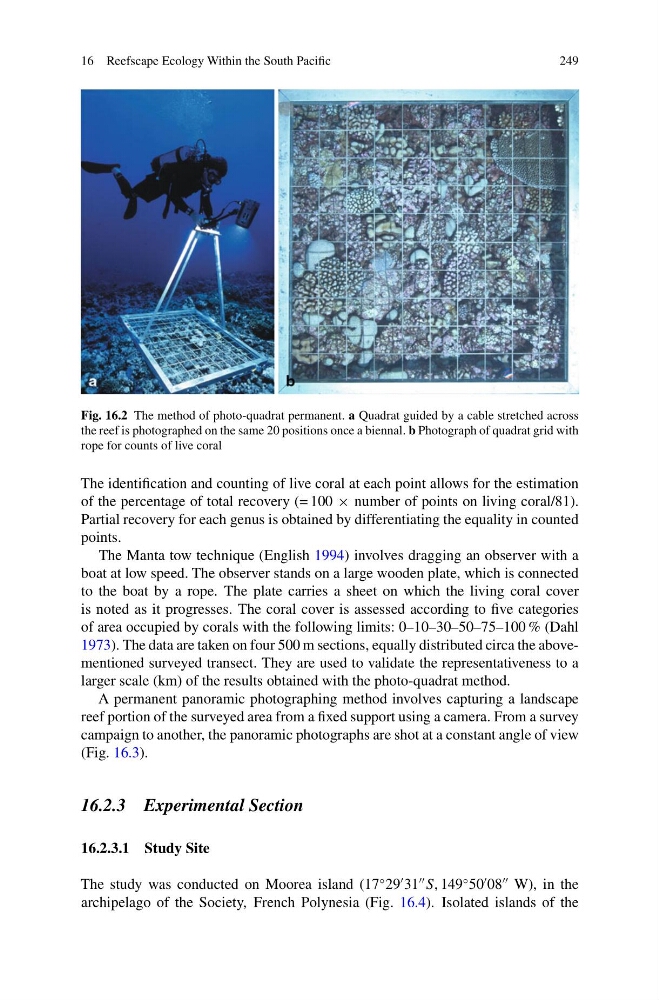
Fig. 16.2 The method of photo-quadrat permanent. a Quadrat guided by a cable stretched across
the reef is photographed on the same 20 positions once a biennal. b Photograph of quadrat grid with
rope for counts of live coral
The identification and counting of live coral at each point allows for the estimation
of the percentage of total recovery (= 100 × number of points on living coral/81).
Partial recovery for each genus is obtained by differentiating the equality in counted
points.
The Manta tow technique (English 1994) involves dragging an observer with a
boat at low speed. The observer stands on a large wooden plate, which is connected
to the boat by a rope. The plate carries a sheet on which the living coral cover
is noted as it progresses. The coral cover is assessed according to five categories
of area occupied by corals with the following limits: 0–10–30–50–75–100 % (Dahl
1973). The data are taken on four 500 m sections, equally distributed circa the abovementioned surveyed transect. They are used to validate the representativeness to a
larger scale (km) of the results obtained with the photo-quadrat method.
A permanent panoramic photographing method involves capturing a landscape
reef portion of the surveyed area from a fixed support using a camera. From a survey
campaign to another, the panoramic photographs are shot at a constant angle of view
(Fig. 16.3).
16.2.3 Experimental Section
16.2.3.1 Study Site
The study was conducted on Moorea island (17
◦ 29
31
S, 149
◦ 50
08
W), in the
archipelago of the Society, French Polynesia (Fig. 16.4). Isolated islands of the
249
Fig. 16.2 The method of photo-quadrat permanent. a Quadrat guided by a cable stretched across
the reef is photographed on the same 20 positions once a biennal. b Photograph of quadrat grid with
rope for counts of live coral
The identification and counting of live coral at each point allows for the estimation
of the percentage of total recovery (= 100 × number of points on living coral/81).
Partial recovery for each genus is obtained by differentiating the equality in counted
points.
The Manta tow technique (English 1994) involves dragging an observer with a
boat at low speed. The observer stands on a large wooden plate, which is connected
to the boat by a rope. The plate carries a sheet on which the living coral cover
is noted as it progresses. The coral cover is assessed according to five categories
of area occupied by corals with the following limits: 0–10–30–50–75–100 % (Dahl
1973). The data are taken on four 500 m sections, equally distributed circa the abovementioned surveyed transect. They are used to validate the representativeness to a
larger scale (km) of the results obtained with the photo-quadrat method.
A permanent panoramic photographing method involves capturing a landscape
reef portion of the surveyed area from a fixed support using a camera. From a survey
campaign to another, the panoramic photographs are shot at a constant angle of view
(Fig. 16.3).
16.2.3 Experimental Section
16.2.3.1 Study Site
The study was conducted on Moorea island (17
◦ 29
31
S, 149
◦ 50
08
W), in the
archipelago of the Society, French Polynesia (Fig. 16.4). Isolated islands of the