

226
P. Drap et al.
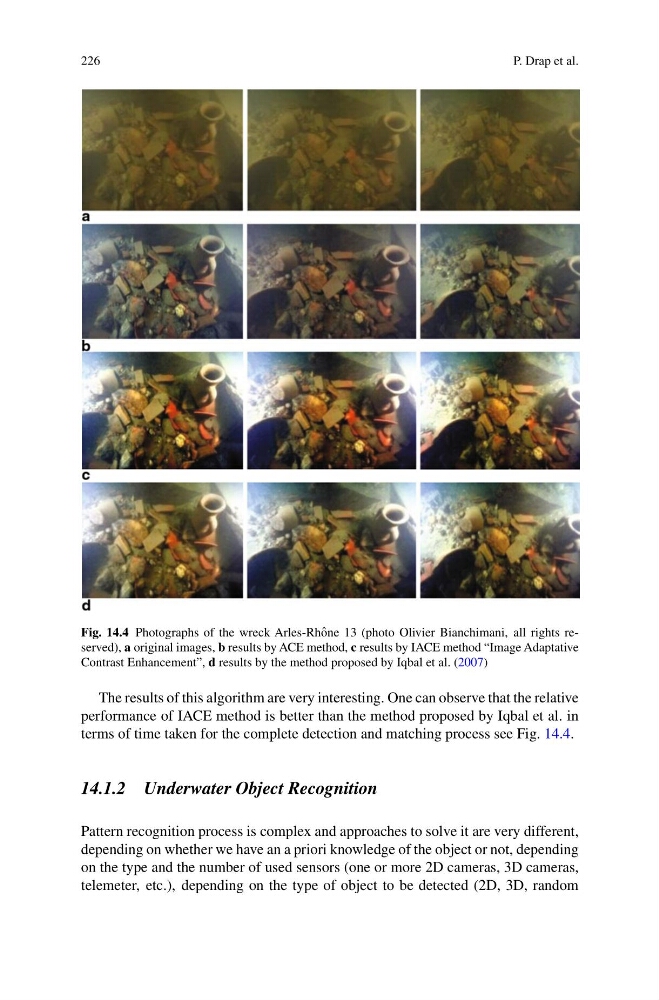
Fig. 14.4 Photographs of the wreck Arles-Rhˆ one 13 (photo Olivier Bianchimani, all rights reserved), a original images, b results by ACE method, c results by IACE method “Image Adaptative
Contrast Enhancement”, d results by the method proposed by Iqbal et al. (2007)
The results of this algorithm are very interesting. One can observe that the relative
performance of IACE method is better than the method proposed by Iqbal et al. in
terms of time taken for the complete detection and matching process see Fig. 14.4.
14.1.2 Underwater Object Recognition
Pattern recognition process is complex and approaches to solve it are very different,
depending on whether we have an a priori knowledge of the object or not, depending
on the type and the number of used sensors (one or more 2D cameras, 3D cameras,
telemeter, etc.), depending on the type of object to be detected (2D, 3D, random
P. Drap et al.
Fig. 14.4 Photographs of the wreck Arles-Rhˆ one 13 (photo Olivier Bianchimani, all rights reserved), a original images, b results by ACE method, c results by IACE method “Image Adaptative
Contrast Enhancement”, d results by the method proposed by Iqbal et al. (2007)
The results of this algorithm are very interesting. One can observe that the relative
performance of IACE method is better than the method proposed by Iqbal et al. in
terms of time taken for the complete detection and matching process see Fig. 14.4.
14.1.2 Underwater Object Recognition
Pattern recognition process is complex and approaches to solve it are very different,
depending on whether we have an a priori knowledge of the object or not, depending
on the type and the number of used sensors (one or more 2D cameras, 3D cameras,
telemeter, etc.), depending on the type of object to be detected (2D, 3D, random