

210
C. Hily and M. Bernard
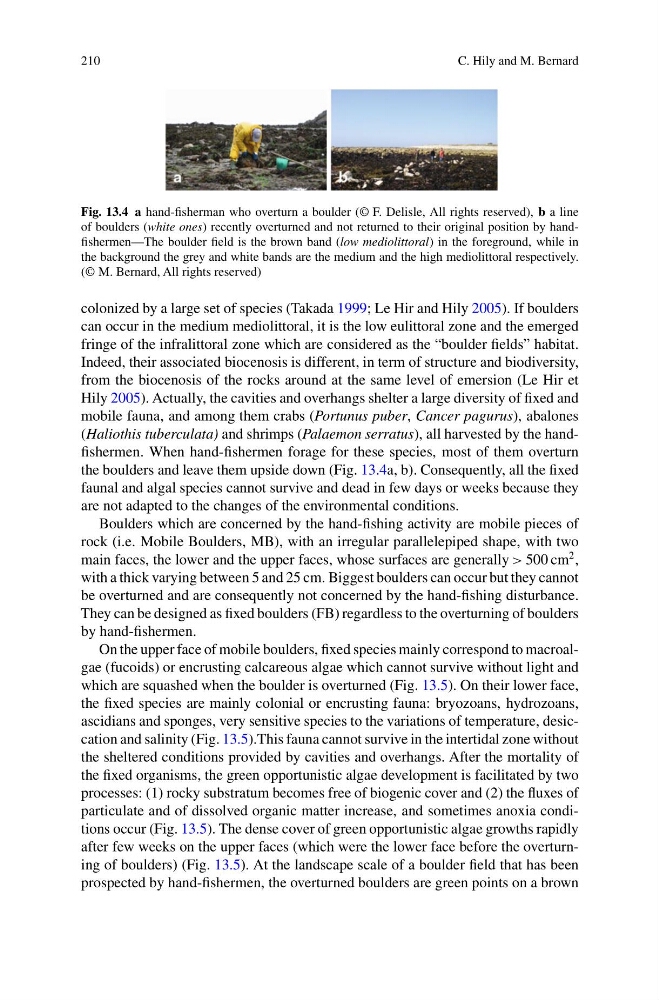
Fig. 13.4 a hand-fisherman who overturn a boulder (© F. Delisle, All rights reserved), b a line
of boulders (white ones) recently overturned and not returned to their original position by handfishermen—The boulder field is the brown band (low mediolittoral) in the foreground, while in
the background the grey and white bands are the medium and the high mediolittoral respectively.
(© M. Bernard, All rights reserved)
colonized by a large set of species (Takada 1999; Le Hir and Hily 2005). If boulders
can occur in the medium mediolittoral, it is the low eulittoral zone and the emerged
fringe of the infralittoral zone which are considered as the “boulder fields” habitat.
Indeed, their associated biocenosis is different, in term of structure and biodiversity,
from the biocenosis of the rocks around at the same level of emersion (Le Hir et
Hily 2005). Actually, the cavities and overhangs shelter a large diversity of fixed and
mobile fauna, and among them crabs (Portunus puber, Cancer pagurus), abalones
(Haliothis tuberculata) and shrimps (Palaemon serratus), all harvested by the handfishermen. When hand-fishermen forage for these species, most of them overturn
the boulders and leave them upside down (Fig. 13.4a, b). Consequently, all the fixed
faunal and algal species cannot survive and dead in few days or weeks because they
are not adapted to the changes of the environmental conditions.
Boulders which are concerned by the hand-fishing activity are mobile pieces of
rock (i.e. Mobile Boulders, MB), with an irregular parallelepiped shape, with two
main faces, the lower and the upper faces, whose surfaces are generally > 500 cm
2 ,
with a thick varying between 5 and 25 cm. Biggest boulders can occur but they cannot
be overturned and are consequently not concerned by the hand-fishing disturbance.
They can be designed as fixed boulders (FB) regardless to the overturning of boulders
by hand-fishermen.
On the upper face of mobile boulders, fixed species mainly correspond to macroalgae (fucoids) or encrusting calcareous algae which cannot survive without light and
which are squashed when the boulder is overturned (Fig. 13.5). On their lower face,
the fixed species are mainly colonial or encrusting fauna: bryozoans, hydrozoans,
ascidians and sponges, very sensitive species to the variations of temperature, desiccation and salinity (Fig. 13.5).This fauna cannot survive in the intertidal zone without
the sheltered conditions provided by cavities and overhangs. After the mortality of
the fixed organisms, the green opportunistic algae development is facilitated by two
processes: (1) rocky substratum becomes free of biogenic cover and (2) the fluxes of
particulate and of dissolved organic matter increase, and sometimes anoxia conditions occur (Fig. 13.5). The dense cover of green opportunistic algae growths rapidly
after few weeks on the upper faces (which were the lower face before the overturning of boulders) (Fig. 13.5). At the landscape scale of a boulder field that has been
prospected by hand-fishermen, the overturned boulders are green points on a brown
C. Hily and M. Bernard
Fig. 13.4 a hand-fisherman who overturn a boulder (© F. Delisle, All rights reserved), b a line
of boulders (white ones) recently overturned and not returned to their original position by handfishermen—The boulder field is the brown band (low mediolittoral) in the foreground, while in
the background the grey and white bands are the medium and the high mediolittoral respectively.
(© M. Bernard, All rights reserved)
colonized by a large set of species (Takada 1999; Le Hir and Hily 2005). If boulders
can occur in the medium mediolittoral, it is the low eulittoral zone and the emerged
fringe of the infralittoral zone which are considered as the “boulder fields” habitat.
Indeed, their associated biocenosis is different, in term of structure and biodiversity,
from the biocenosis of the rocks around at the same level of emersion (Le Hir et
Hily 2005). Actually, the cavities and overhangs shelter a large diversity of fixed and
mobile fauna, and among them crabs (Portunus puber, Cancer pagurus), abalones
(Haliothis tuberculata) and shrimps (Palaemon serratus), all harvested by the handfishermen. When hand-fishermen forage for these species, most of them overturn
the boulders and leave them upside down (Fig. 13.4a, b). Consequently, all the fixed
faunal and algal species cannot survive and dead in few days or weeks because they
are not adapted to the changes of the environmental conditions.
Boulders which are concerned by the hand-fishing activity are mobile pieces of
rock (i.e. Mobile Boulders, MB), with an irregular parallelepiped shape, with two
main faces, the lower and the upper faces, whose surfaces are generally > 500 cm
2 ,
with a thick varying between 5 and 25 cm. Biggest boulders can occur but they cannot
be overturned and are consequently not concerned by the hand-fishing disturbance.
They can be designed as fixed boulders (FB) regardless to the overturning of boulders
by hand-fishermen.
On the upper face of mobile boulders, fixed species mainly correspond to macroalgae (fucoids) or encrusting calcareous algae which cannot survive without light and
which are squashed when the boulder is overturned (Fig. 13.5). On their lower face,
the fixed species are mainly colonial or encrusting fauna: bryozoans, hydrozoans,
ascidians and sponges, very sensitive species to the variations of temperature, desiccation and salinity (Fig. 13.5).This fauna cannot survive in the intertidal zone without
the sheltered conditions provided by cavities and overhangs. After the mortality of
the fixed organisms, the green opportunistic algae development is facilitated by two
processes: (1) rocky substratum becomes free of biogenic cover and (2) the fluxes of
particulate and of dissolved organic matter increase, and sometimes anoxia conditions occur (Fig. 13.5). The dense cover of green opportunistic algae growths rapidly
after few weeks on the upper faces (which were the lower face before the overturning of boulders) (Fig. 13.5). At the landscape scale of a boulder field that has been
prospected by hand-fishermen, the overturned boulders are green points on a brown