

13 Can We use a Landscape Approach to Assess Natural and Anthropogenic . . .
209
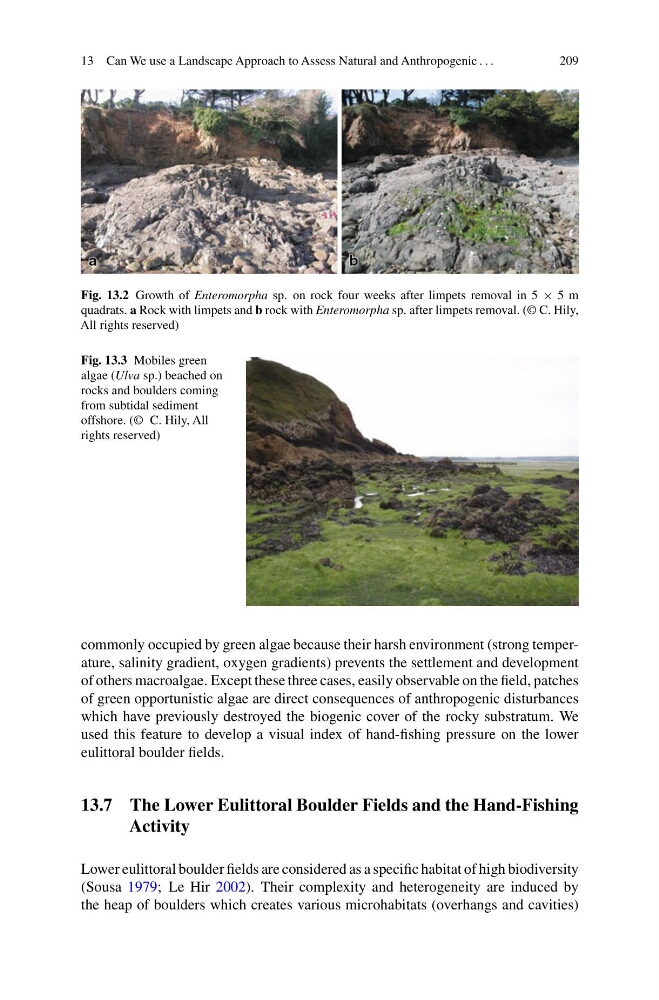
Fig. 13.2 Growth of Enteromorpha sp. on rock four weeks after limpets removal in 5 × 5 m
quadrats. a Rock with limpets and b rock with Enteromorpha sp. after limpets removal. (© C. Hily,
All rights reserved)
Fig. 13.3 Mobiles green
algae (Ulva sp.) beached on
rocks and boulders coming
from subtidal sediment
offshore. (© C. Hily, All
rights reserved)
commonly occupied by green algae because their harsh environment (strong temperature, salinity gradient, oxygen gradients) prevents the settlement and development
of others macroalgae. Except these three cases, easily observable on the field, patches
of green opportunistic algae are direct consequences of anthropogenic disturbances
which have previously destroyed the biogenic cover of the rocky substratum. We
used this feature to develop a visual index of hand-fishing pressure on the lower
eulittoral boulder fields.
13.7 The Lower Eulittoral Boulder Fields and the Hand-Fishing
Activity
Lower eulittoral boulder fields are considered as a specific habitat of high biodiversity
(Sousa 1979; Le Hir 2002). Their complexity and heterogeneity are induced by
the heap of boulders which creates various microhabitats (overhangs and cavities)
209
Fig. 13.2 Growth of Enteromorpha sp. on rock four weeks after limpets removal in 5 × 5 m
quadrats. a Rock with limpets and b rock with Enteromorpha sp. after limpets removal. (© C. Hily,
All rights reserved)
Fig. 13.3 Mobiles green
algae (Ulva sp.) beached on
rocks and boulders coming
from subtidal sediment
offshore. (© C. Hily, All
rights reserved)
commonly occupied by green algae because their harsh environment (strong temperature, salinity gradient, oxygen gradients) prevents the settlement and development
of others macroalgae. Except these three cases, easily observable on the field, patches
of green opportunistic algae are direct consequences of anthropogenic disturbances
which have previously destroyed the biogenic cover of the rocky substratum. We
used this feature to develop a visual index of hand-fishing pressure on the lower
eulittoral boulder fields.
13.7 The Lower Eulittoral Boulder Fields and the Hand-Fishing
Activity
Lower eulittoral boulder fields are considered as a specific habitat of high biodiversity
(Sousa 1979; Le Hir 2002). Their complexity and heterogeneity are induced by
the heap of boulders which creates various microhabitats (overhangs and cavities)