

12 Habitat 3D Complexity Effects on the Processes Structuring . . .
195
Box 5: Predation mortality of juveniles between habitats—from Nanjo
et al. (2011)
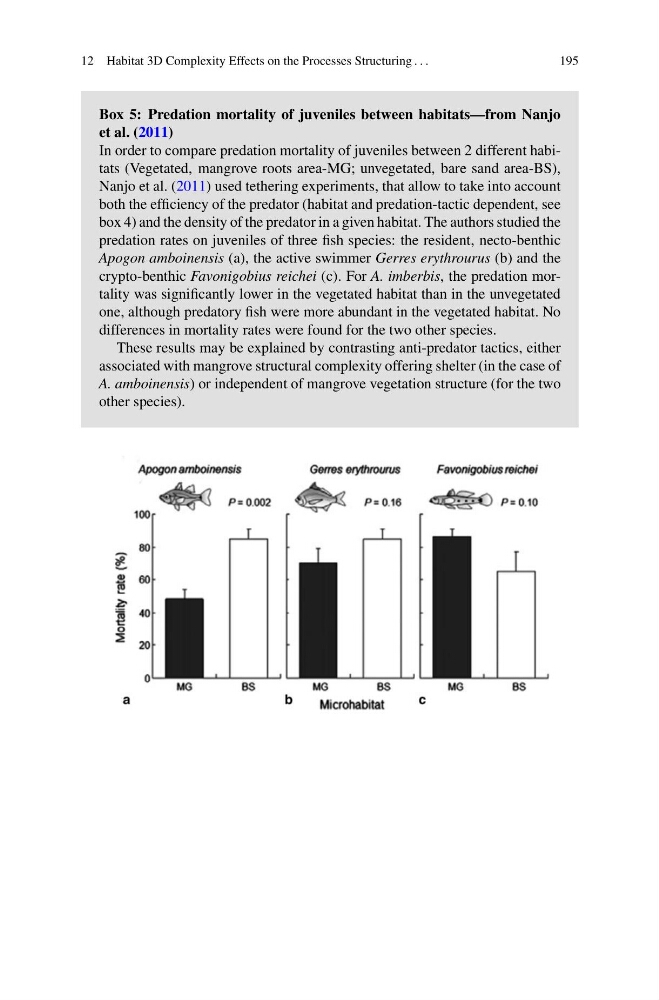
In order to compare predation mortality of juveniles between 2 different habitats (Vegetated, mangrove roots area-MG; unvegetated, bare sand area-BS),
Nanjo et al. (2011) used tethering experiments, that allow to take into account
both the efficiency of the predator (habitat and predation-tactic dependent, see
box 4) and the density of the predator in a given habitat. The authors studied the
predation rates on juveniles of three fish species: the resident, necto-benthic
Apogon amboinensis (a), the active swimmer Gerres erythrourus (b) and the
crypto-benthic Favonigobius reichei (c). For A. imberbis, the predation mortality was significantly lower in the vegetated habitat than in the unvegetated
one, although predatory fish were more abundant in the vegetated habitat. No
differences in mortality rates were found for the two other species.
These results may be explained by contrasting anti-predator tactics, either
associated with mangrove structural complexity offering shelter (in the case of
A. amboinensis) or independent of mangrove vegetation structure (for the two
other species).
195
Box 5: Predation mortality of juveniles between habitats—from Nanjo
et al. (2011)
In order to compare predation mortality of juveniles between 2 different habitats (Vegetated, mangrove roots area-MG; unvegetated, bare sand area-BS),
Nanjo et al. (2011) used tethering experiments, that allow to take into account
both the efficiency of the predator (habitat and predation-tactic dependent, see
box 4) and the density of the predator in a given habitat. The authors studied the
predation rates on juveniles of three fish species: the resident, necto-benthic
Apogon amboinensis (a), the active swimmer Gerres erythrourus (b) and the
crypto-benthic Favonigobius reichei (c). For A. imberbis, the predation mortality was significantly lower in the vegetated habitat than in the unvegetated
one, although predatory fish were more abundant in the vegetated habitat. No
differences in mortality rates were found for the two other species.
These results may be explained by contrasting anti-predator tactics, either
associated with mangrove structural complexity offering shelter (in the case of
A. amboinensis) or independent of mangrove vegetation structure (for the two
other species).