

194
P. Thiriet et al.
Box 4: Predation success and habitat architectural complexity—Authors’
unpublished data
Thiriet et al. studied interaction between predation success and habitat architectural complexity. To avoid confounding effects with food availability,
experiments were done in aquariums. Artificial habitats of increasing architectural complexity were constructed using different length of plastic algae: Bare
Substrate, Bush (short stems), Forest (long stems). The biological models were
two co-occurring demersal fishes in Mediterranean Infralittoral rocky reef: the
comber Serranus cabrilla preying on post-settlement juveniles of the wrasse
Symphodus ocellatus. Survival of one prey facing one predator was assessed
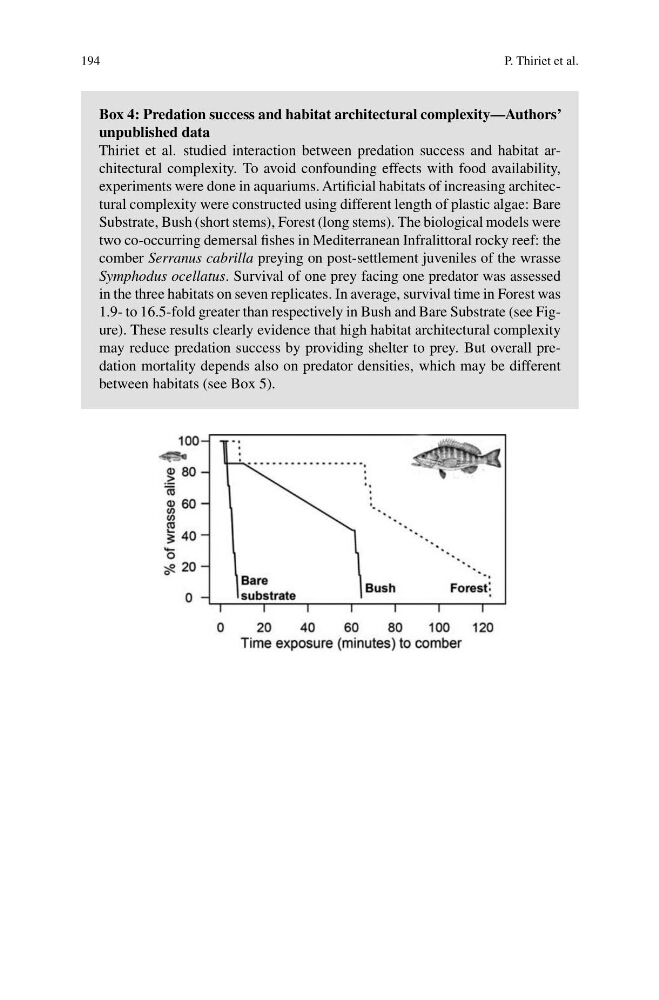
in the three habitats on seven replicates. In average, survival time in Forest was
1.9- to 16.5-fold greater than respectively in Bush and Bare Substrate (see Figure). These results clearly evidence that high habitat architectural complexity
may reduce predation success by providing shelter to prey. But overall predation mortality depends also on predator densities, which may be different
between habitats (see Box 5).
P. Thiriet et al.
Box 4: Predation success and habitat architectural complexity—Authors’
unpublished data
Thiriet et al. studied interaction between predation success and habitat architectural complexity. To avoid confounding effects with food availability,
experiments were done in aquariums. Artificial habitats of increasing architectural complexity were constructed using different length of plastic algae: Bare
Substrate, Bush (short stems), Forest (long stems). The biological models were
two co-occurring demersal fishes in Mediterranean Infralittoral rocky reef: the
comber Serranus cabrilla preying on post-settlement juveniles of the wrasse
Symphodus ocellatus. Survival of one prey facing one predator was assessed
in the three habitats on seven replicates. In average, survival time in Forest was
1.9- to 16.5-fold greater than respectively in Bush and Bare Substrate (see Figure). These results clearly evidence that high habitat architectural complexity
may reduce predation success by providing shelter to prey. But overall predation mortality depends also on predator densities, which may be different
between habitats (see Box 5).