

78
J. Kuo and C. den Hartog
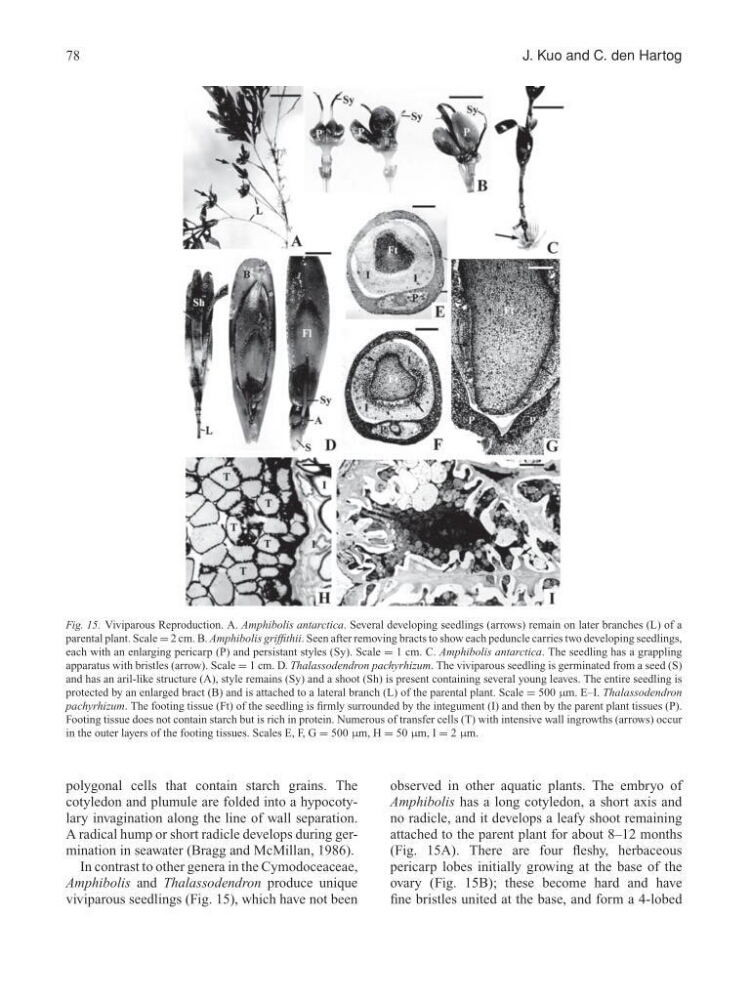
Fig. 15. Viviparous Reproduction. A. Amphibolis antarctica. Several developing seedlings (arrows) remain on later branches (L) of a
parental plant. Scale = 2 cm. B. Amphibolis griffithii. Seen after removing bracts to show each peduncle carries two developing seedlings,
each with an enlarging pericarp (P) and persistant styles (Sy). Scale = 1 cm. C. Amphibolis antarctica. The seedling has a grappling
apparatus with bristles (arrow). Scale = 1 cm. D. Thalassodendron pachyrhizum. The viviparous seedling is germinated from a seed (S)
and has an aril-like structure (A), style remains (Sy) and a shoot (Sh) is present containing several young leaves. The entire seedling is
protected by an enlarged bract (B) and is attached to a lateral branch (L) of the parental plant. Scale = 500 µm. E–I. Thalassodendron
pachyrhizum. The footing tissue (Ft) of the seedling is firmly surrounded by the integument (I) and then by the parent plant tissues (P).
Footing tissue does not contain starch but is rich in protein. Numerous of transfer cells (T) with intensive wall ingrowths (arrows) occur
in the outer layers of the footing tissues. Scales E, F, G = 500 µm, H = 50 µm, I = 2 µm.
polygonal cells that contain starch grains. The
cotyledon and plumule are folded into a hypocotylary invagination along the line of wall separation.
A radical hump or short radicle develops during germination in seawater (Bragg and McMillan, 1986).
In contrast to other genera in the Cymodoceaceae,
Amphibolis and Thalassodendron produce unique
viviparous seedlings (Fig. 15), which have not been
observed in other aquatic plants. The embryo of
Amphibolis has a long cotyledon, a short axis and
no radicle, and it develops a leafy shoot remaining
attached to the parent plant for about 8–12 months
(Fig. 15A). There are four fleshy, herbaceous
pericarp lobes initially growing at the base of the
ovary (Fig. 15B); these become hard and have
fine bristles united at the base, and form a 4-lobed
J. Kuo and C. den Hartog
Fig. 15. Viviparous Reproduction. A. Amphibolis antarctica. Several developing seedlings (arrows) remain on later branches (L) of a
parental plant. Scale = 2 cm. B. Amphibolis griffithii. Seen after removing bracts to show each peduncle carries two developing seedlings,
each with an enlarging pericarp (P) and persistant styles (Sy). Scale = 1 cm. C. Amphibolis antarctica. The seedling has a grappling
apparatus with bristles (arrow). Scale = 1 cm. D. Thalassodendron pachyrhizum. The viviparous seedling is germinated from a seed (S)
and has an aril-like structure (A), style remains (Sy) and a shoot (Sh) is present containing several young leaves. The entire seedling is
protected by an enlarged bract (B) and is attached to a lateral branch (L) of the parental plant. Scale = 500 µm. E–I. Thalassodendron
pachyrhizum. The footing tissue (Ft) of the seedling is firmly surrounded by the integument (I) and then by the parent plant tissues (P).
Footing tissue does not contain starch but is rich in protein. Numerous of transfer cells (T) with intensive wall ingrowths (arrows) occur
in the outer layers of the footing tissues. Scales E, F, G = 500 µm, H = 50 µm, I = 2 µm.
polygonal cells that contain starch grains. The
cotyledon and plumule are folded into a hypocotylary invagination along the line of wall separation.
A radical hump or short radicle develops during germination in seawater (Bragg and McMillan, 1986).
In contrast to other genera in the Cymodoceaceae,
Amphibolis and Thalassodendron produce unique
viviparous seedlings (Fig. 15), which have not been
observed in other aquatic plants. The embryo of
Amphibolis has a long cotyledon, a short axis and
no radicle, and it develops a leafy shoot remaining
attached to the parent plant for about 8–12 months
(Fig. 15A). There are four fleshy, herbaceous
pericarp lobes initially growing at the base of the
ovary (Fig. 15B); these become hard and have
fine bristles united at the base, and form a 4-lobed