

Chapter 3 Seagrass Morphology, Anatomy, and Ultrastructure
77
A
B
C
E
D
F
G
H
J
I
K
L
M
N
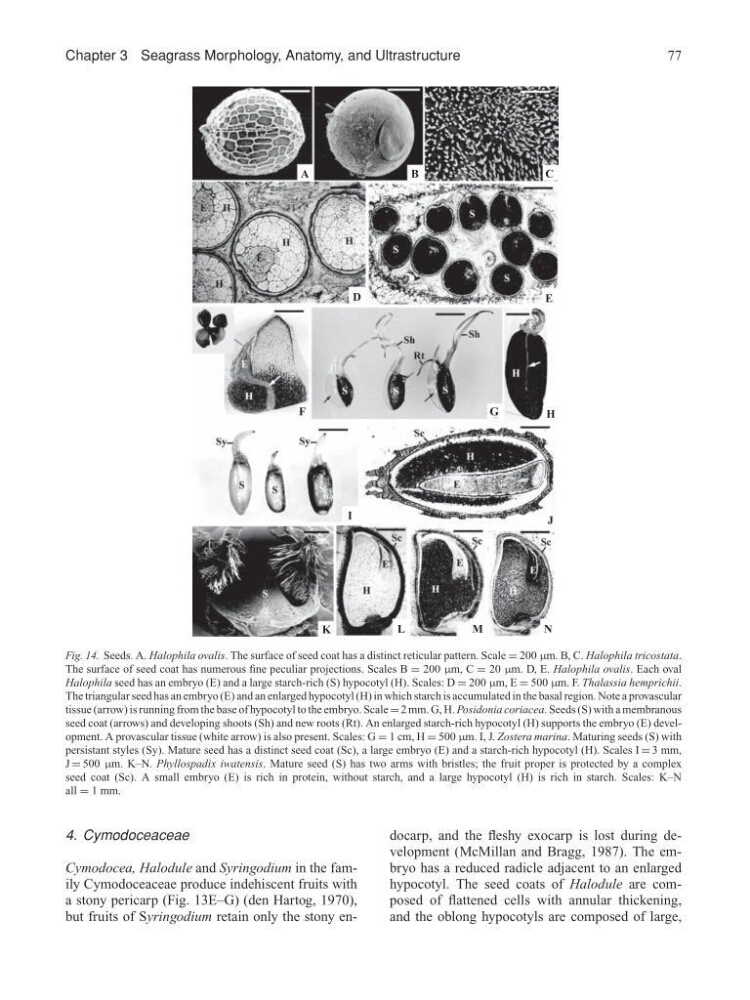
Fig. 14. Seeds. A. Halophila ovalis. The surface of seed coat has a distinct reticular pattern. Scale = 200 µm. B, C. Halophila tricostata.
The surface of seed coat has numerous fine peculiar projections. Scales B = 200 µm, C = 20 µm. D, E. Halophila ovalis. Each oval
Halophila seed has an embryo (E) and a large starch-rich (S) hypocotyl (H). Scales: D = 200 µm, E = 500 µm. F. Thalassia hemprichii.
The triangular seed has an embryo (E) and an enlarged hypocotyl (H) in which starch is accumulated in the basal region. Note a provascular
tissue (arrow) is running from the base of hypocotyl to the embryo. Scale = 2 mm. G, H. Posidonia coriacea. Seeds (S) with a membranous
seed coat (arrows) and developing shoots (Sh) and new roots (Rt). An enlarged starch-rich hypocotyl (H) supports the embryo (E) development. A provascular tissue (white arrow) is also present. Scales: G = 1 cm, H = 500 µm. I, J. Zostera marina. Maturing seeds (S) with
persistant styles (Sy). Mature seed has a distinct seed coat (Sc), a large embryo (E) and a starch-rich hypocotyl (H). Scales I = 3 mm,
J = 500 µm. K–N. Phyllospadix iwatensis. Mature seed (S) has two arms with bristles; the fruit proper is protected by a complex
seed coat (Sc). A small embryo (E) is rich in protein, without starch, and a large hypocotyl (H) is rich in starch. Scales: K–N
all = 1 mm.
4. Cymodoceaceae
Cymodocea, Halodule and Syringodium in the family Cymodoceaceae produce indehiscent fruits with
a stony pericarp (Fig. 13E–G) (den Hartog, 1970),
but fruits of Syringodium retain only the stony endocarp, and the fleshy exocarp is lost during development (McMillan and Bragg, 1987). The embryo has a reduced radicle adjacent to an enlarged
hypocotyl. The seed coats of Halodule are composed of flattened cells with annular thickening,
and the oblong hypocotyls are composed of large,
77
A
B
C
E
D
F
G
H
J
I
K
L
M
N
Fig. 14. Seeds. A. Halophila ovalis. The surface of seed coat has a distinct reticular pattern. Scale = 200 µm. B, C. Halophila tricostata.
The surface of seed coat has numerous fine peculiar projections. Scales B = 200 µm, C = 20 µm. D, E. Halophila ovalis. Each oval
Halophila seed has an embryo (E) and a large starch-rich (S) hypocotyl (H). Scales: D = 200 µm, E = 500 µm. F. Thalassia hemprichii.
The triangular seed has an embryo (E) and an enlarged hypocotyl (H) in which starch is accumulated in the basal region. Note a provascular
tissue (arrow) is running from the base of hypocotyl to the embryo. Scale = 2 mm. G, H. Posidonia coriacea. Seeds (S) with a membranous
seed coat (arrows) and developing shoots (Sh) and new roots (Rt). An enlarged starch-rich hypocotyl (H) supports the embryo (E) development. A provascular tissue (white arrow) is also present. Scales: G = 1 cm, H = 500 µm. I, J. Zostera marina. Maturing seeds (S) with
persistant styles (Sy). Mature seed has a distinct seed coat (Sc), a large embryo (E) and a starch-rich hypocotyl (H). Scales I = 3 mm,
J = 500 µm. K–N. Phyllospadix iwatensis. Mature seed (S) has two arms with bristles; the fruit proper is protected by a complex
seed coat (Sc). A small embryo (E) is rich in protein, without starch, and a large hypocotyl (H) is rich in starch. Scales: K–N
all = 1 mm.
4. Cymodoceaceae
Cymodocea, Halodule and Syringodium in the family Cymodoceaceae produce indehiscent fruits with
a stony pericarp (Fig. 13E–G) (den Hartog, 1970),
but fruits of Syringodium retain only the stony endocarp, and the fleshy exocarp is lost during development (McMillan and Bragg, 1987). The embryo has a reduced radicle adjacent to an enlarged
hypocotyl. The seed coats of Halodule are composed of flattened cells with annular thickening,
and the oblong hypocotyls are composed of large,