

Chapter 23 Decline and Recovery of Seagrasses
553
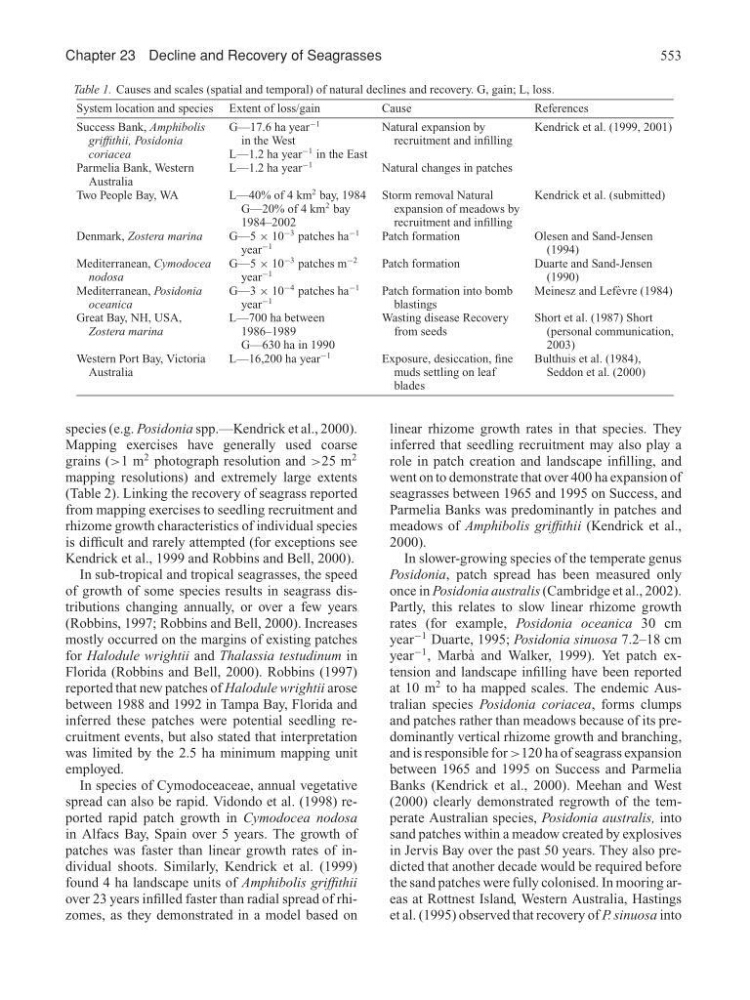
Table 1. Causes and scales (spatial and temporal) of natural declines and recovery. G, gain; L, loss.
System location and species Extent of loss/gain
Cause
References
Success Bank, Amphibolis
griffithii, Posidonia
coriacea
G—17.6 ha year
−1
in the West
L—1.2 ha year
−1 in the East
Natural expansion by
recruitment and infilling
Kendrick et al. (1999, 2001)
Parmelia Bank, Western
Australia
L—1.2 ha year
−1
Natural changes in patches
Two People Bay, WA
L—40% of 4 km
2 bay, 1984
G—20% of 4 km
2 bay
1984–2002
Storm removal Natural
expansion of meadows by
recruitment and infilling
Kendrick et al. (submitted)
Denmark, Zostera marina
G—5 × 10
−3 patches ha
−1
year
−1
Patch formation
Olesen and Sand-Jensen
(1994)
Mediterranean, Cymodocea
nodosa
G—5 × 10
−3 patches m
−2
year
−1
Patch formation
Duarte and Sand-Jensen
(1990)
Mediterranean, Posidonia
oceanica
G—3 × 10
−4 patches ha
−1
year
−1
Patch formation into bomb
blastings
Meinesz and Lef` evre (1984)
Great Bay, NH, USA,
Zostera marina
L—700 ha between
1986–1989
G—630 ha in 1990
Wasting disease Recovery
from seeds
Short et al. (1987) Short
(personal communication,
2003)
Western Port Bay, Victoria
Australia
L—16,200 ha year
−1
Exposure, desiccation, fine
muds settling on leaf
blades
Bulthuis et al. (1984),
Seddon et al. (2000)
species (e.g. Posidonia spp.—Kendrick et al., 2000).
Mapping exercises have generally used coarse
grains (>1 m
2 photograph resolution and >25 m
2
mapping resolutions) and extremely large extents
(Table 2). Linking the recovery of seagrass reported
from mapping exercises to seedling recruitment and
rhizome growth characteristics of individual species
is difficult and rarely attempted (for exceptions see
Kendrick et al., 1999 and Robbins and Bell, 2000).
In sub-tropical and tropical seagrasses, the speed
of growth of some species results in seagrass distributions changing annually, or over a few years
(Robbins, 1997; Robbins and Bell, 2000). Increases
mostly occurred on the margins of existing patches
for Halodule wrightii and Thalassia testudinum in
Florida (Robbins and Bell, 2000). Robbins (1997)
reported that new patches of Halodule wrightii arose
between 1988 and 1992 in Tampa Bay, Florida and
inferred these patches were potential seedling recruitment events, but also stated that interpretation
was limited by the 2.5 ha minimum mapping unit
employed.
In species of Cymodoceaceae, annual vegetative
spread can also be rapid. Vidondo et al. (1998) reported rapid patch growth in Cymodocea nodosa
in Alfacs Bay, Spain over 5 years. The growth of
patches was faster than linear growth rates of individual shoots. Similarly, Kendrick et al. (1999)
found 4 ha landscape units of Amphibolis griffithii
over 23 years infilled faster than radial spread of rhizomes, as they demonstrated in a model based on
linear rhizome growth rates in that species. They
inferred that seedling recruitment may also play a
role in patch creation and landscape infilling, and
went on to demonstrate that over 400 ha expansion of
seagrasses between 1965 and 1995 on Success, and
Parmelia Banks was predominantly in patches and
meadows of Amphibolis griffithii (Kendrick et al.,
2000).
In slower-growing species of the temperate genus
Posidonia, patch spread has been measured only
once in Posidonia australis (Cambridge et al., 2002).
Partly, this relates to slow linear rhizome growth
rates (for example, Posidonia oceanica 30 cm
year
−1 Duarte, 1995; Posidonia sinuosa 7.2–18 cm
year
−1 , Marb` a and Walker, 1999). Yet patch extension and landscape infilling have been reported
at 10 m
2 to ha mapped scales. The endemic Australian species Posidonia coriacea, forms clumps
and patches rather than meadows because of its predominantly vertical rhizome growth and branching,
and is responsible for >120 ha of seagrass expansion
between 1965 and 1995 on Success and Parmelia
Banks (Kendrick et al., 2000). Meehan and West
(2000) clearly demonstrated regrowth of the temperate Australian species, Posidonia australis, into
sand patches within a meadow created by explosives
in Jervis Bay over the past 50 years. They also predicted that another decade would be required before
the sand patches were fully colonised. In mooring areas at Rottnest Island, Western Australia, Hastings
et al. (1995) observed that recovery of P. sinuosa into
553
Table 1. Causes and scales (spatial and temporal) of natural declines and recovery. G, gain; L, loss.
System location and species Extent of loss/gain
Cause
References
Success Bank, Amphibolis
griffithii, Posidonia
coriacea
G—17.6 ha year
−1
in the West
L—1.2 ha year
−1 in the East
Natural expansion by
recruitment and infilling
Kendrick et al. (1999, 2001)
Parmelia Bank, Western
Australia
L—1.2 ha year
−1
Natural changes in patches
Two People Bay, WA
L—40% of 4 km
2 bay, 1984
G—20% of 4 km
2 bay
1984–2002
Storm removal Natural
expansion of meadows by
recruitment and infilling
Kendrick et al. (submitted)
Denmark, Zostera marina
G—5 × 10
−3 patches ha
−1
year
−1
Patch formation
Olesen and Sand-Jensen
(1994)
Mediterranean, Cymodocea
nodosa
G—5 × 10
−3 patches m
−2
year
−1
Patch formation
Duarte and Sand-Jensen
(1990)
Mediterranean, Posidonia
oceanica
G—3 × 10
−4 patches ha
−1
year
−1
Patch formation into bomb
blastings
Meinesz and Lef` evre (1984)
Great Bay, NH, USA,
Zostera marina
L—700 ha between
1986–1989
G—630 ha in 1990
Wasting disease Recovery
from seeds
Short et al. (1987) Short
(personal communication,
2003)
Western Port Bay, Victoria
Australia
L—16,200 ha year
−1
Exposure, desiccation, fine
muds settling on leaf
blades
Bulthuis et al. (1984),
Seddon et al. (2000)
species (e.g. Posidonia spp.—Kendrick et al., 2000).
Mapping exercises have generally used coarse
grains (>1 m
2 photograph resolution and >25 m
2
mapping resolutions) and extremely large extents
(Table 2). Linking the recovery of seagrass reported
from mapping exercises to seedling recruitment and
rhizome growth characteristics of individual species
is difficult and rarely attempted (for exceptions see
Kendrick et al., 1999 and Robbins and Bell, 2000).
In sub-tropical and tropical seagrasses, the speed
of growth of some species results in seagrass distributions changing annually, or over a few years
(Robbins, 1997; Robbins and Bell, 2000). Increases
mostly occurred on the margins of existing patches
for Halodule wrightii and Thalassia testudinum in
Florida (Robbins and Bell, 2000). Robbins (1997)
reported that new patches of Halodule wrightii arose
between 1988 and 1992 in Tampa Bay, Florida and
inferred these patches were potential seedling recruitment events, but also stated that interpretation
was limited by the 2.5 ha minimum mapping unit
employed.
In species of Cymodoceaceae, annual vegetative
spread can also be rapid. Vidondo et al. (1998) reported rapid patch growth in Cymodocea nodosa
in Alfacs Bay, Spain over 5 years. The growth of
patches was faster than linear growth rates of individual shoots. Similarly, Kendrick et al. (1999)
found 4 ha landscape units of Amphibolis griffithii
over 23 years infilled faster than radial spread of rhizomes, as they demonstrated in a model based on
linear rhizome growth rates in that species. They
inferred that seedling recruitment may also play a
role in patch creation and landscape infilling, and
went on to demonstrate that over 400 ha expansion of
seagrasses between 1965 and 1995 on Success, and
Parmelia Banks was predominantly in patches and
meadows of Amphibolis griffithii (Kendrick et al.,
2000).
In slower-growing species of the temperate genus
Posidonia, patch spread has been measured only
once in Posidonia australis (Cambridge et al., 2002).
Partly, this relates to slow linear rhizome growth
rates (for example, Posidonia oceanica 30 cm
year
−1 Duarte, 1995; Posidonia sinuosa 7.2–18 cm
year
−1 , Marb` a and Walker, 1999). Yet patch extension and landscape infilling have been reported
at 10 m
2 to ha mapped scales. The endemic Australian species Posidonia coriacea, forms clumps
and patches rather than meadows because of its predominantly vertical rhizome growth and branching,
and is responsible for >120 ha of seagrass expansion
between 1965 and 1995 on Success and Parmelia
Banks (Kendrick et al., 2000). Meehan and West
(2000) clearly demonstrated regrowth of the temperate Australian species, Posidonia australis, into
sand patches within a meadow created by explosives
in Jervis Bay over the past 50 years. They also predicted that another decade would be required before
the sand patches were fully colonised. In mooring areas at Rottnest Island, Western Australia, Hastings
et al. (1995) observed that recovery of P. sinuosa into