

504
Bronwyn M. Gillanders
other factors are teased out further in Heck and Orth,
Chapter 22.
A. Permanent Residents of Seagrass Beds
Few species of fish inhabit seagrass beds all year
round and throughout their entire life history. Permanent residents are usually small in size and cryptic (Edgar and Shaw, 1995a). Although the proportion of resident species may represent half of the
total number of species present (e.g. Hair et al.,
1994), residents are likely to represent less of the
total number and/or biomass of individuals. For example, two studies suggest that resident species represent less than 20% of the total number of individuals (Hair et al., 1994; Arrivillaga and Baltz, 1999).
To gain a better understanding of the proportion of
resident species in terms of both number of species
and number of individuals, future studies should
report these figures. Resident fish will feed within
seagrass beds, but usually not on the seagrass itself.
Resident species are also known to spawn in
nearshore seagrass areas including species that
brood eggs (e.g. syngnathids) or have demersal eggs
(e.g. atherinids).
B. Species Utilizing Seagrass
on Rare Occasions
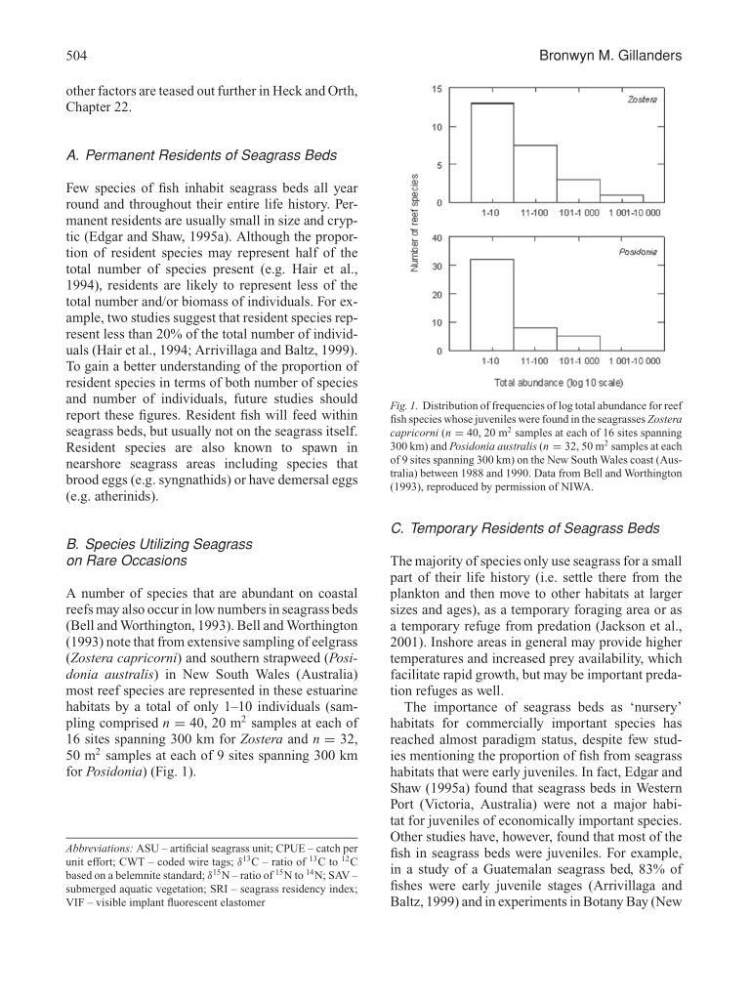
A number of species that are abundant on coastal
reefs may also occur in low numbers in seagrass beds
(Bell and Worthington, 1993). Bell and Worthington
(1993) note that from extensive sampling of eelgrass
(Zostera capricorni) and southern strapweed (Posidonia australis) in New South Wales (Australia)
most reef species are represented in these estuarine
habitats by a total of only 1–10 individuals (sampling comprised n = 40, 20 m
2 samples at each of
16 sites spanning 300 km for Zostera and n = 32,
50 m
2 samples at each of 9 sites spanning 300 km
for Posidonia) (Fig. 1).
Abbreviations: ASU – artificial seagrass unit; CPUE – catch per
unit effort; CWT – coded wire tags; δ
13 C – ratio of
13 C to
12 C
based on a belemnite standard; δ
15 N – ratio of
15 N to
14 N; SAV –
submerged aquatic vegetation; SRI – seagrass residency index;
VIF – visible implant fluorescent elastomer
Fig. 1. Distribution of frequencies of log total abundance for reef
fish species whose juveniles were found in the seagrasses Zostera
capricorni (n = 40, 20 m
2 samples at each of 16 sites spanning
300 km) and Posidonia australis (n = 32, 50 m
2 samples at each
of 9 sites spanning 300 km) on the New South Wales coast (Australia) between 1988 and 1990. Data from Bell and Worthington
(1993), reproduced by permission of NIWA.
C. Temporary Residents of Seagrass Beds
The majority of species only use seagrass for a small
part of their life history (i.e. settle there from the
plankton and then move to other habitats at larger
sizes and ages), as a temporary foraging area or as
a temporary refuge from predation (Jackson et al.,
2001). Inshore areas in general may provide higher
temperatures and increased prey availability, which
facilitate rapid growth, but may be important predation refuges as well.
The importance of seagrass beds as ‘nursery’
habitats for commercially important species has
reached almost paradigm status, despite few studies mentioning the proportion of fish from seagrass
habitats that were early juveniles. In fact, Edgar and
Shaw (1995a) found that seagrass beds in Western
Port (Victoria, Australia) were not a major habitat for juveniles of economically important species.
Other studies have, however, found that most of the
fish in seagrass beds were juveniles. For example,
in a study of a Guatemalan seagrass bed, 83% of
fishes were early juvenile stages (Arrivillaga and
Baltz, 1999) and in experiments in Botany Bay (New
Bronwyn M. Gillanders
other factors are teased out further in Heck and Orth,
Chapter 22.
A. Permanent Residents of Seagrass Beds
Few species of fish inhabit seagrass beds all year
round and throughout their entire life history. Permanent residents are usually small in size and cryptic (Edgar and Shaw, 1995a). Although the proportion of resident species may represent half of the
total number of species present (e.g. Hair et al.,
1994), residents are likely to represent less of the
total number and/or biomass of individuals. For example, two studies suggest that resident species represent less than 20% of the total number of individuals (Hair et al., 1994; Arrivillaga and Baltz, 1999).
To gain a better understanding of the proportion of
resident species in terms of both number of species
and number of individuals, future studies should
report these figures. Resident fish will feed within
seagrass beds, but usually not on the seagrass itself.
Resident species are also known to spawn in
nearshore seagrass areas including species that
brood eggs (e.g. syngnathids) or have demersal eggs
(e.g. atherinids).
B. Species Utilizing Seagrass
on Rare Occasions
A number of species that are abundant on coastal
reefs may also occur in low numbers in seagrass beds
(Bell and Worthington, 1993). Bell and Worthington
(1993) note that from extensive sampling of eelgrass
(Zostera capricorni) and southern strapweed (Posidonia australis) in New South Wales (Australia)
most reef species are represented in these estuarine
habitats by a total of only 1–10 individuals (sampling comprised n = 40, 20 m
2 samples at each of
16 sites spanning 300 km for Zostera and n = 32,
50 m
2 samples at each of 9 sites spanning 300 km
for Posidonia) (Fig. 1).
Abbreviations: ASU – artificial seagrass unit; CPUE – catch per
unit effort; CWT – coded wire tags; δ
13 C – ratio of
13 C to
12 C
based on a belemnite standard; δ
15 N – ratio of
15 N to
14 N; SAV –
submerged aquatic vegetation; SRI – seagrass residency index;
VIF – visible implant fluorescent elastomer
Fig. 1. Distribution of frequencies of log total abundance for reef
fish species whose juveniles were found in the seagrasses Zostera
capricorni (n = 40, 20 m
2 samples at each of 16 sites spanning
300 km) and Posidonia australis (n = 32, 50 m
2 samples at each
of 9 sites spanning 300 km) on the New South Wales coast (Australia) between 1988 and 1990. Data from Bell and Worthington
(1993), reproduced by permission of NIWA.
C. Temporary Residents of Seagrass Beds
The majority of species only use seagrass for a small
part of their life history (i.e. settle there from the
plankton and then move to other habitats at larger
sizes and ages), as a temporary foraging area or as
a temporary refuge from predation (Jackson et al.,
2001). Inshore areas in general may provide higher
temperatures and increased prey availability, which
facilitate rapid growth, but may be important predation refuges as well.
The importance of seagrass beds as ‘nursery’
habitats for commercially important species has
reached almost paradigm status, despite few studies mentioning the proportion of fish from seagrass
habitats that were early juveniles. In fact, Edgar and
Shaw (1995a) found that seagrass beds in Western
Port (Victoria, Australia) were not a major habitat for juveniles of economically important species.
Other studies have, however, found that most of the
fish in seagrass beds were juveniles. For example,
in a study of a Guatemalan seagrass bed, 83% of
fishes were early juvenile stages (Arrivillaga and
Baltz, 1999) and in experiments in Botany Bay (New