

484
John F. Valentine and J. Emmett Duffy
epiphyte cropping by mesograzers is a key process
facilitating seagrass dominance in shallow, well-lit
waters. Accordingly, mesograzers can be seen as
having a facultative mutualistic relationship with
seagrasses, removing algal competitors in exchange
for a substratum and shelter from predators. This
positive indirect effect of small invertebrate grazers
on seagrasses sets them apart from the large vertebrate grazers and sea urchins discussed previously.
As in many intimate relationships, the facultative
mutualism between mesograzers and seagrasses represents a delicate balance and can easily turn antagonistic. Existing experiments illustrate that certain
common mesograzer taxa, notably idoteid isopods
and ampithoid amphipods, readily feed on seagrasses in the laboratory and can severely overgraze
seagrasses when alternative foods are limiting. Several authors have reported loss of seagrass cultures to
grazing amphipods in mesocosms (Kirkman 1978;
Short et al. 1995), and controlled mesocosm experiments confirm that, in the absence of control by
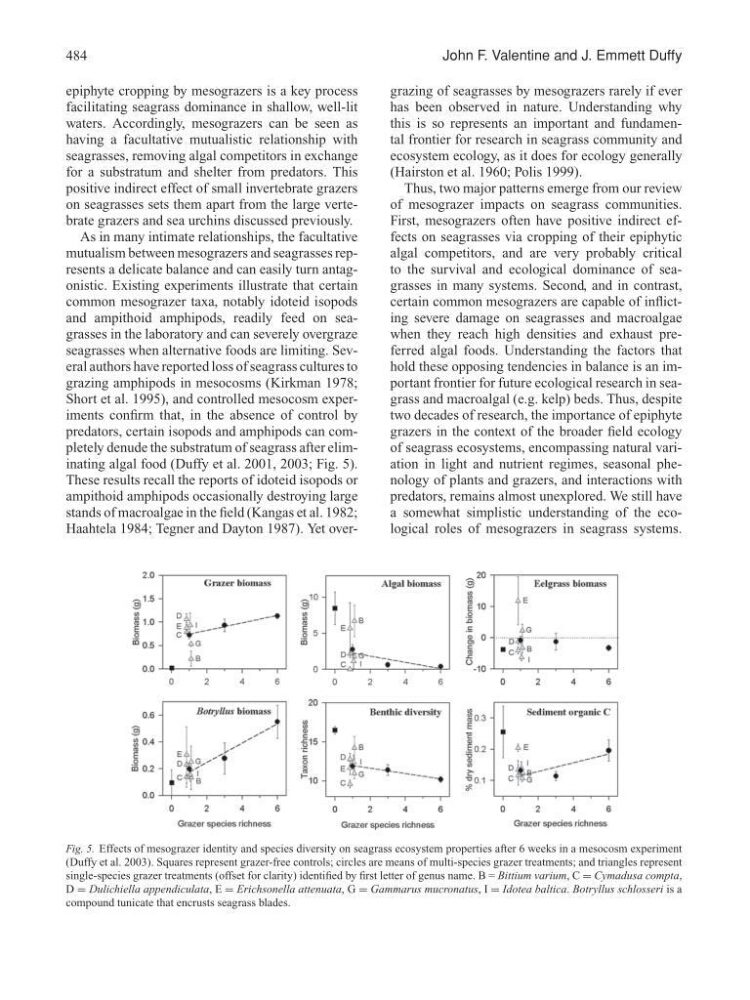
predators, certain isopods and amphipods can completely denude the substratum of seagrass after eliminating algal food (Duffy et al. 2001, 2003; Fig. 5).
These results recall the reports of idoteid isopods or
ampithoid amphipods occasionally destroying large
stands of macroalgae in the field (Kangas et al. 1982;
Haahtela 1984; Tegner and Dayton 1987). Yet overFig. 5. Effects of mesograzer identity and species diversity on seagrass ecosystem properties after 6 weeks in a mesocosm experiment
(Duffy et al. 2003). Squares represent grazer-free controls; circles are means of multi-species grazer treatments; and triangles represent
single-species grazer treatments (offset for clarity) identified by first letter of genus name. B = Bittium varium, C = Cymadusa compta,
D = Dulichiella appendiculata, E = Erichsonella attenuata, G = Gammarus mucronatus, I = Idotea baltica. Botryllus schlosseri is a
compound tunicate that encrusts seagrass blades.
grazing of seagrasses by mesograzers rarely if ever
has been observed in nature. Understanding why
this is so represents an important and fundamental frontier for research in seagrass community and
ecosystem ecology, as it does for ecology generally
(Hairston et al. 1960; Polis 1999).
Thus, two major patterns emerge from our review
of mesograzer impacts on seagrass communities.
First, mesograzers often have positive indirect effects on seagrasses via cropping of their epiphytic
algal competitors, and are very probably critical
to the survival and ecological dominance of seagrasses in many systems. Second, and in contrast,
certain common mesograzers are capable of inflicting severe damage on seagrasses and macroalgae
when they reach high densities and exhaust preferred algal foods. Understanding the factors that
hold these opposing tendencies in balance is an important frontier for future ecological research in seagrass and macroalgal (e.g. kelp) beds. Thus, despite
two decades of research, the importance of epiphyte
grazers in the context of the broader field ecology
of seagrass ecosystems, encompassing natural variation in light and nutrient regimes, seasonal phenology of plants and grazers, and interactions with
predators, remains almost unexplored. We still have
a somewhat simplistic understanding of the ecological roles of mesograzers in seagrass systems.
John F. Valentine and J. Emmett Duffy
epiphyte cropping by mesograzers is a key process
facilitating seagrass dominance in shallow, well-lit
waters. Accordingly, mesograzers can be seen as
having a facultative mutualistic relationship with
seagrasses, removing algal competitors in exchange
for a substratum and shelter from predators. This
positive indirect effect of small invertebrate grazers
on seagrasses sets them apart from the large vertebrate grazers and sea urchins discussed previously.
As in many intimate relationships, the facultative
mutualism between mesograzers and seagrasses represents a delicate balance and can easily turn antagonistic. Existing experiments illustrate that certain
common mesograzer taxa, notably idoteid isopods
and ampithoid amphipods, readily feed on seagrasses in the laboratory and can severely overgraze
seagrasses when alternative foods are limiting. Several authors have reported loss of seagrass cultures to
grazing amphipods in mesocosms (Kirkman 1978;
Short et al. 1995), and controlled mesocosm experiments confirm that, in the absence of control by
predators, certain isopods and amphipods can completely denude the substratum of seagrass after eliminating algal food (Duffy et al. 2001, 2003; Fig. 5).
These results recall the reports of idoteid isopods or
ampithoid amphipods occasionally destroying large
stands of macroalgae in the field (Kangas et al. 1982;
Haahtela 1984; Tegner and Dayton 1987). Yet overFig. 5. Effects of mesograzer identity and species diversity on seagrass ecosystem properties after 6 weeks in a mesocosm experiment
(Duffy et al. 2003). Squares represent grazer-free controls; circles are means of multi-species grazer treatments; and triangles represent
single-species grazer treatments (offset for clarity) identified by first letter of genus name. B = Bittium varium, C = Cymadusa compta,
D = Dulichiella appendiculata, E = Erichsonella attenuata, G = Gammarus mucronatus, I = Idotea baltica. Botryllus schlosseri is a
compound tunicate that encrusts seagrass blades.
grazing of seagrasses by mesograzers rarely if ever
has been observed in nature. Understanding why
this is so represents an important and fundamental frontier for research in seagrass community and
ecosystem ecology, as it does for ecology generally
(Hairston et al. 1960; Polis 1999).
Thus, two major patterns emerge from our review
of mesograzer impacts on seagrass communities.
First, mesograzers often have positive indirect effects on seagrasses via cropping of their epiphytic
algal competitors, and are very probably critical
to the survival and ecological dominance of seagrasses in many systems. Second, and in contrast,
certain common mesograzers are capable of inflicting severe damage on seagrasses and macroalgae
when they reach high densities and exhaust preferred algal foods. Understanding the factors that
hold these opposing tendencies in balance is an important frontier for future ecological research in seagrass and macroalgal (e.g. kelp) beds. Thus, despite
two decades of research, the importance of epiphyte
grazers in the context of the broader field ecology
of seagrass ecosystems, encompassing natural variation in light and nutrient regimes, seasonal phenology of plants and grazers, and interactions with
predators, remains almost unexplored. We still have
a somewhat simplistic understanding of the ecological roles of mesograzers in seagrass systems.