

476
John F. Valentine and J. Emmett Duffy
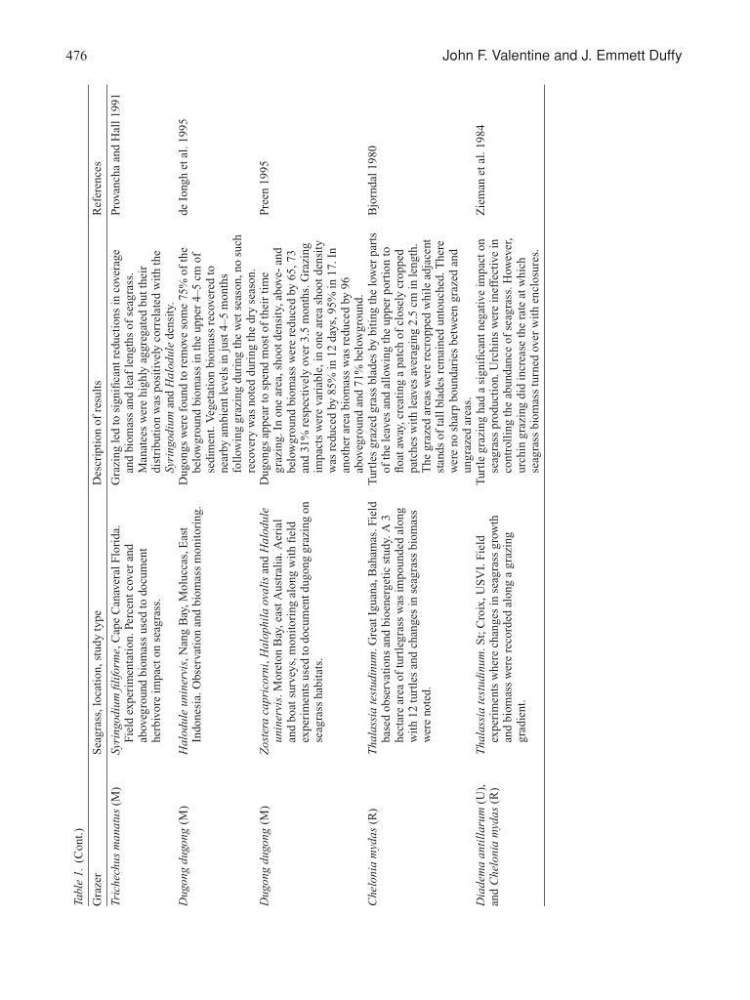
Table 1. (Cont.)
Grazer
Seagrass, location, study type
Description of results
References
Trichechus manatus (M)
Syringodium filiforme, Cape Canaveral Florida.
Field experimentation. Percent cover and
aboveground biomass used to document
herbivore impact on seagrass.
Grazing led to significant reductions in coverage
and biomass and leaf lengths of seagrass.
Manatees were highly aggregated but their
distribution was positively correlated with the
Syringodium and Halodule density.
Provancha and Hall 1991
Dugong dugong (M)
Halodule uninervis, Nang Bay, Moluccas, East
Indonesia. Observation and biomass monitoring.
Dugongs were found to remove some 75% of the
belowground biomass in the upper 4–5 cm of
sediment. Vegetation biomass recovered to
nearby ambient levels in just 4–5 months
following grazing during the wet season, no such
recovery was noted during the dry season.
de Iongh et al. 1995
Dugong dugong (M)
Zostera capricorni, Halophila ovalis and Halodule
uninervis. Moreton Bay, east Australia. Aerial
and boat surveys, monitoring along with field
experiments used to document dugong grazing on
seagrass habitats.
Dugongs appear to spend most of their time
grazing. In one area, shoot density, above- and
belowground biomass were reduced by 65, 73
and 31% respectively over 3.5 months. Grazing
impacts were variable, in one area shoot density
was reduced by 85% in 12 days, 95% in 17. In
another area biomass was reduced by 96
aboveground and 71% belowground.
Preen 1995
Chelonia mydas (R)
Thalassia testudinum. Great Iguana, Bahamas. Field
based observations and bioenergetic study. A 3
hectare area of turtlegrass was impounded along
with 12 turtles and changes in seagrass biomass
were noted.
Turtles grazed grass blades by biting the lower parts
of the leaves and allowing the upper portion to
float away, creating a patch of closely cropped
patches with leaves averaging 2.5 cm in length.
The grazed areas were recropped while adjacent
stands of tall blades remained untouched. There
were no sharp boundaries between grazed and
ungrazed areas.
Bjorndal 1980
Diadema antillarum (U),
and Chelonia mydas (R)
Thalassia testudinum. St; Croix, USVI. Field
experiments where changes in seagrass growth
and biomass were recorded along a grazing
gradient.
Turtle grazing had a significant negative impact on
seagrass production. Urchins were ineffective in
controlling the abundance of seagrass. However,
urchin grazing did increase the rate at which
seagrass biomass turned over with enclosures.
Zieman et al. 1984
John F. Valentine and J. Emmett Duffy
Table 1. (Cont.)
Grazer
Seagrass, location, study type
Description of results
References
Trichechus manatus (M)
Syringodium filiforme, Cape Canaveral Florida.
Field experimentation. Percent cover and
aboveground biomass used to document
herbivore impact on seagrass.
Grazing led to significant reductions in coverage
and biomass and leaf lengths of seagrass.
Manatees were highly aggregated but their
distribution was positively correlated with the
Syringodium and Halodule density.
Provancha and Hall 1991
Dugong dugong (M)
Halodule uninervis, Nang Bay, Moluccas, East
Indonesia. Observation and biomass monitoring.
Dugongs were found to remove some 75% of the
belowground biomass in the upper 4–5 cm of
sediment. Vegetation biomass recovered to
nearby ambient levels in just 4–5 months
following grazing during the wet season, no such
recovery was noted during the dry season.
de Iongh et al. 1995
Dugong dugong (M)
Zostera capricorni, Halophila ovalis and Halodule
uninervis. Moreton Bay, east Australia. Aerial
and boat surveys, monitoring along with field
experiments used to document dugong grazing on
seagrass habitats.
Dugongs appear to spend most of their time
grazing. In one area, shoot density, above- and
belowground biomass were reduced by 65, 73
and 31% respectively over 3.5 months. Grazing
impacts were variable, in one area shoot density
was reduced by 85% in 12 days, 95% in 17. In
another area biomass was reduced by 96
aboveground and 71% belowground.
Preen 1995
Chelonia mydas (R)
Thalassia testudinum. Great Iguana, Bahamas. Field
based observations and bioenergetic study. A 3
hectare area of turtlegrass was impounded along
with 12 turtles and changes in seagrass biomass
were noted.
Turtles grazed grass blades by biting the lower parts
of the leaves and allowing the upper portion to
float away, creating a patch of closely cropped
patches with leaves averaging 2.5 cm in length.
The grazed areas were recropped while adjacent
stands of tall blades remained untouched. There
were no sharp boundaries between grazed and
ungrazed areas.
Bjorndal 1980
Diadema antillarum (U),
and Chelonia mydas (R)
Thalassia testudinum. St; Croix, USVI. Field
experiments where changes in seagrass growth
and biomass were recorded along a grazing
gradient.
Turtle grazing had a significant negative impact on
seagrass production. Urchins were ineffective in
controlling the abundance of seagrass. However,
urchin grazing did increase the rate at which
seagrass biomass turned over with enclosures.
Zieman et al. 1984