

464
John F. Valentine and J. Emmett Duffy
are profoundly influenced by consumers in many
ecosystems (Hairston et al. 1960, Cyr and Pace
1993; Menge 1995; Duffy and Hay 2001; Shurin
et al. 2002). Debate over the relative influence of
bottom-up and top-down regulation in ecology began in earnest with the suggestion by Hairston et al.
(1960) that, in terrestrial ecosystems, predator influence penetrates downward to regulate total plant
biomass, in what has since become known (Paine
1980; Carpenter et al. 1985) as a trophic cascade.
In essence, Hairston et al. (1960) suggested that
top predators and alternating trophic levels below
them are regulated by food availability, with intervening levels being regulated by predation. Thus
in a system with three effective levels, abundances
of predators and plants are controlled by resources
(bottom-up) and herbivores by higher-order predators (top-down). That is, control of trophic level
biomass should alternate between resource supply
and consumer pressure at successive levels. A few
empirical studies have dramatically confirmed such
alternate control by resources and consumers at successive trophic levels (Wootton and Power 1993),
and trophic cascades have been documented in a
wide range of marine, freshwater, and terrestrial systems (reviewed by Brett and Goldman 1996; Micheli
1999; Schmitz et al. 2000; Halaj and Wise 2001;
Shurin et al. 2002). Indeed, trophic cascades tend to
be stronger, on average, in marine benthic systems
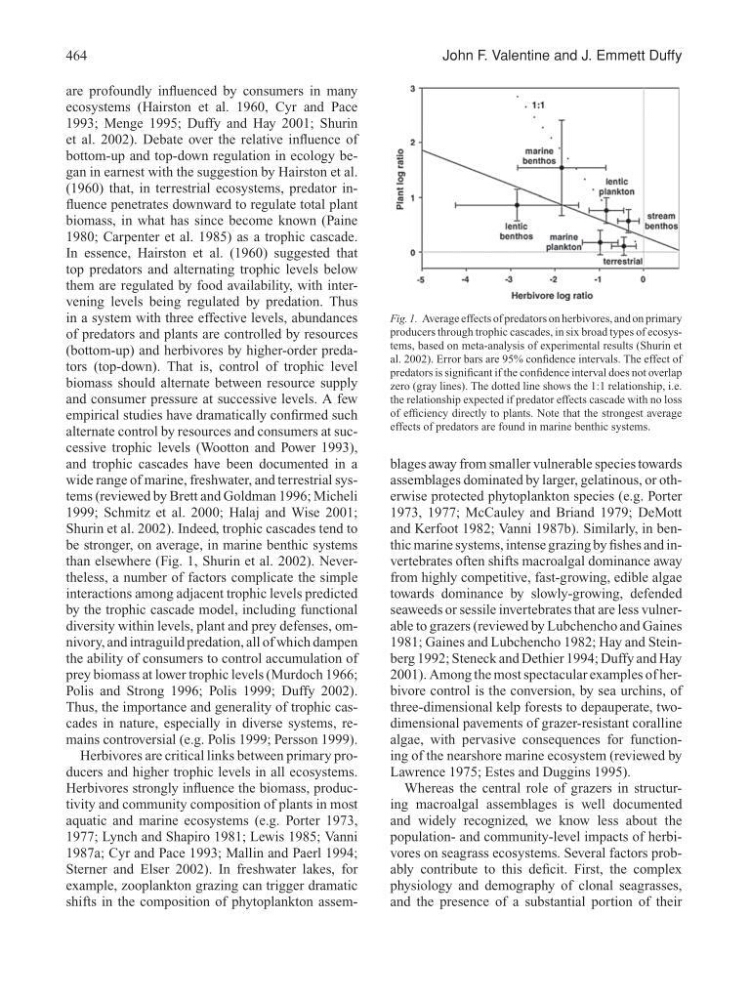
than elsewhere (Fig. 1, Shurin et al. 2002). Nevertheless, a number of factors complicate the simple
interactions among adjacent trophic levels predicted
by the trophic cascade model, including functional
diversity within levels, plant and prey defenses, omnivory, and intraguild predation, all of which dampen
the ability of consumers to control accumulation of
prey biomass at lower trophic levels (Murdoch 1966;
Polis and Strong 1996; Polis 1999; Duffy 2002).
Thus, the importance and generality of trophic cascades in nature, especially in diverse systems, remains controversial (e.g. Polis 1999; Persson 1999).
Herbivores are critical links between primary producers and higher trophic levels in all ecosystems.
Herbivores strongly influence the biomass, productivity and community composition of plants in most
aquatic and marine ecosystems (e.g. Porter 1973,
1977; Lynch and Shapiro 1981; Lewis 1985; Vanni
1987a; Cyr and Pace 1993; Mallin and Paerl 1994;
Sterner and Elser 2002). In freshwater lakes, for
example, zooplankton grazing can trigger dramatic
shifts in the composition of phytoplankton assemFig. 1. Average effects of predators on herbivores, and on primary
producers through trophic cascades, in six broad types of ecosystems, based on meta-analysis of experimental results (Shurin et
al. 2002). Error bars are 95% confidence intervals. The effect of
predators is significant if the confidence interval does not overlap
zero (gray lines). The dotted line shows the 1:1 relationship, i.e.
the relationship expected if predator effects cascade with no loss
of efficiency directly to plants. Note that the strongest average
effects of predators are found in marine benthic systems.
blages away from smaller vulnerable species towards
assemblages dominated by larger, gelatinous, or otherwise protected phytoplankton species (e.g. Porter
1973, 1977; McCauley and Briand 1979; DeMott
and Kerfoot 1982; Vanni 1987b). Similarly, in benthic marine systems, intense grazing by fishes and invertebrates often shifts macroalgal dominance away
from highly competitive, fast-growing, edible algae
towards dominance by slowly-growing, defended
seaweeds or sessile invertebrates that are less vulnerable to grazers (reviewed by Lubchencho and Gaines
1981; Gaines and Lubchencho 1982; Hay and Steinberg 1992; Steneck and Dethier 1994; Duffy and Hay
2001). Among the most spectacular examples of herbivore control is the conversion, by sea urchins, of
three-dimensional kelp forests to depauperate, twodimensional pavements of grazer-resistant coralline
algae, with pervasive consequences for functioning of the nearshore marine ecosystem (reviewed by
Lawrence 1975; Estes and Duggins 1995).
Whereas the central role of grazers in structuring macroalgal assemblages is well documented
and widely recognized, we know less about the
population- and community-level impacts of herbivores on seagrass ecosystems. Several factors probably contribute to this deficit. First, the complex
physiology and demography of clonal seagrasses,
and the presence of a substantial portion of their
John F. Valentine and J. Emmett Duffy
are profoundly influenced by consumers in many
ecosystems (Hairston et al. 1960, Cyr and Pace
1993; Menge 1995; Duffy and Hay 2001; Shurin
et al. 2002). Debate over the relative influence of
bottom-up and top-down regulation in ecology began in earnest with the suggestion by Hairston et al.
(1960) that, in terrestrial ecosystems, predator influence penetrates downward to regulate total plant
biomass, in what has since become known (Paine
1980; Carpenter et al. 1985) as a trophic cascade.
In essence, Hairston et al. (1960) suggested that
top predators and alternating trophic levels below
them are regulated by food availability, with intervening levels being regulated by predation. Thus
in a system with three effective levels, abundances
of predators and plants are controlled by resources
(bottom-up) and herbivores by higher-order predators (top-down). That is, control of trophic level
biomass should alternate between resource supply
and consumer pressure at successive levels. A few
empirical studies have dramatically confirmed such
alternate control by resources and consumers at successive trophic levels (Wootton and Power 1993),
and trophic cascades have been documented in a
wide range of marine, freshwater, and terrestrial systems (reviewed by Brett and Goldman 1996; Micheli
1999; Schmitz et al. 2000; Halaj and Wise 2001;
Shurin et al. 2002). Indeed, trophic cascades tend to
be stronger, on average, in marine benthic systems
than elsewhere (Fig. 1, Shurin et al. 2002). Nevertheless, a number of factors complicate the simple
interactions among adjacent trophic levels predicted
by the trophic cascade model, including functional
diversity within levels, plant and prey defenses, omnivory, and intraguild predation, all of which dampen
the ability of consumers to control accumulation of
prey biomass at lower trophic levels (Murdoch 1966;
Polis and Strong 1996; Polis 1999; Duffy 2002).
Thus, the importance and generality of trophic cascades in nature, especially in diverse systems, remains controversial (e.g. Polis 1999; Persson 1999).
Herbivores are critical links between primary producers and higher trophic levels in all ecosystems.
Herbivores strongly influence the biomass, productivity and community composition of plants in most
aquatic and marine ecosystems (e.g. Porter 1973,
1977; Lynch and Shapiro 1981; Lewis 1985; Vanni
1987a; Cyr and Pace 1993; Mallin and Paerl 1994;
Sterner and Elser 2002). In freshwater lakes, for
example, zooplankton grazing can trigger dramatic
shifts in the composition of phytoplankton assemFig. 1. Average effects of predators on herbivores, and on primary
producers through trophic cascades, in six broad types of ecosystems, based on meta-analysis of experimental results (Shurin et
al. 2002). Error bars are 95% confidence intervals. The effect of
predators is significant if the confidence interval does not overlap
zero (gray lines). The dotted line shows the 1:1 relationship, i.e.
the relationship expected if predator effects cascade with no loss
of efficiency directly to plants. Note that the strongest average
effects of predators are found in marine benthic systems.
blages away from smaller vulnerable species towards
assemblages dominated by larger, gelatinous, or otherwise protected phytoplankton species (e.g. Porter
1973, 1977; McCauley and Briand 1979; DeMott
and Kerfoot 1982; Vanni 1987b). Similarly, in benthic marine systems, intense grazing by fishes and invertebrates often shifts macroalgal dominance away
from highly competitive, fast-growing, edible algae
towards dominance by slowly-growing, defended
seaweeds or sessile invertebrates that are less vulnerable to grazers (reviewed by Lubchencho and Gaines
1981; Gaines and Lubchencho 1982; Hay and Steinberg 1992; Steneck and Dethier 1994; Duffy and Hay
2001). Among the most spectacular examples of herbivore control is the conversion, by sea urchins, of
three-dimensional kelp forests to depauperate, twodimensional pavements of grazer-resistant coralline
algae, with pervasive consequences for functioning of the nearshore marine ecosystem (reviewed by
Lawrence 1975; Estes and Duggins 1995).
Whereas the central role of grazers in structuring macroalgal assemblages is well documented
and widely recognized, we know less about the
population- and community-level impacts of herbivores on seagrass ecosystems. Several factors probably contribute to this deficit. First, the complex
physiology and demography of clonal seagrasses,
and the presence of a substantial portion of their