

Chapter 2 Seagrass Genetics and Evolution
31
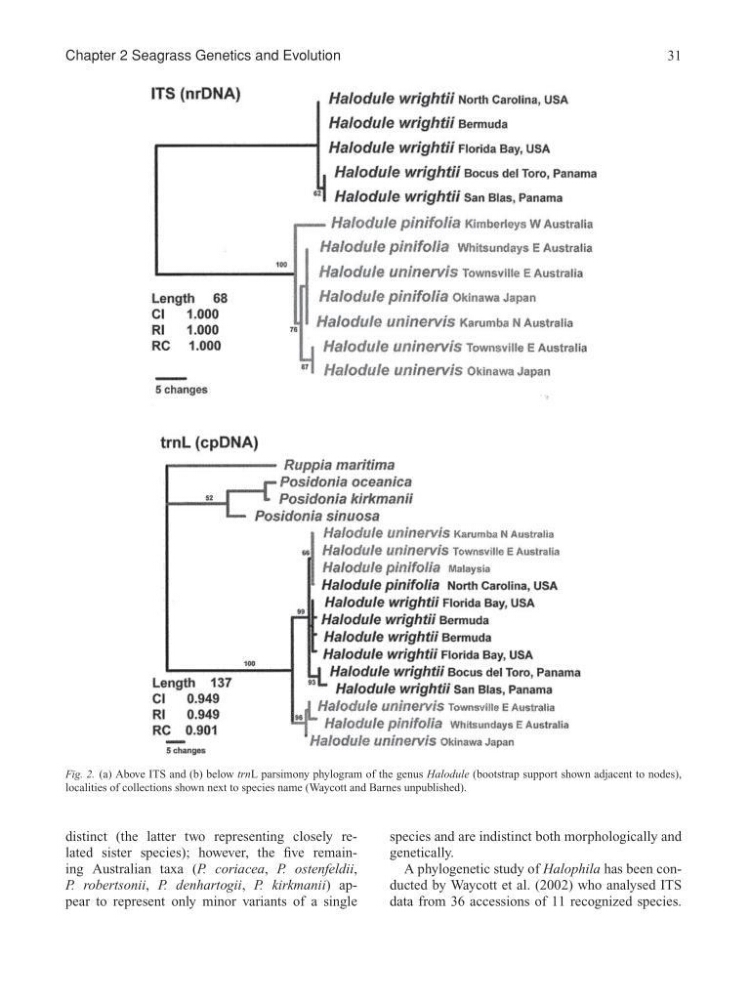
Fig. 2. (a) Above ITS and (b) below trnL parsimony phylogram of the genus Halodule (bootstrap support shown adjacent to nodes),
localities of collections shown next to species name (Waycott and Barnes unpublished).
distinct (the latter two representing closely related sister species); however, the five remaining Australian taxa (P. coriacea, P. ostenfeldii,
P. robertsonii, P. denhartogii, P. kirkmanii) appear to represent only minor variants of a single
species and are indistinct both morphologically and
genetically.
A phylogenetic study of Halophila has been conducted by Waycott et al. (2002) who analysed ITS
data from 36 accessions of 11 recognized species.
31
Fig. 2. (a) Above ITS and (b) below trnL parsimony phylogram of the genus Halodule (bootstrap support shown adjacent to nodes),
localities of collections shown next to species name (Waycott and Barnes unpublished).
distinct (the latter two representing closely related sister species); however, the five remaining Australian taxa (P. coriacea, P. ostenfeldii,
P. robertsonii, P. denhartogii, P. kirkmanii) appear to represent only minor variants of a single
species and are indistinct both morphologically and
genetically.
A phylogenetic study of Halophila has been conducted by Waycott et al. (2002) who analysed ITS
data from 36 accessions of 11 recognized species.