

446
Michael A. Borowitzka, Paul Lavery, and Mike van Keulen
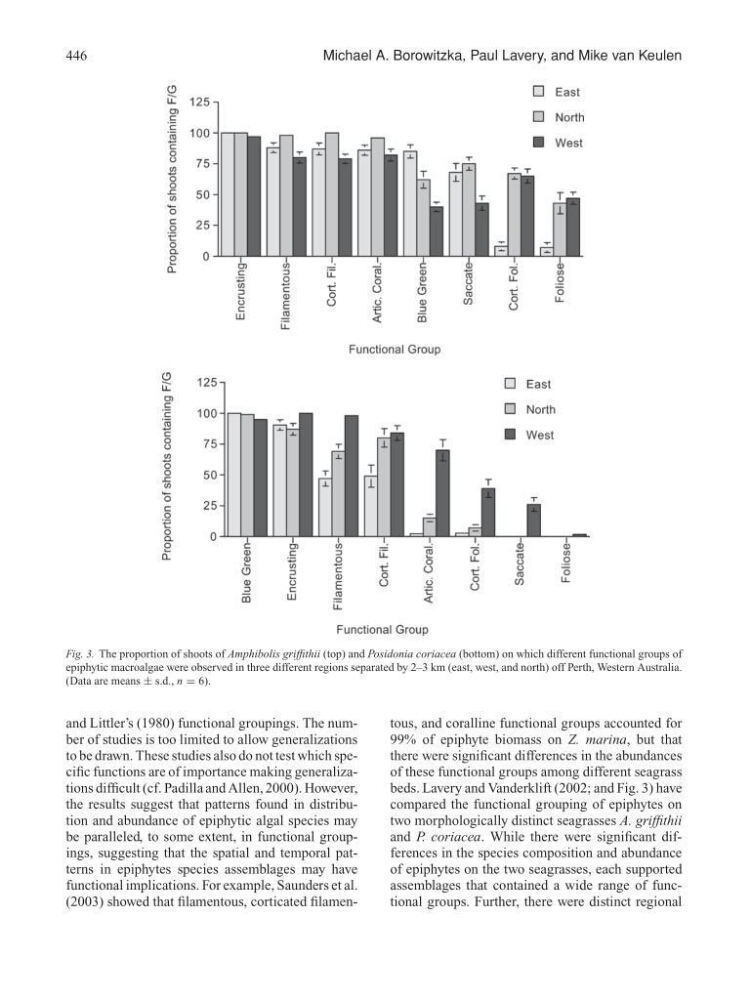
Fig. 3. The proportion of shoots of Amphibolis griffithii (top) and Posidonia coriacea (bottom) on which different functional groups of
epiphytic macroalgae were observed in three different regions separated by 2–3 km (east, west, and north) off Perth, Western Australia.
(Data are means ± s.d., n = 6).
and Littler’s (1980) functional groupings. The number of studies is too limited to allow generalizations
to be drawn. These studies also do not test which specific functions are of importance making generalizations difficult (cf. Padilla and Allen, 2000). However,
the results suggest that patterns found in distribution and abundance of epiphytic algal species may
be paralleled, to some extent, in functional groupings, suggesting that the spatial and temporal patterns in epiphytes species assemblages may have
functional implications. For example, Saunders et al.
(2003) showed that filamentous, corticated filamentous, and coralline functional groups accounted for
99% of epiphyte biomass on Z. marina, but that
there were significant differences in the abundances
of these functional groups among different seagrass
beds. Lavery and Vanderklift (2002; and Fig. 3) have
compared the functional grouping of epiphytes on
two morphologically distinct seagrasses A. griffithii
and P. coriacea. While there were significant differences in the species composition and abundance
of epiphytes on the two seagrasses, each supported
assemblages that contained a wide range of functional groups. Further, there were distinct regional
Michael A. Borowitzka, Paul Lavery, and Mike van Keulen
Fig. 3. The proportion of shoots of Amphibolis griffithii (top) and Posidonia coriacea (bottom) on which different functional groups of
epiphytic macroalgae were observed in three different regions separated by 2–3 km (east, west, and north) off Perth, Western Australia.
(Data are means ± s.d., n = 6).
and Littler’s (1980) functional groupings. The number of studies is too limited to allow generalizations
to be drawn. These studies also do not test which specific functions are of importance making generalizations difficult (cf. Padilla and Allen, 2000). However,
the results suggest that patterns found in distribution and abundance of epiphytic algal species may
be paralleled, to some extent, in functional groupings, suggesting that the spatial and temporal patterns in epiphytes species assemblages may have
functional implications. For example, Saunders et al.
(2003) showed that filamentous, corticated filamentous, and coralline functional groups accounted for
99% of epiphyte biomass on Z. marina, but that
there were significant differences in the abundances
of these functional groups among different seagrass
beds. Lavery and Vanderklift (2002; and Fig. 3) have
compared the functional grouping of epiphytes on
two morphologically distinct seagrasses A. griffithii
and P. coriacea. While there were significant differences in the species composition and abundance
of epiphytes on the two seagrasses, each supported
assemblages that contained a wide range of functional groups. Further, there were distinct regional