

Chapter 19 Epiphytes of Seagrasses
445
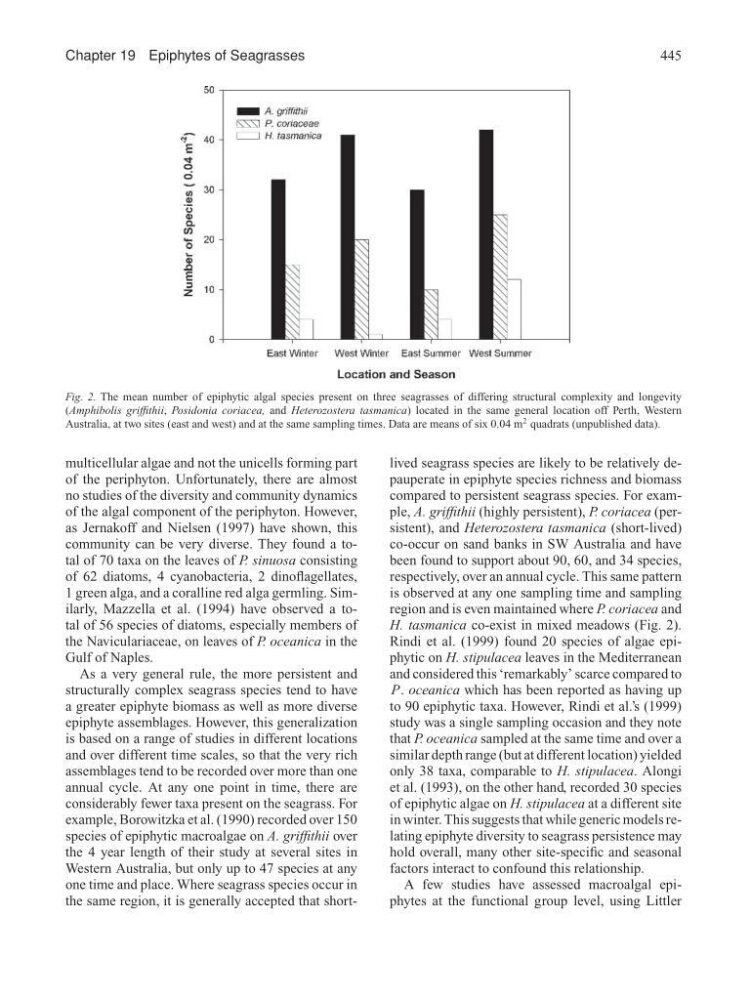
Fig. 2. The mean number of epiphytic algal species present on three seagrasses of differing structural complexity and longevity
(Amphibolis griffithii, Posidonia coriacea, and Heterozostera tasmanica) located in the same general location off Perth, Western
Australia, at two sites (east and west) and at the same sampling times. Data are means of six 0.04 m
2 quadrats (unpublished data).
multicellular algae and not the unicells forming part
of the periphyton. Unfortunately, there are almost
no studies of the diversity and community dynamics
of the algal component of the periphyton. However,
as Jernakoff and Nielsen (1997) have shown, this
community can be very diverse. They found a total of 70 taxa on the leaves of P. sinuosa consisting
of 62 diatoms, 4 cyanobacteria, 2 dinoflagellates,
1 green alga, and a coralline red alga germling. Similarly, Mazzella et al. (1994) have observed a total of 56 species of diatoms, especially members of
the Naviculariaceae, on leaves of P. oceanica in the
Gulf of Naples.
As a very general rule, the more persistent and
structurally complex seagrass species tend to have
a greater epiphyte biomass as well as more diverse
epiphyte assemblages. However, this generalization
is based on a range of studies in different locations
and over different time scales, so that the very rich
assemblages tend to be recorded over more than one
annual cycle. At any one point in time, there are
considerably fewer taxa present on the seagrass. For
example, Borowitzka et al. (1990) recorded over 150
species of epiphytic macroalgae on A. griffithii over
the 4 year length of their study at several sites in
Western Australia, but only up to 47 species at any
one time and place. Where seagrass species occur in
the same region, it is generally accepted that shortlived seagrass species are likely to be relatively depauperate in epiphyte species richness and biomass
compared to persistent seagrass species. For example, A. griffithii (highly persistent), P. coriacea (persistent), and Heterozostera tasmanica (short-lived)
co-occur on sand banks in SW Australia and have
been found to support about 90, 60, and 34 species,
respectively, over an annual cycle. This same pattern
is observed at any one sampling time and sampling
region and is even maintained where P. coriacea and
H. tasmanica co-exist in mixed meadows (Fig. 2).
Rindi et al. (1999) found 20 species of algae epiphytic on H. stipulacea leaves in the Mediterranean
and considered this ‘remarkably’ scarce compared to
P. oceanica which has been reported as having up
to 90 epiphytic taxa. However, Rindi et al.’s (1999)
study was a single sampling occasion and they note
that P. oceanica sampled at the same time and over a
similar depth range (but at different location) yielded
only 38 taxa, comparable to H. stipulacea. Alongi
et al. (1993), on the other hand, recorded 30 species
of epiphytic algae on H. stipulacea at a different site
in winter. This suggests that while generic models relating epiphyte diversity to seagrass persistence may
hold overall, many other site-specific and seasonal
factors interact to confound this relationship.
A few studies have assessed macroalgal epiphytes at the functional group level, using Littler
445
Fig. 2. The mean number of epiphytic algal species present on three seagrasses of differing structural complexity and longevity
(Amphibolis griffithii, Posidonia coriacea, and Heterozostera tasmanica) located in the same general location off Perth, Western
Australia, at two sites (east and west) and at the same sampling times. Data are means of six 0.04 m
2 quadrats (unpublished data).
multicellular algae and not the unicells forming part
of the periphyton. Unfortunately, there are almost
no studies of the diversity and community dynamics
of the algal component of the periphyton. However,
as Jernakoff and Nielsen (1997) have shown, this
community can be very diverse. They found a total of 70 taxa on the leaves of P. sinuosa consisting
of 62 diatoms, 4 cyanobacteria, 2 dinoflagellates,
1 green alga, and a coralline red alga germling. Similarly, Mazzella et al. (1994) have observed a total of 56 species of diatoms, especially members of
the Naviculariaceae, on leaves of P. oceanica in the
Gulf of Naples.
As a very general rule, the more persistent and
structurally complex seagrass species tend to have
a greater epiphyte biomass as well as more diverse
epiphyte assemblages. However, this generalization
is based on a range of studies in different locations
and over different time scales, so that the very rich
assemblages tend to be recorded over more than one
annual cycle. At any one point in time, there are
considerably fewer taxa present on the seagrass. For
example, Borowitzka et al. (1990) recorded over 150
species of epiphytic macroalgae on A. griffithii over
the 4 year length of their study at several sites in
Western Australia, but only up to 47 species at any
one time and place. Where seagrass species occur in
the same region, it is generally accepted that shortlived seagrass species are likely to be relatively depauperate in epiphyte species richness and biomass
compared to persistent seagrass species. For example, A. griffithii (highly persistent), P. coriacea (persistent), and Heterozostera tasmanica (short-lived)
co-occur on sand banks in SW Australia and have
been found to support about 90, 60, and 34 species,
respectively, over an annual cycle. This same pattern
is observed at any one sampling time and sampling
region and is even maintained where P. coriacea and
H. tasmanica co-exist in mixed meadows (Fig. 2).
Rindi et al. (1999) found 20 species of algae epiphytic on H. stipulacea leaves in the Mediterranean
and considered this ‘remarkably’ scarce compared to
P. oceanica which has been reported as having up
to 90 epiphytic taxa. However, Rindi et al.’s (1999)
study was a single sampling occasion and they note
that P. oceanica sampled at the same time and over a
similar depth range (but at different location) yielded
only 38 taxa, comparable to H. stipulacea. Alongi
et al. (1993), on the other hand, recorded 30 species
of epiphytic algae on H. stipulacea at a different site
in winter. This suggests that while generic models relating epiphyte diversity to seagrass persistence may
hold overall, many other site-specific and seasonal
factors interact to confound this relationship.
A few studies have assessed macroalgal epiphytes at the functional group level, using Littler