

390
S. Gobert, M. L. Cambridge, B. Velimirov, et al.
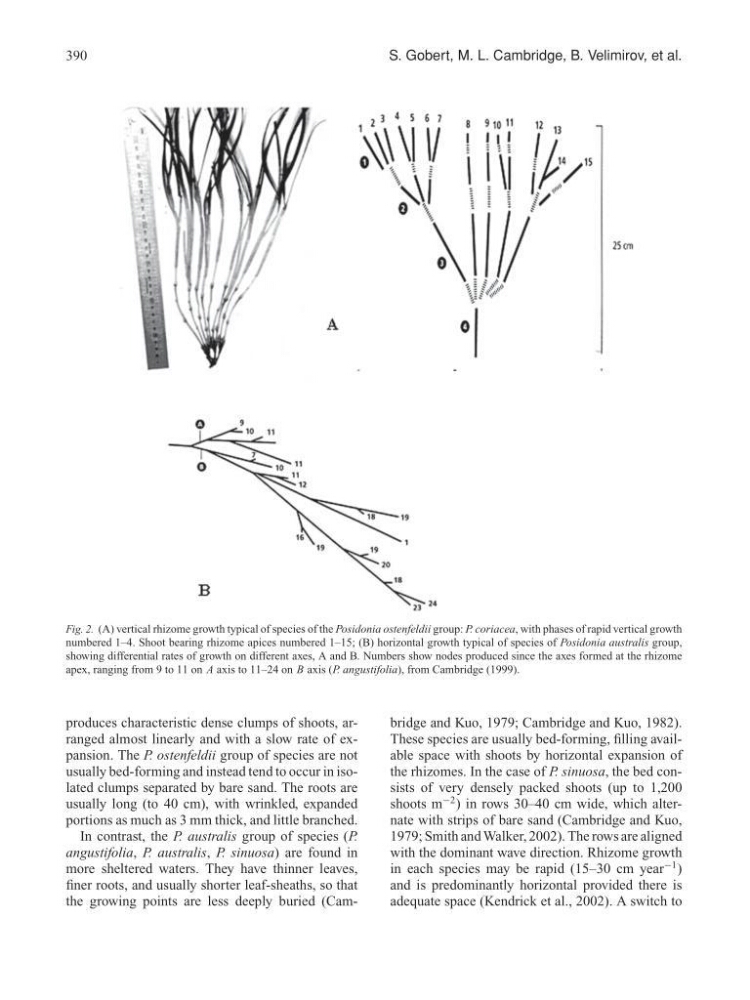
Fig. 2. (A) vertical rhizome growth typical of species of the Posidonia ostenfeldii group: P. coriacea, with phases of rapid vertical growth
numbered 1–4. Shoot bearing rhizome apices numbered 1–15; (B) horizontal growth typical of species of Posidonia australis group,
showing differential rates of growth on different axes, A and B. Numbers show nodes produced since the axes formed at the rhizome
apex, ranging from 9 to 11 on A axis to 11–24 on B axis (P. angustifolia), from Cambridge (1999).
produces characteristic dense clumps of shoots, arranged almost linearly and with a slow rate of expansion. The P. ostenfeldii group of species are not
usually bed-forming and instead tend to occur in isolated clumps separated by bare sand. The roots are
usually long (to 40 cm), with wrinkled, expanded
portions as much as 3 mm thick, and little branched.
In contrast, the P. australis group of species (P.
angustifolia, P. australis, P. sinuosa) are found in
more sheltered waters. They have thinner leaves,
finer roots, and usually shorter leaf-sheaths, so that
the growing points are less deeply buried (Cambridge and Kuo, 1979; Cambridge and Kuo, 1982).
These species are usually bed-forming, filling available space with shoots by horizontal expansion of
the rhizomes. In the case of P. sinuosa, the bed consists of very densely packed shoots (up to 1,200
shoots m
−2 ) in rows 30–40 cm wide, which alternate with strips of bare sand (Cambridge and Kuo,
1979; Smith and Walker, 2002). The rows are aligned
with the dominant wave direction. Rhizome growth
in each species may be rapid (15–30 cm year
−1 )
and is predominantly horizontal provided there is
adequate space (Kendrick et al., 2002). A switch to
S. Gobert, M. L. Cambridge, B. Velimirov, et al.
Fig. 2. (A) vertical rhizome growth typical of species of the Posidonia ostenfeldii group: P. coriacea, with phases of rapid vertical growth
numbered 1–4. Shoot bearing rhizome apices numbered 1–15; (B) horizontal growth typical of species of Posidonia australis group,
showing differential rates of growth on different axes, A and B. Numbers show nodes produced since the axes formed at the rhizome
apex, ranging from 9 to 11 on A axis to 11–24 on B axis (P. angustifolia), from Cambridge (1999).
produces characteristic dense clumps of shoots, arranged almost linearly and with a slow rate of expansion. The P. ostenfeldii group of species are not
usually bed-forming and instead tend to occur in isolated clumps separated by bare sand. The roots are
usually long (to 40 cm), with wrinkled, expanded
portions as much as 3 mm thick, and little branched.
In contrast, the P. australis group of species (P.
angustifolia, P. australis, P. sinuosa) are found in
more sheltered waters. They have thinner leaves,
finer roots, and usually shorter leaf-sheaths, so that
the growing points are less deeply buried (Cambridge and Kuo, 1979; Cambridge and Kuo, 1982).
These species are usually bed-forming, filling available space with shoots by horizontal expansion of
the rhizomes. In the case of P. sinuosa, the bed consists of very densely packed shoots (up to 1,200
shoots m
−2 ) in rows 30–40 cm wide, which alternate with strips of bare sand (Cambridge and Kuo,
1979; Smith and Walker, 2002). The rows are aligned
with the dominant wave direction. Rhizome growth
in each species may be rapid (15–30 cm year
−1 )
and is predominantly horizontal provided there is
adequate space (Kendrick et al., 2002). A switch to