

Chapter 17 Biology of Posidonia
389
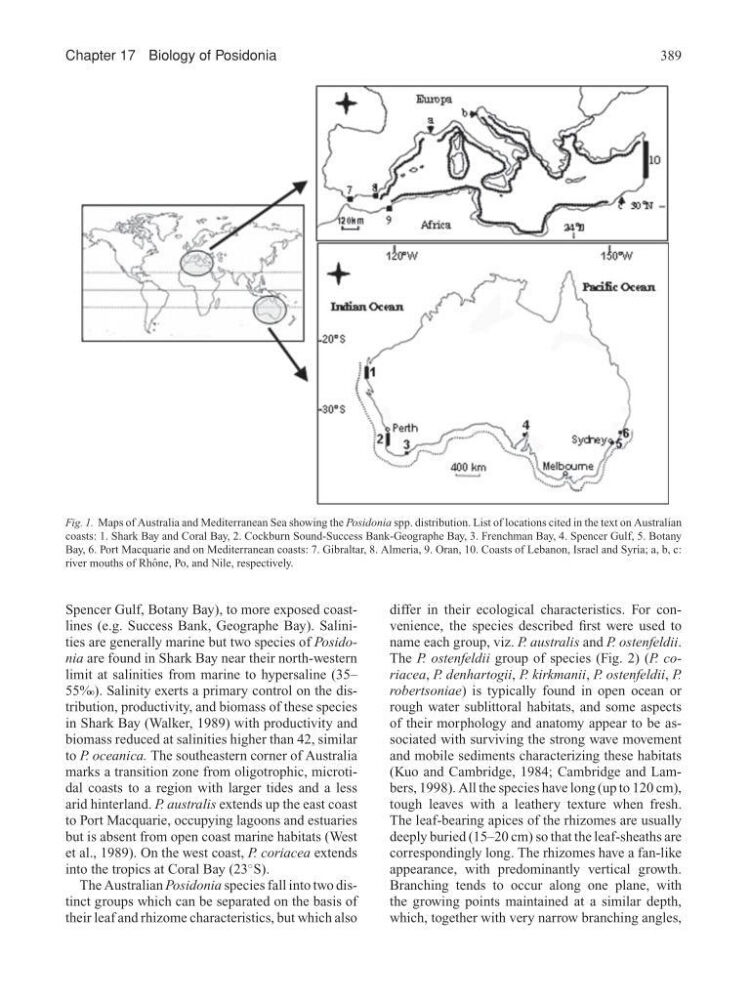
Fig. 1. Maps of Australia and Mediterranean Sea showing the Posidonia spp. distribution. List of locations cited in the text on Australian
coasts: 1. Shark Bay and Coral Bay, 2. Cockburn Sound-Success Bank-Geographe Bay, 3. Frenchman Bay, 4. Spencer Gulf, 5. Botany
Bay, 6. Port Macquarie and on Mediterranean coasts: 7. Gibraltar, 8. Almeria, 9. Oran, 10. Coasts of Lebanon, Israel and Syria; a, b, c:
river mouths of Rhˆ one, Po, and Nile, respectively.
Spencer Gulf, Botany Bay), to more exposed coastlines (e.g. Success Bank, Geographe Bay). Salinities are generally marine but two species of Posidonia are found in Shark Bay near their north-western
limit at salinities from marine to hypersaline (35–
55%0). Salinity exerts a primary control on the distribution, productivity, and biomass of these species
in Shark Bay (Walker, 1989) with productivity and
biomass reduced at salinities higher than 42, similar
to P. oceanica. The southeastern corner of Australia
marks a transition zone from oligotrophic, microtidal coasts to a region with larger tides and a less
arid hinterland. P. australis extends up the east coast
to Port Macquarie, occupying lagoons and estuaries
but is absent from open coast marine habitats (West
et al., 1989). On the west coast, P. coriacea extends
into the tropics at Coral Bay (23
◦ S).
The Australian Posidonia species fall into two distinct groups which can be separated on the basis of
their leaf and rhizome characteristics, but which also
differ in their ecological characteristics. For convenience, the species described first were used to
name each group, viz. P. australis and P. ostenfeldii.
The P. ostenfeldii group of species (Fig. 2) (P. coriacea, P. denhartogii, P. kirkmanii, P. ostenfeldii, P.
robertsoniae) is typically found in open ocean or
rough water sublittoral habitats, and some aspects
of their morphology and anatomy appear to be associated with surviving the strong wave movement
and mobile sediments characterizing these habitats
(Kuo and Cambridge, 1984; Cambridge and Lambers, 1998). All the species have long (up to 120 cm),
tough leaves with a leathery texture when fresh.
The leaf-bearing apices of the rhizomes are usually
deeply buried (15–20 cm) so that the leaf-sheaths are
correspondingly long. The rhizomes have a fan-like
appearance, with predominantly vertical growth.
Branching tends to occur along one plane, with
the growing points maintained at a similar depth,
which, together with very narrow branching angles,
389
Fig. 1. Maps of Australia and Mediterranean Sea showing the Posidonia spp. distribution. List of locations cited in the text on Australian
coasts: 1. Shark Bay and Coral Bay, 2. Cockburn Sound-Success Bank-Geographe Bay, 3. Frenchman Bay, 4. Spencer Gulf, 5. Botany
Bay, 6. Port Macquarie and on Mediterranean coasts: 7. Gibraltar, 8. Almeria, 9. Oran, 10. Coasts of Lebanon, Israel and Syria; a, b, c:
river mouths of Rhˆ one, Po, and Nile, respectively.
Spencer Gulf, Botany Bay), to more exposed coastlines (e.g. Success Bank, Geographe Bay). Salinities are generally marine but two species of Posidonia are found in Shark Bay near their north-western
limit at salinities from marine to hypersaline (35–
55%0). Salinity exerts a primary control on the distribution, productivity, and biomass of these species
in Shark Bay (Walker, 1989) with productivity and
biomass reduced at salinities higher than 42, similar
to P. oceanica. The southeastern corner of Australia
marks a transition zone from oligotrophic, microtidal coasts to a region with larger tides and a less
arid hinterland. P. australis extends up the east coast
to Port Macquarie, occupying lagoons and estuaries
but is absent from open coast marine habitats (West
et al., 1989). On the west coast, P. coriacea extends
into the tropics at Coral Bay (23
◦ S).
The Australian Posidonia species fall into two distinct groups which can be separated on the basis of
their leaf and rhizome characteristics, but which also
differ in their ecological characteristics. For convenience, the species described first were used to
name each group, viz. P. australis and P. ostenfeldii.
The P. ostenfeldii group of species (Fig. 2) (P. coriacea, P. denhartogii, P. kirkmanii, P. ostenfeldii, P.
robertsoniae) is typically found in open ocean or
rough water sublittoral habitats, and some aspects
of their morphology and anatomy appear to be associated with surviving the strong wave movement
and mobile sediments characterizing these habitats
(Kuo and Cambridge, 1984; Cambridge and Lambers, 1998). All the species have long (up to 120 cm),
tough leaves with a leathery texture when fresh.
The leaf-bearing apices of the rhizomes are usually
deeply buried (15–20 cm) so that the leaf-sheaths are
correspondingly long. The rhizomes have a fan-like
appearance, with predominantly vertical growth.
Branching tends to occur along one plane, with
the growing points maintained at a similar depth,
which, together with very narrow branching angles,