

Chapter 16 Biology of Zostera
377
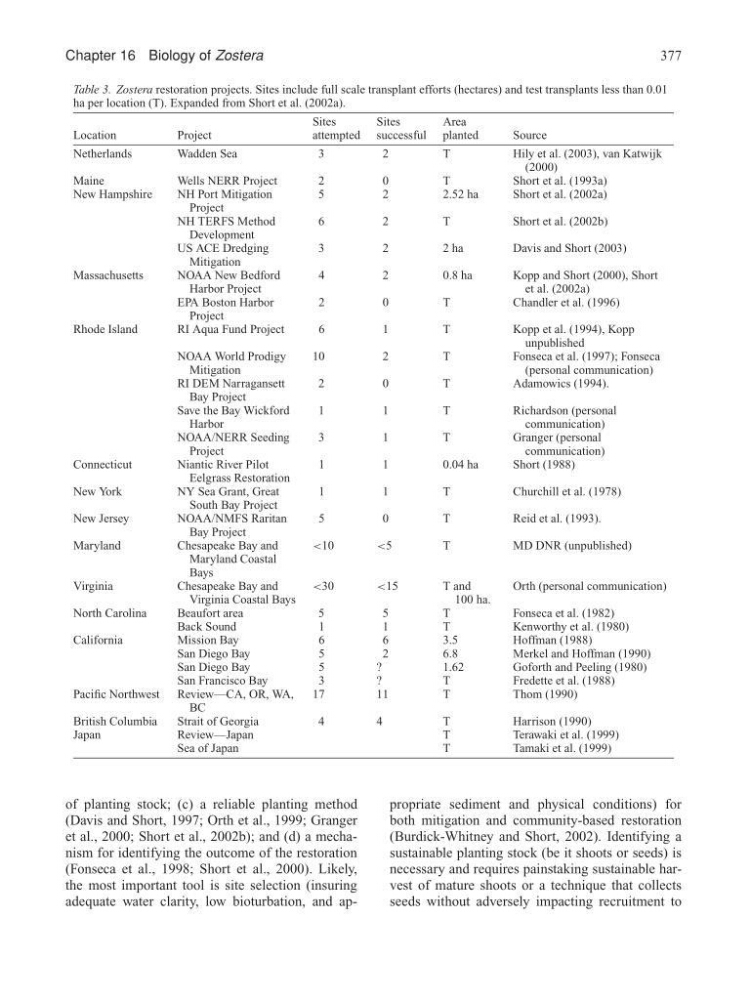
Table 3. Zostera restoration projects. Sites include full scale transplant efforts (hectares) and test transplants less than 0.01
ha per location (T). Expanded from Short et al. (2002a).
Sites
Sites
Area
Location
Project
attempted successful planted
Source
Netherlands
Wadden Sea
3
2
T
Hily et al. (2003), van Katwijk
(2000)
Maine
Wells NERR Project
2
0
T
Short et al. (1993a)
New Hampshire
NH Port Mitigation
Project
5
2
2.52 ha
Short et al. (2002a)
NH TERFS Method
Development
6
2
T
Short et al. (2002b)
US ACE Dredging
Mitigation
3
2
2 ha
Davis and Short (2003)
Massachusetts
NOAA New Bedford
Harbor Project
4
2
0.8 ha
Kopp and Short (2000), Short
et al. (2002a)
EPA Boston Harbor
Project
2
0
T
Chandler et al. (1996)
Rhode Island
RI Aqua Fund Project
6
1
T
Kopp et al. (1994), Kopp
unpublished
NOAA World Prodigy
Mitigation
10
2
T
Fonseca et al. (1997); Fonseca
(personal communication)
RI DEM Narragansett
Bay Project
2
0
T
Adamowics (1994).
Save the Bay Wickford
Harbor
1
1
T
Richardson (personal
communication)
NOAA/NERR Seeding
Project
3
1
T
Granger (personal
communication)
Connecticut
Niantic River Pilot
Eelgrass Restoration
1
1
0.04 ha
Short (1988)
New York
NY Sea Grant, Great
South Bay Project
1
1
T
Churchill et al. (1978)
New Jersey
NOAA/NMFS Raritan
Bay Project
5
0
T
Reid et al. (1993).
Maryland
Chesapeake Bay and
Maryland Coastal
Bays
<10
<5
T
MD DNR (unpublished)
Virginia
Chesapeake Bay and
Virginia Coastal Bays
<30
<15
T and
100 ha.
Orth (personal communication)
North Carolina
Beaufort area
5
5
T
Fonseca et al. (1982)
Back Sound
1
1
T
Kenworthy et al. (1980)
California
Mission Bay
6
6
3.5
Hoffman (1988)
San Diego Bay
5
2
6.8
Merkel and Hoffman (1990)
San Diego Bay
5
?
1.62
Goforth and Peeling (1980)
San Francisco Bay
3
?
T
Fredette et al. (1988)
Pacific Northwest Review—CA, OR, WA,
BC
17
11
T
Thom (1990)
British Columbia
Strait of Georgia
4
4
T
Harrison (1990)
Japan
Review—Japan
T
Terawaki et al. (1999)
Sea of Japan
T
Tamaki et al. (1999)
of planting stock; (c) a reliable planting method
(Davis and Short, 1997; Orth et al., 1999; Granger
et al., 2000; Short et al., 2002b); and (d) a mechanism for identifying the outcome of the restoration
(Fonseca et al., 1998; Short et al., 2000). Likely,
the most important tool is site selection (insuring
adequate water clarity, low bioturbation, and appropriate sediment and physical conditions) for
both mitigation and community-based restoration
(Burdick-Whitney and Short, 2002). Identifying a
sustainable planting stock (be it shoots or seeds) is
necessary and requires painstaking sustainable harvest of mature shoots or a technique that collects
seeds without adversely impacting recruitment to
377
Table 3. Zostera restoration projects. Sites include full scale transplant efforts (hectares) and test transplants less than 0.01
ha per location (T). Expanded from Short et al. (2002a).
Sites
Sites
Area
Location
Project
attempted successful planted
Source
Netherlands
Wadden Sea
3
2
T
Hily et al. (2003), van Katwijk
(2000)
Maine
Wells NERR Project
2
0
T
Short et al. (1993a)
New Hampshire
NH Port Mitigation
Project
5
2
2.52 ha
Short et al. (2002a)
NH TERFS Method
Development
6
2
T
Short et al. (2002b)
US ACE Dredging
Mitigation
3
2
2 ha
Davis and Short (2003)
Massachusetts
NOAA New Bedford
Harbor Project
4
2
0.8 ha
Kopp and Short (2000), Short
et al. (2002a)
EPA Boston Harbor
Project
2
0
T
Chandler et al. (1996)
Rhode Island
RI Aqua Fund Project
6
1
T
Kopp et al. (1994), Kopp
unpublished
NOAA World Prodigy
Mitigation
10
2
T
Fonseca et al. (1997); Fonseca
(personal communication)
RI DEM Narragansett
Bay Project
2
0
T
Adamowics (1994).
Save the Bay Wickford
Harbor
1
1
T
Richardson (personal
communication)
NOAA/NERR Seeding
Project
3
1
T
Granger (personal
communication)
Connecticut
Niantic River Pilot
Eelgrass Restoration
1
1
0.04 ha
Short (1988)
New York
NY Sea Grant, Great
South Bay Project
1
1
T
Churchill et al. (1978)
New Jersey
NOAA/NMFS Raritan
Bay Project
5
0
T
Reid et al. (1993).
Maryland
Chesapeake Bay and
Maryland Coastal
Bays
<10
<5
T
MD DNR (unpublished)
Virginia
Chesapeake Bay and
Virginia Coastal Bays
<30
<15
T and
100 ha.
Orth (personal communication)
North Carolina
Beaufort area
5
5
T
Fonseca et al. (1982)
Back Sound
1
1
T
Kenworthy et al. (1980)
California
Mission Bay
6
6
3.5
Hoffman (1988)
San Diego Bay
5
2
6.8
Merkel and Hoffman (1990)
San Diego Bay
5
?
1.62
Goforth and Peeling (1980)
San Francisco Bay
3
?
T
Fredette et al. (1988)
Pacific Northwest Review—CA, OR, WA,
BC
17
11
T
Thom (1990)
British Columbia
Strait of Georgia
4
4
T
Harrison (1990)
Japan
Review—Japan
T
Terawaki et al. (1999)
Sea of Japan
T
Tamaki et al. (1999)
of planting stock; (c) a reliable planting method
(Davis and Short, 1997; Orth et al., 1999; Granger
et al., 2000; Short et al., 2002b); and (d) a mechanism for identifying the outcome of the restoration
(Fonseca et al., 1998; Short et al., 2000). Likely,
the most important tool is site selection (insuring
adequate water clarity, low bioturbation, and appropriate sediment and physical conditions) for
both mitigation and community-based restoration
(Burdick-Whitney and Short, 2002). Identifying a
sustainable planting stock (be it shoots or seeds) is
necessary and requires painstaking sustainable harvest of mature shoots or a technique that collects
seeds without adversely impacting recruitment to