

Chapter 16 Biology of Zostera
369
below low water in the Sea of Cortez, Mexico. They
also observed that plants growing in deep water (7 m)
flowered and produced mature seeds that were released much earlier than those of plants growing in
shallow water (<3 m). Plants in intertidal locations
were the most delayed in their reproduction. In contrast, Orth and Moore (1983b) found little flowering
in perennial Z. marina growing near its depth limits
in the Chesapeake Bay.
Interactions between light availability and other
factors such as nutrient availability on flowering success in Zostera have received only limited study.
Short (1983) reported higher flowering rates of Z.
marina growing in shallow, nutrient-poor sediments
in Alaska compared to deeper, nutrient-rich sediments. van Lent et al. (1995) subsequently investigated the interaction of light and nutrients on
flowering of Z. marina in The Netherlands. Here,
they found that although light availability was the
principal factor affecting flowering success, when
sufficient light was available, sediment nutrient enrichment significantly increased flowering over unenriched treatments.
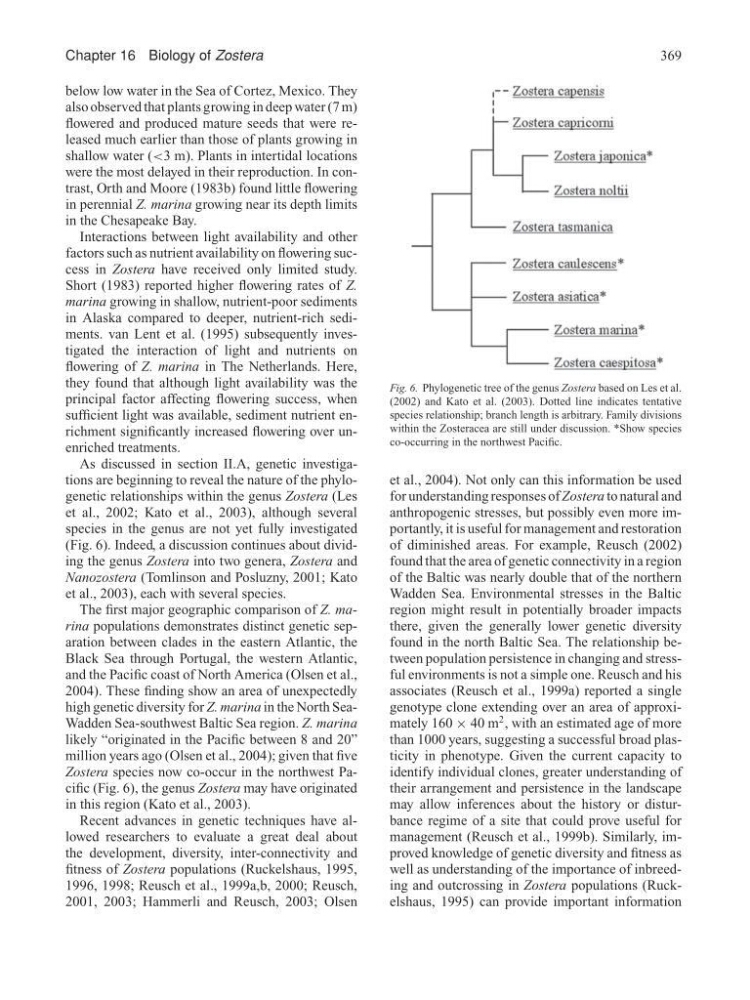
As discussed in section II.A, genetic investigations are beginning to reveal the nature of the phylogenetic relationships within the genus Zostera (Les
et al., 2002; Kato et al., 2003), although several
species in the genus are not yet fully investigated
(Fig. 6). Indeed, a discussion continues about dividing the genus Zostera into two genera, Zostera and
Nanozostera (Tomlinson and Posluzny, 2001; Kato
et al., 2003), each with several species.
The first major geographic comparison of Z. marina populations demonstrates distinct genetic separation between clades in the eastern Atlantic, the
Black Sea through Portugal, the western Atlantic,
and the Pacific coast of North America (Olsen et al.,
2004). These finding show an area of unexpectedly
high genetic diversity for Z. marina in the North SeaWadden Sea-southwest Baltic Sea region. Z. marina
likely “originated in the Pacific between 8 and 20”
million years ago (Olsen et al., 2004); given that five
Zostera species now co-occur in the northwest Pacific (Fig. 6), the genus Zostera may have originated
in this region (Kato et al., 2003).
Recent advances in genetic techniques have allowed researchers to evaluate a great deal about
the development, diversity, inter-connectivity and
fitness of Zostera populations (Ruckelshaus, 1995,
1996, 1998; Reusch et al., 1999a,b, 2000; Reusch,
2001, 2003; Hammerli and Reusch, 2003; Olsen
Fig. 6. Phylogenetic tree of the genus Zostera based on Les et al.
(2002) and Kato et al. (2003). Dotted line indicates tentative
species relationship; branch length is arbitrary. Family divisions
within the Zosteracea are still under discussion. *Show species
co-occurring in the northwest Pacific.
et al., 2004). Not only can this information be used
for understanding responses of Zostera to natural and
anthropogenic stresses, but possibly even more importantly, it is useful for management and restoration
of diminished areas. For example, Reusch (2002)
found that the area of genetic connectivity in a region
of the Baltic was nearly double that of the northern
Wadden Sea. Environmental stresses in the Baltic
region might result in potentially broader impacts
there, given the generally lower genetic diversity
found in the north Baltic Sea. The relationship between population persistence in changing and stressful environments is not a simple one. Reusch and his
associates (Reusch et al., 1999a) reported a single
genotype clone extending over an area of approximately 160 × 40 m
2 , with an estimated age of more
than 1000 years, suggesting a successful broad plasticity in phenotype. Given the current capacity to
identify individual clones, greater understanding of
their arrangement and persistence in the landscape
may allow inferences about the history or disturbance regime of a site that could prove useful for
management (Reusch et al., 1999b). Similarly, improved knowledge of genetic diversity and fitness as
well as understanding of the importance of inbreeding and outcrossing in Zostera populations (Ruckelshaus, 1995) can provide important information
369
below low water in the Sea of Cortez, Mexico. They
also observed that plants growing in deep water (7 m)
flowered and produced mature seeds that were released much earlier than those of plants growing in
shallow water (<3 m). Plants in intertidal locations
were the most delayed in their reproduction. In contrast, Orth and Moore (1983b) found little flowering
in perennial Z. marina growing near its depth limits
in the Chesapeake Bay.
Interactions between light availability and other
factors such as nutrient availability on flowering success in Zostera have received only limited study.
Short (1983) reported higher flowering rates of Z.
marina growing in shallow, nutrient-poor sediments
in Alaska compared to deeper, nutrient-rich sediments. van Lent et al. (1995) subsequently investigated the interaction of light and nutrients on
flowering of Z. marina in The Netherlands. Here,
they found that although light availability was the
principal factor affecting flowering success, when
sufficient light was available, sediment nutrient enrichment significantly increased flowering over unenriched treatments.
As discussed in section II.A, genetic investigations are beginning to reveal the nature of the phylogenetic relationships within the genus Zostera (Les
et al., 2002; Kato et al., 2003), although several
species in the genus are not yet fully investigated
(Fig. 6). Indeed, a discussion continues about dividing the genus Zostera into two genera, Zostera and
Nanozostera (Tomlinson and Posluzny, 2001; Kato
et al., 2003), each with several species.
The first major geographic comparison of Z. marina populations demonstrates distinct genetic separation between clades in the eastern Atlantic, the
Black Sea through Portugal, the western Atlantic,
and the Pacific coast of North America (Olsen et al.,
2004). These finding show an area of unexpectedly
high genetic diversity for Z. marina in the North SeaWadden Sea-southwest Baltic Sea region. Z. marina
likely “originated in the Pacific between 8 and 20”
million years ago (Olsen et al., 2004); given that five
Zostera species now co-occur in the northwest Pacific (Fig. 6), the genus Zostera may have originated
in this region (Kato et al., 2003).
Recent advances in genetic techniques have allowed researchers to evaluate a great deal about
the development, diversity, inter-connectivity and
fitness of Zostera populations (Ruckelshaus, 1995,
1996, 1998; Reusch et al., 1999a,b, 2000; Reusch,
2001, 2003; Hammerli and Reusch, 2003; Olsen
Fig. 6. Phylogenetic tree of the genus Zostera based on Les et al.
(2002) and Kato et al. (2003). Dotted line indicates tentative
species relationship; branch length is arbitrary. Family divisions
within the Zosteracea are still under discussion. *Show species
co-occurring in the northwest Pacific.
et al., 2004). Not only can this information be used
for understanding responses of Zostera to natural and
anthropogenic stresses, but possibly even more importantly, it is useful for management and restoration
of diminished areas. For example, Reusch (2002)
found that the area of genetic connectivity in a region
of the Baltic was nearly double that of the northern
Wadden Sea. Environmental stresses in the Baltic
region might result in potentially broader impacts
there, given the generally lower genetic diversity
found in the north Baltic Sea. The relationship between population persistence in changing and stressful environments is not a simple one. Reusch and his
associates (Reusch et al., 1999a) reported a single
genotype clone extending over an area of approximately 160 × 40 m
2 , with an estimated age of more
than 1000 years, suggesting a successful broad plasticity in phenotype. Given the current capacity to
identify individual clones, greater understanding of
their arrangement and persistence in the landscape
may allow inferences about the history or disturbance regime of a site that could prove useful for
management (Reusch et al., 1999b). Similarly, improved knowledge of genetic diversity and fitness as
well as understanding of the importance of inbreeding and outcrossing in Zostera populations (Ruckelshaus, 1995) can provide important information