

Chapter 13 Light and Photosynthesis in Seagrass Meadows
315
0
10
20
30
40
50
60
70
80
90
100
0.0
0.5
1.0
1.5
2.0
2.5
3.0
3.5
4.0
4.5
Leaf Area Index
Light Absorbed (%)
β = 5°
β increasing
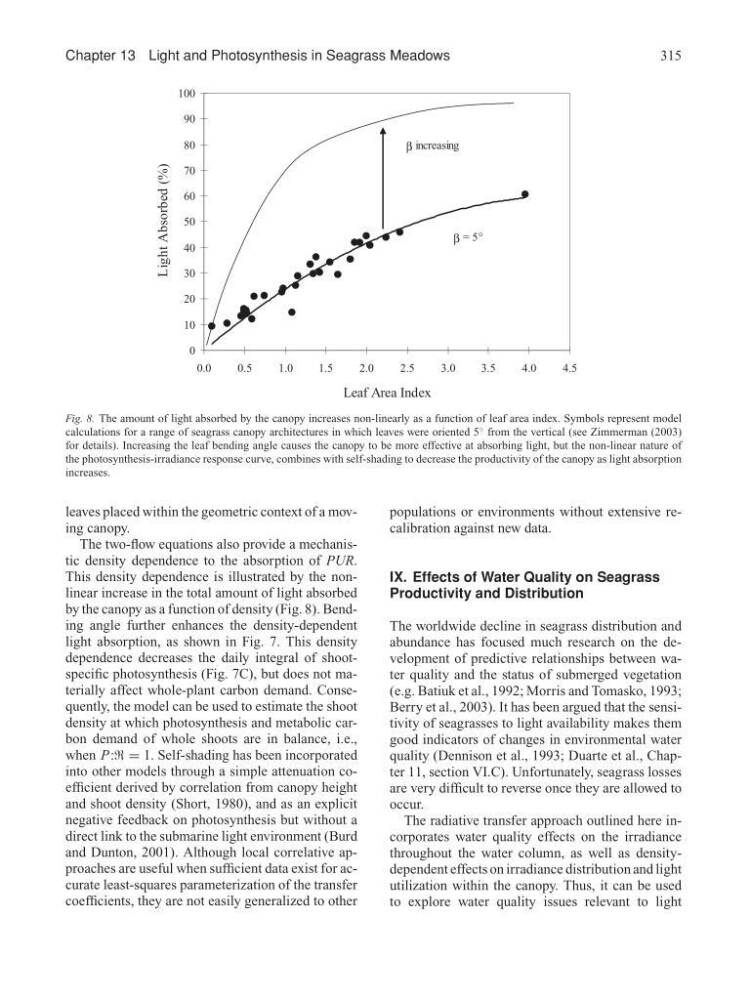
Fig. 8. The amount of light absorbed by the canopy increases non-linearly as a function of leaf area index. Symbols represent model
calculations for a range of seagrass canopy architectures in which leaves were oriented 5
◦ from the vertical (see Zimmerman (2003)
for details). Increasing the leaf bending angle causes the canopy to be more effective at absorbing light, but the non-linear nature of
the photosynthesis-irradiance response curve, combines with self-shading to decrease the productivity of the canopy as light absorption
increases.
leaves placed within the geometric context of a moving canopy.
The two-flow equations also provide a mechanistic density dependence to the absorption of PUR.
This density dependence is illustrated by the nonlinear increase in the total amount of light absorbed
by the canopy as a function of density (Fig. 8). Bending angle further enhances the density-dependent
light absorption, as shown in Fig. 7. This density
dependence decreases the daily integral of shootspecific photosynthesis (Fig. 7C), but does not materially affect whole-plant carbon demand. Consequently, the model can be used to estimate the shoot
density at which photosynthesis and metabolic carbon demand of whole shoots are in balance, i.e.,
when P: = 1. Self-shading has been incorporated
into other models through a simple attenuation coefficient derived by correlation from canopy height
and shoot density (Short, 1980), and as an explicit
negative feedback on photosynthesis but without a
direct link to the submarine light environment (Burd
and Dunton, 2001). Although local correlative approaches are useful when sufficient data exist for accurate least-squares parameterization of the transfer
coefficients, they are not easily generalized to other
populations or environments without extensive recalibration against new data.
IX. Effects of Water Quality on Seagrass
Productivity and Distribution
The worldwide decline in seagrass distribution and
abundance has focused much research on the development of predictive relationships between water quality and the status of submerged vegetation
(e.g. Batiuk et al., 1992; Morris and Tomasko, 1993;
Berry et al., 2003). It has been argued that the sensitivity of seagrasses to light availability makes them
good indicators of changes in environmental water
quality (Dennison et al., 1993; Duarte et al., Chapter 11, section VI.C). Unfortunately, seagrass losses
are very difficult to reverse once they are allowed to
occur.
The radiative transfer approach outlined here incorporates water quality effects on the irradiance
throughout the water column, as well as densitydependent effects on irradiance distribution and light
utilization within the canopy. Thus, it can be used
to explore water quality issues relevant to light
315
0
10
20
30
40
50
60
70
80
90
100
0.0
0.5
1.0
1.5
2.0
2.5
3.0
3.5
4.0
4.5
Leaf Area Index
Light Absorbed (%)
β = 5°
β increasing
Fig. 8. The amount of light absorbed by the canopy increases non-linearly as a function of leaf area index. Symbols represent model
calculations for a range of seagrass canopy architectures in which leaves were oriented 5
◦ from the vertical (see Zimmerman (2003)
for details). Increasing the leaf bending angle causes the canopy to be more effective at absorbing light, but the non-linear nature of
the photosynthesis-irradiance response curve, combines with self-shading to decrease the productivity of the canopy as light absorption
increases.
leaves placed within the geometric context of a moving canopy.
The two-flow equations also provide a mechanistic density dependence to the absorption of PUR.
This density dependence is illustrated by the nonlinear increase in the total amount of light absorbed
by the canopy as a function of density (Fig. 8). Bending angle further enhances the density-dependent
light absorption, as shown in Fig. 7. This density
dependence decreases the daily integral of shootspecific photosynthesis (Fig. 7C), but does not materially affect whole-plant carbon demand. Consequently, the model can be used to estimate the shoot
density at which photosynthesis and metabolic carbon demand of whole shoots are in balance, i.e.,
when P: = 1. Self-shading has been incorporated
into other models through a simple attenuation coefficient derived by correlation from canopy height
and shoot density (Short, 1980), and as an explicit
negative feedback on photosynthesis but without a
direct link to the submarine light environment (Burd
and Dunton, 2001). Although local correlative approaches are useful when sufficient data exist for accurate least-squares parameterization of the transfer
coefficients, they are not easily generalized to other
populations or environments without extensive recalibration against new data.
IX. Effects of Water Quality on Seagrass
Productivity and Distribution
The worldwide decline in seagrass distribution and
abundance has focused much research on the development of predictive relationships between water quality and the status of submerged vegetation
(e.g. Batiuk et al., 1992; Morris and Tomasko, 1993;
Berry et al., 2003). It has been argued that the sensitivity of seagrasses to light availability makes them
good indicators of changes in environmental water
quality (Dennison et al., 1993; Duarte et al., Chapter 11, section VI.C). Unfortunately, seagrass losses
are very difficult to reverse once they are allowed to
occur.
The radiative transfer approach outlined here incorporates water quality effects on the irradiance
throughout the water column, as well as densitydependent effects on irradiance distribution and light
utilization within the canopy. Thus, it can be used
to explore water quality issues relevant to light