

314
R. C. Zimmerman
β (∞ )
10
20
30
40
50
60
(P
m equiv d
-1
)
5
6
7
8
9
10
ΣE
d absorbed (%)
30
40
50
60
70
80
90
100
A
P
d
B
ΣE d absorbed (%)
10 20 30 40 50 60 70 80 90 100
(P
m equiv d
-1
)
0
1
2
3
4
5
6
7
8
9
B
P
d
C
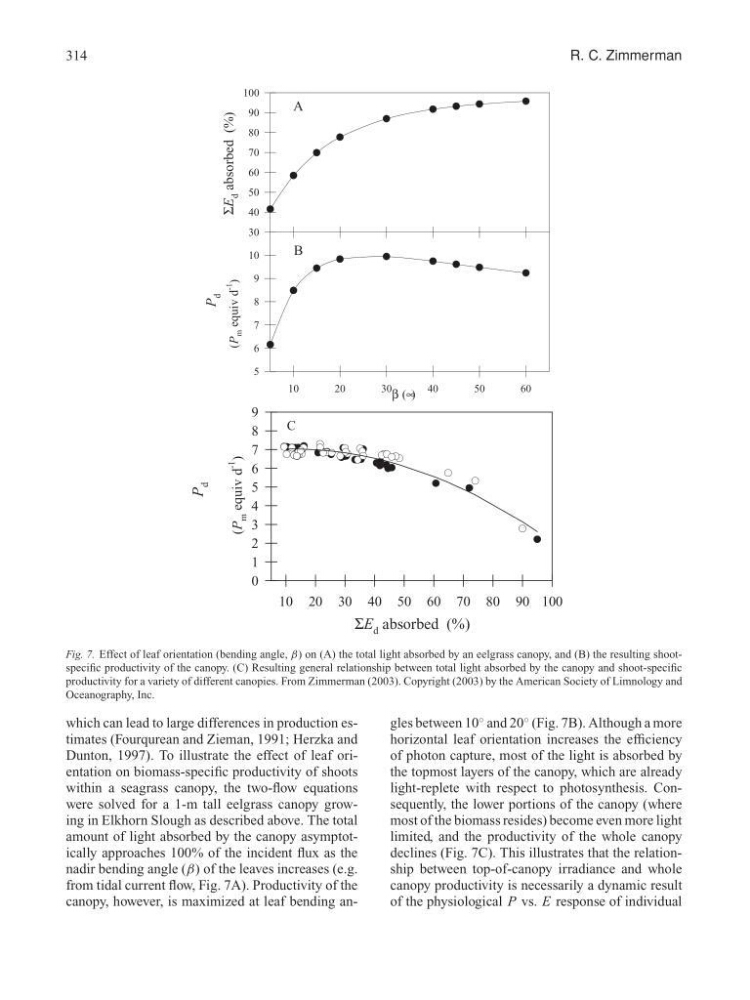
Fig. 7. Effect of leaf orientation (bending angle, β) on (A) the total light absorbed by an eelgrass canopy, and (B) the resulting shootspecific productivity of the canopy. (C) Resulting general relationship between total light absorbed by the canopy and shoot-specific
productivity for a variety of different canopies. From Zimmerman (2003). Copyright (2003) by the American Society of Limnology and
Oceanography, Inc.
which can lead to large differences in production estimates (Fourqurean and Zieman, 1991; Herzka and
Dunton, 1997). To illustrate the effect of leaf orientation on biomass-specific productivity of shoots
within a seagrass canopy, the two-flow equations
were solved for a 1-m tall eelgrass canopy growing in Elkhorn Slough as described above. The total
amount of light absorbed by the canopy asymptotically approaches 100% of the incident flux as the
nadir bending angle (β) of the leaves increases (e.g.
from tidal current flow, Fig. 7A). Productivity of the
canopy, however, is maximized at leaf bending angles between 10
◦ and 20
◦ (Fig. 7B). Although a more
horizontal leaf orientation increases the efficiency
of photon capture, most of the light is absorbed by
the topmost layers of the canopy, which are already
light-replete with respect to photosynthesis. Consequently, the lower portions of the canopy (where
most of the biomass resides) become even more light
limited, and the productivity of the whole canopy
declines (Fig. 7C). This illustrates that the relationship between top-of-canopy irradiance and whole
canopy productivity is necessarily a dynamic result
of the physiological P vs. E response of individual
R. C. Zimmerman
β (∞ )
10
20
30
40
50
60
(P
m equiv d
-1
)
5
6
7
8
9
10
ΣE
d absorbed (%)
30
40
50
60
70
80
90
100
A
P
d
B
ΣE d absorbed (%)
10 20 30 40 50 60 70 80 90 100
(P
m equiv d
-1
)
0
1
2
3
4
5
6
7
8
9
B
P
d
C
Fig. 7. Effect of leaf orientation (bending angle, β) on (A) the total light absorbed by an eelgrass canopy, and (B) the resulting shootspecific productivity of the canopy. (C) Resulting general relationship between total light absorbed by the canopy and shoot-specific
productivity for a variety of different canopies. From Zimmerman (2003). Copyright (2003) by the American Society of Limnology and
Oceanography, Inc.
which can lead to large differences in production estimates (Fourqurean and Zieman, 1991; Herzka and
Dunton, 1997). To illustrate the effect of leaf orientation on biomass-specific productivity of shoots
within a seagrass canopy, the two-flow equations
were solved for a 1-m tall eelgrass canopy growing in Elkhorn Slough as described above. The total
amount of light absorbed by the canopy asymptotically approaches 100% of the incident flux as the
nadir bending angle (β) of the leaves increases (e.g.
from tidal current flow, Fig. 7A). Productivity of the
canopy, however, is maximized at leaf bending angles between 10
◦ and 20
◦ (Fig. 7B). Although a more
horizontal leaf orientation increases the efficiency
of photon capture, most of the light is absorbed by
the topmost layers of the canopy, which are already
light-replete with respect to photosynthesis. Consequently, the lower portions of the canopy (where
most of the biomass resides) become even more light
limited, and the productivity of the whole canopy
declines (Fig. 7C). This illustrates that the relationship between top-of-canopy irradiance and whole
canopy productivity is necessarily a dynamic result
of the physiological P vs. E response of individual