

312
R. C. Zimmerman
Simulated downwelling irradiance in a taller,
denser and more heavily pigmented eelgrass canopy
(h c = 1.0 m, shoot density = 110 shoots m
−2 , L =
2.72) submerged in the turbid waters of Elkhorn
Slough, California, USA were within 15% of measured E d (λ, z) throughout the canopy (Fig. 6B). The
RMS difference between modeled and measured
spectra was 2.3% at 0.25 m, 1.5% at 0.5 m, 8.7%
at 0.75 m and 14% at 0.85 m depth. The model predicted E d (λ, z) to peak more strongly in the green
in the two bottom layers (0.75 and 0.85 m) of the
canopy than was measured. Flattening of the measured spectra at the lower depths, however, may be
attributed the effects of leaf epiphytes that were
not accounted for in the model simulation (but see
Drake et al., 2003) and to potential distortion of
the measured spectra caused by low signal:noise in
the red and blue portions at energy fluxes below
0.05 W m
−2 nm
−1 .
VII. Productivity and Carbon Balance
in Submerged Plant Canopies
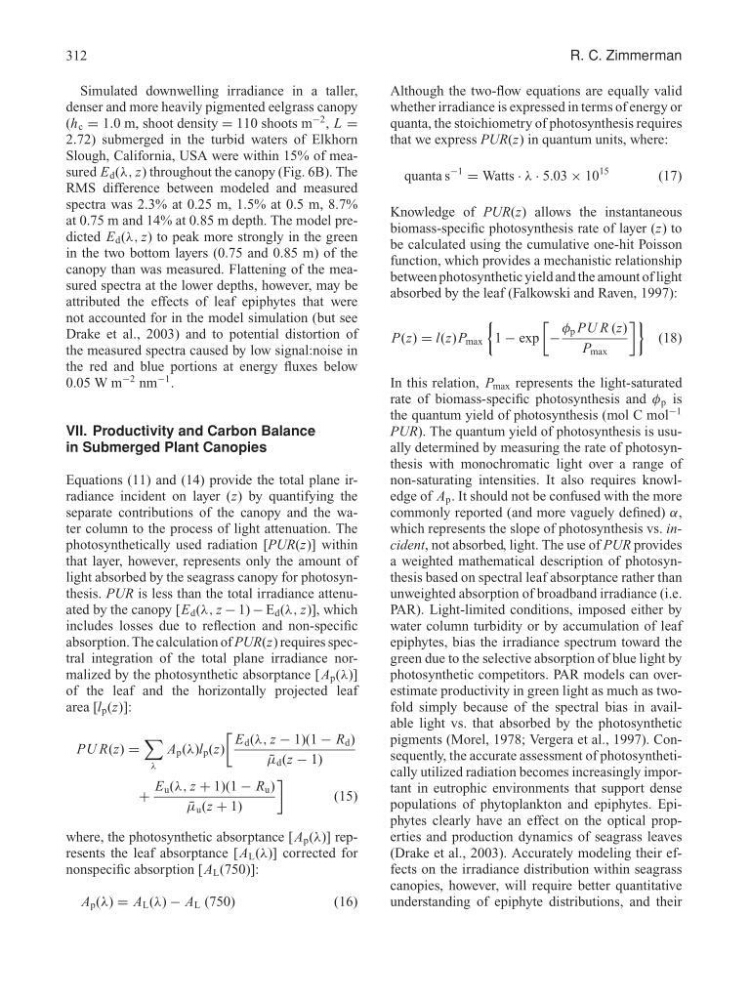
Equations (11) and (14) provide the total plane irradiance incident on layer (z) by quantifying the
separate contributions of the canopy and the water column to the process of light attenuation. The
photosynthetically used radiation [PUR(z)] within
that layer, however, represents only the amount of
light absorbed by the seagrass canopy for photosynthesis. PUR is less than the total irradiance attenuated by the canopy [E d (λ, z − 1) − E d (λ, z)], which
includes losses due to reflection and non-specific
absorption. The calculation of PUR(z) requires spectral integration of the total plane irradiance normalized by the photosynthetic absorptance [ A p (λ)]
of the leaf and the horizontally projected leaf
area [l p (z)]:
PU R(z) =
λ
A p (λ)l p (z)
E d (λ, z − 1)(1 − R d )
¯
µ d (z − 1)
+
E u (λ, z + 1)(1 − R u )
¯
µ u (z + 1)
(15)
where, the photosynthetic absorptance [A p (λ)] represents the leaf absorptance [A L (λ)] corrected for
nonspecific absorption [A L (750)]:
A p (λ) = A L (λ) − A L (750)
(16)
Although the two-flow equations are equally valid
whether irradiance is expressed in terms of energy or
quanta, the stoichiometry of photosynthesis requires
that we express PUR(z) in quantum units, where:
quanta s
−1
= Watts · λ · 5.03 × 10
15
(17)
Knowledge of PUR(z) allows the instantaneous
biomass-specific photosynthesis rate of layer (z) to
be calculated using the cumulative one-hit Poisson
function, which provides a mechanistic relationship
between photosynthetic yield and the amount of light
absorbed by the leaf (Falkowski and Raven, 1997):
P(z) = l(z)P max
1 − exp
−
φ p PU R (z)
P max
(18)
In this relation, P max represents the light-saturated
rate of biomass-specific photosynthesis and φ p is
the quantum yield of photosynthesis (mol C mol
−1
PUR). The quantum yield of photosynthesis is usually determined by measuring the rate of photosynthesis with monochromatic light over a range of
non-saturating intensities. It also requires knowledge of A p . It should not be confused with the more
commonly reported (and more vaguely defined) α,
which represents the slope of photosynthesis vs. incident, not absorbed, light. The use of PUR provides
a weighted mathematical description of photosynthesis based on spectral leaf absorptance rather than
unweighted absorption of broadband irradiance (i.e.
PAR). Light-limited conditions, imposed either by
water column turbidity or by accumulation of leaf
epiphytes, bias the irradiance spectrum toward the
green due to the selective absorption of blue light by
photosynthetic competitors. PAR models can overestimate productivity in green light as much as twofold simply because of the spectral bias in available light vs. that absorbed by the photosynthetic
pigments (Morel, 1978; Vergera et al., 1997). Consequently, the accurate assessment of photosynthetically utilized radiation becomes increasingly important in eutrophic environments that support dense
populations of phytoplankton and epiphytes. Epiphytes clearly have an effect on the optical properties and production dynamics of seagrass leaves
(Drake et al., 2003). Accurately modeling their effects on the irradiance distribution within seagrass
canopies, however, will require better quantitative
understanding of epiphyte distributions, and their
R. C. Zimmerman
Simulated downwelling irradiance in a taller,
denser and more heavily pigmented eelgrass canopy
(h c = 1.0 m, shoot density = 110 shoots m
−2 , L =
2.72) submerged in the turbid waters of Elkhorn
Slough, California, USA were within 15% of measured E d (λ, z) throughout the canopy (Fig. 6B). The
RMS difference between modeled and measured
spectra was 2.3% at 0.25 m, 1.5% at 0.5 m, 8.7%
at 0.75 m and 14% at 0.85 m depth. The model predicted E d (λ, z) to peak more strongly in the green
in the two bottom layers (0.75 and 0.85 m) of the
canopy than was measured. Flattening of the measured spectra at the lower depths, however, may be
attributed the effects of leaf epiphytes that were
not accounted for in the model simulation (but see
Drake et al., 2003) and to potential distortion of
the measured spectra caused by low signal:noise in
the red and blue portions at energy fluxes below
0.05 W m
−2 nm
−1 .
VII. Productivity and Carbon Balance
in Submerged Plant Canopies
Equations (11) and (14) provide the total plane irradiance incident on layer (z) by quantifying the
separate contributions of the canopy and the water column to the process of light attenuation. The
photosynthetically used radiation [PUR(z)] within
that layer, however, represents only the amount of
light absorbed by the seagrass canopy for photosynthesis. PUR is less than the total irradiance attenuated by the canopy [E d (λ, z − 1) − E d (λ, z)], which
includes losses due to reflection and non-specific
absorption. The calculation of PUR(z) requires spectral integration of the total plane irradiance normalized by the photosynthetic absorptance [ A p (λ)]
of the leaf and the horizontally projected leaf
area [l p (z)]:
PU R(z) =
λ
A p (λ)l p (z)
E d (λ, z − 1)(1 − R d )
¯
µ d (z − 1)
+
E u (λ, z + 1)(1 − R u )
¯
µ u (z + 1)
(15)
where, the photosynthetic absorptance [A p (λ)] represents the leaf absorptance [A L (λ)] corrected for
nonspecific absorption [A L (750)]:
A p (λ) = A L (λ) − A L (750)
(16)
Although the two-flow equations are equally valid
whether irradiance is expressed in terms of energy or
quanta, the stoichiometry of photosynthesis requires
that we express PUR(z) in quantum units, where:
quanta s
−1
= Watts · λ · 5.03 × 10
15
(17)
Knowledge of PUR(z) allows the instantaneous
biomass-specific photosynthesis rate of layer (z) to
be calculated using the cumulative one-hit Poisson
function, which provides a mechanistic relationship
between photosynthetic yield and the amount of light
absorbed by the leaf (Falkowski and Raven, 1997):
P(z) = l(z)P max
1 − exp
−
φ p PU R (z)
P max
(18)
In this relation, P max represents the light-saturated
rate of biomass-specific photosynthesis and φ p is
the quantum yield of photosynthesis (mol C mol
−1
PUR). The quantum yield of photosynthesis is usually determined by measuring the rate of photosynthesis with monochromatic light over a range of
non-saturating intensities. It also requires knowledge of A p . It should not be confused with the more
commonly reported (and more vaguely defined) α,
which represents the slope of photosynthesis vs. incident, not absorbed, light. The use of PUR provides
a weighted mathematical description of photosynthesis based on spectral leaf absorptance rather than
unweighted absorption of broadband irradiance (i.e.
PAR). Light-limited conditions, imposed either by
water column turbidity or by accumulation of leaf
epiphytes, bias the irradiance spectrum toward the
green due to the selective absorption of blue light by
photosynthetic competitors. PAR models can overestimate productivity in green light as much as twofold simply because of the spectral bias in available light vs. that absorbed by the photosynthetic
pigments (Morel, 1978; Vergera et al., 1997). Consequently, the accurate assessment of photosynthetically utilized radiation becomes increasingly important in eutrophic environments that support dense
populations of phytoplankton and epiphytes. Epiphytes clearly have an effect on the optical properties and production dynamics of seagrass leaves
(Drake et al., 2003). Accurately modeling their effects on the irradiance distribution within seagrass
canopies, however, will require better quantitative
understanding of epiphyte distributions, and their