

Chapter 12 Aquatic Optics
297
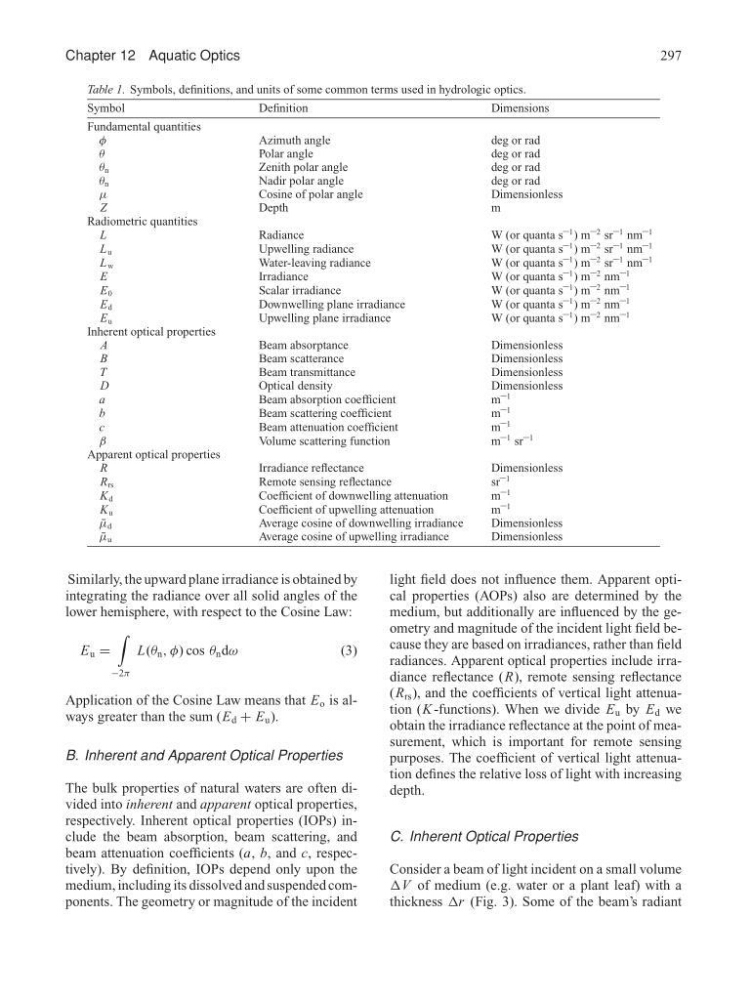
Table 1. Symbols, definitions, and units of some common terms used in hydrologic optics.
Symbol
Definition
Dimensions
Fundamental quantities
φ
Azimuth angle
deg or rad
θ
Polar angle
deg or rad
θ n
Zenith polar angle
deg or rad
θ n
Nadir polar angle
deg or rad
µ
Cosine of polar angle
Dimensionless
Z
Depth
m
Radiometric quantities
L
Radiance
W (or quanta s –1 ) m –2 sr –1 nm –1
L u
Upwelling radiance
W (or quanta s –1 ) m –2 sr –1 nm –1
L w
Water-leaving radiance
W (or quanta s –1 ) m –2 sr –1 nm –1
E
Irradiance
W (or quanta s –1 ) m –2 nm –1
E 0
Scalar irradiance
W (or quanta s –1 ) m –2 nm –1
E d
Downwelling plane irradiance
W (or quanta s –1 ) m –2 nm –1
E u
Upwelling plane irradiance
W (or quanta s –1 ) m –2 nm –1
Inherent optical properties
A
Beam absorptance
Dimensionless
B
Beam scatterance
Dimensionless
T
Beam transmittance
Dimensionless
D
Optical density
Dimensionless
a
Beam absorption coefficient
m –1
b
Beam scattering coefficient
m –1
c
Beam attenuation coefficient
m –1
β
Volume scattering function
m –1 sr –1
Apparent optical properties
R
Irradiance reflectance
Dimensionless
R rs
Remote sensing reflectance
sr –1
K d
Coefficient of downwelling attenuation
m –1
K u
Coefficient of upwelling attenuation
m –1
¯
µ d
Average cosine of downwelling irradiance
Dimensionless
¯
µ u
Average cosine of upwelling irradiance
Dimensionless
Similarly, the upward plane irradiance is obtained by
integrating the radiance over all solid angles of the
lower hemisphere, with respect to the Cosine Law:
E u =
−2π
L(θ n , φ) cos θ n dω
(3)
Application of the Cosine Law means that E o is always greater than the sum (E d + E u ).
B. Inherent and Apparent Optical Properties
The bulk properties of natural waters are often divided into inherent and apparent optical properties,
respectively. Inherent optical properties (IOPs) include the beam absorption, beam scattering, and
beam attenuation coefficients (a, b, and c, respectively). By definition, IOPs depend only upon the
medium, including its dissolved and suspended components. The geometry or magnitude of the incident
light field does not influence them. Apparent optical properties (AOPs) also are determined by the
medium, but additionally are influenced by the geometry and magnitude of the incident light field because they are based on irradiances, rather than field
radiances. Apparent optical properties include irradiance reflectance (R), remote sensing reflectance
(R rs ), and the coefficients of vertical light attenuation (K -functions). When we divide E u by E d we
obtain the irradiance reflectance at the point of measurement, which is important for remote sensing
purposes. The coefficient of vertical light attenuation defines the relative loss of light with increasing
depth.
C. Inherent Optical Properties
Consider a beam of light incident on a small volume
V of medium (e.g. water or a plant leaf) with a
thickness r (Fig. 3). Some of the beam’s radiant
297
Table 1. Symbols, definitions, and units of some common terms used in hydrologic optics.
Symbol
Definition
Dimensions
Fundamental quantities
φ
Azimuth angle
deg or rad
θ
Polar angle
deg or rad
θ n
Zenith polar angle
deg or rad
θ n
Nadir polar angle
deg or rad
µ
Cosine of polar angle
Dimensionless
Z
Depth
m
Radiometric quantities
L
Radiance
W (or quanta s –1 ) m –2 sr –1 nm –1
L u
Upwelling radiance
W (or quanta s –1 ) m –2 sr –1 nm –1
L w
Water-leaving radiance
W (or quanta s –1 ) m –2 sr –1 nm –1
E
Irradiance
W (or quanta s –1 ) m –2 nm –1
E 0
Scalar irradiance
W (or quanta s –1 ) m –2 nm –1
E d
Downwelling plane irradiance
W (or quanta s –1 ) m –2 nm –1
E u
Upwelling plane irradiance
W (or quanta s –1 ) m –2 nm –1
Inherent optical properties
A
Beam absorptance
Dimensionless
B
Beam scatterance
Dimensionless
T
Beam transmittance
Dimensionless
D
Optical density
Dimensionless
a
Beam absorption coefficient
m –1
b
Beam scattering coefficient
m –1
c
Beam attenuation coefficient
m –1
β
Volume scattering function
m –1 sr –1
Apparent optical properties
R
Irradiance reflectance
Dimensionless
R rs
Remote sensing reflectance
sr –1
K d
Coefficient of downwelling attenuation
m –1
K u
Coefficient of upwelling attenuation
m –1
¯
µ d
Average cosine of downwelling irradiance
Dimensionless
¯
µ u
Average cosine of upwelling irradiance
Dimensionless
Similarly, the upward plane irradiance is obtained by
integrating the radiance over all solid angles of the
lower hemisphere, with respect to the Cosine Law:
E u =
−2π
L(θ n , φ) cos θ n dω
(3)
Application of the Cosine Law means that E o is always greater than the sum (E d + E u ).
B. Inherent and Apparent Optical Properties
The bulk properties of natural waters are often divided into inherent and apparent optical properties,
respectively. Inherent optical properties (IOPs) include the beam absorption, beam scattering, and
beam attenuation coefficients (a, b, and c, respectively). By definition, IOPs depend only upon the
medium, including its dissolved and suspended components. The geometry or magnitude of the incident
light field does not influence them. Apparent optical properties (AOPs) also are determined by the
medium, but additionally are influenced by the geometry and magnitude of the incident light field because they are based on irradiances, rather than field
radiances. Apparent optical properties include irradiance reflectance (R), remote sensing reflectance
(R rs ), and the coefficients of vertical light attenuation (K -functions). When we divide E u by E d we
obtain the irradiance reflectance at the point of measurement, which is important for remote sensing
purposes. The coefficient of vertical light attenuation defines the relative loss of light with increasing
depth.
C. Inherent Optical Properties
Consider a beam of light incident on a small volume
V of medium (e.g. water or a plant leaf) with a
thickness r (Fig. 3). Some of the beam’s radiant