

296
Richard C. Zimmerman and Arnold G. Dekker
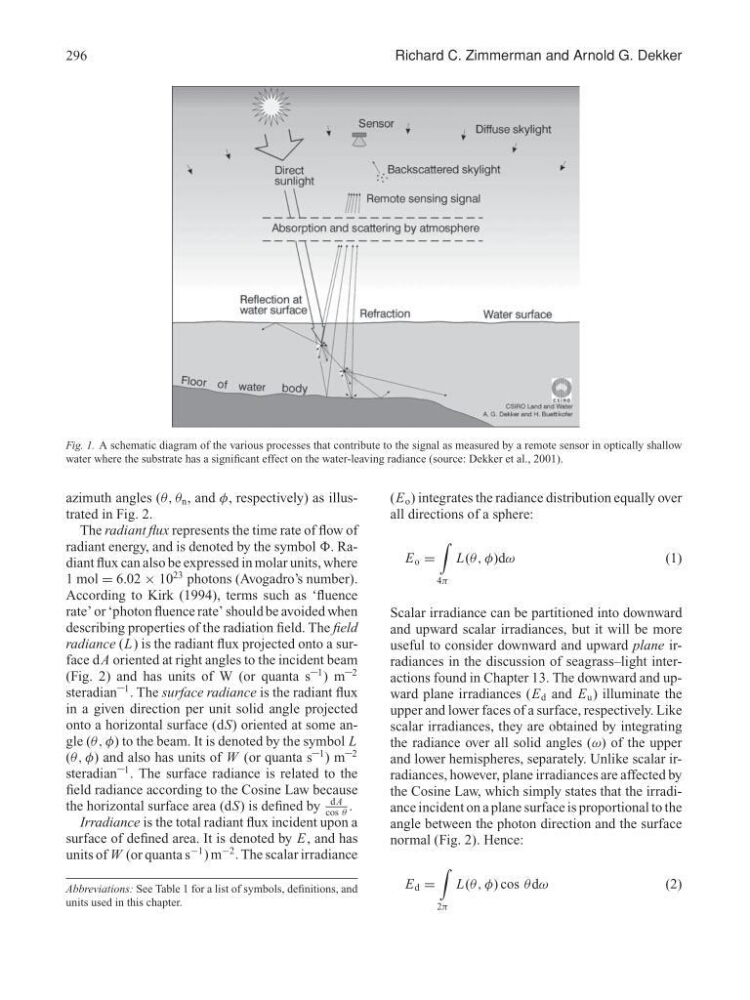
Fig. 1. A schematic diagram of the various processes that contribute to the signal as measured by a remote sensor in optically shallow
water where the substrate has a significant effect on the water-leaving radiance (source: Dekker et al., 2001).
azimuth angles (θ, θ n , and φ, respectively) as illustrated in Fig. 2.
The radiant flux represents the time rate of flow of
radiant energy, and is denoted by the symbol . Radiant flux can also be expressed in molar units, where
1 mol = 6.02 × 10
23 photons (Avogadro’s number).
According to Kirk (1994), terms such as ‘fluence
rate’ or ‘photon fluence rate’ should be avoided when
describing properties of the radiation field. The field
radiance (L) is the radiant flux projected onto a surface dA oriented at right angles to the incident beam
(Fig. 2) and has units of W (or quanta s –1 ) m –2
steradian –1 . The surface radiance is the radiant flux
in a given direction per unit solid angle projected
onto a horizontal surface (dS) oriented at some angle (θ, φ) to the beam. It is denoted by the symbol L
(θ, φ) and also has units of W (or quanta s –1 ) m –2
steradian –1 . The surface radiance is related to the
field radiance according to the Cosine Law because
the horizontal surface area (dS) is defined by
dA
cos θ
.
Irradiance is the total radiant flux incident upon a
surface of defined area. It is denoted by E, and has
units of W (or quanta s
−1 ) m
−2 . The scalar irradiance
Abbreviations: See Table 1 for a list of symbols, definitions, and
units used in this chapter.
(E o ) integrates the radiance distribution equally over
all directions of a sphere:
E o =
4π
L(θ, φ)dω
(1)
Scalar irradiance can be partitioned into downward
and upward scalar irradiances, but it will be more
useful to consider downward and upward plane irradiances in the discussion of seagrass–light interactions found in Chapter 13. The downward and upward plane irradiances (E d and E u ) illuminate the
upper and lower faces of a surface, respectively. Like
scalar irradiances, they are obtained by integrating
the radiance over all solid angles (ω) of the upper
and lower hemispheres, separately. Unlike scalar irradiances, however, plane irradiances are affected by
the Cosine Law, which simply states that the irradiance incident on a plane surface is proportional to the
angle between the photon direction and the surface
normal (Fig. 2). Hence:
E d =
2π
L(θ, φ) cos θ dω
(2)
Richard C. Zimmerman and Arnold G. Dekker
Fig. 1. A schematic diagram of the various processes that contribute to the signal as measured by a remote sensor in optically shallow
water where the substrate has a significant effect on the water-leaving radiance (source: Dekker et al., 2001).
azimuth angles (θ, θ n , and φ, respectively) as illustrated in Fig. 2.
The radiant flux represents the time rate of flow of
radiant energy, and is denoted by the symbol . Radiant flux can also be expressed in molar units, where
1 mol = 6.02 × 10
23 photons (Avogadro’s number).
According to Kirk (1994), terms such as ‘fluence
rate’ or ‘photon fluence rate’ should be avoided when
describing properties of the radiation field. The field
radiance (L) is the radiant flux projected onto a surface dA oriented at right angles to the incident beam
(Fig. 2) and has units of W (or quanta s –1 ) m –2
steradian –1 . The surface radiance is the radiant flux
in a given direction per unit solid angle projected
onto a horizontal surface (dS) oriented at some angle (θ, φ) to the beam. It is denoted by the symbol L
(θ, φ) and also has units of W (or quanta s –1 ) m –2
steradian –1 . The surface radiance is related to the
field radiance according to the Cosine Law because
the horizontal surface area (dS) is defined by
dA
cos θ
.
Irradiance is the total radiant flux incident upon a
surface of defined area. It is denoted by E, and has
units of W (or quanta s
−1 ) m
−2 . The scalar irradiance
Abbreviations: See Table 1 for a list of symbols, definitions, and
units used in this chapter.
(E o ) integrates the radiance distribution equally over
all directions of a sphere:
E o =
4π
L(θ, φ)dω
(1)
Scalar irradiance can be partitioned into downward
and upward scalar irradiances, but it will be more
useful to consider downward and upward plane irradiances in the discussion of seagrass–light interactions found in Chapter 13. The downward and upward plane irradiances (E d and E u ) illuminate the
upper and lower faces of a surface, respectively. Like
scalar irradiances, they are obtained by integrating
the radiance over all solid angles (ω) of the upper
and lower hemispheres, separately. Unlike scalar irradiances, however, plane irradiances are affected by
the Cosine Law, which simply states that the irradiance incident on a plane surface is proportional to the
angle between the photon direction and the surface
normal (Fig. 2). Hence:
E d =
2π
L(θ, φ) cos θ dω
(2)