

Chapter 8 Fluid Dynamics in Seagrass Ecology
205
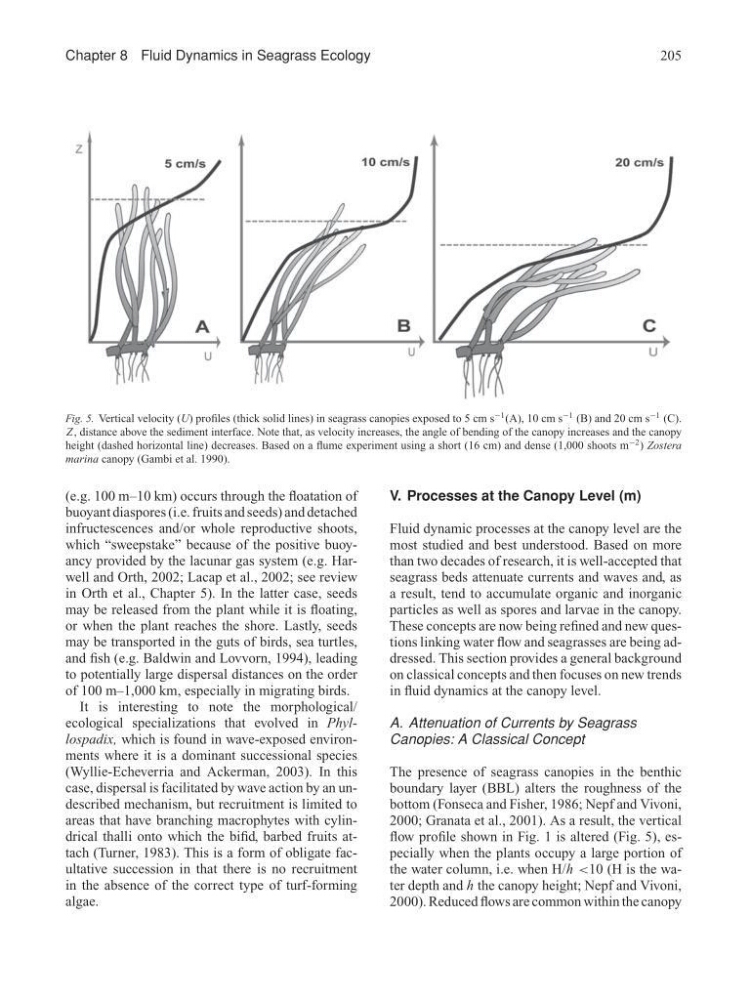
Fig. 5. Vertical velocity (U) profiles (thick solid lines) in seagrass canopies exposed to 5 cm s
−1 (A), 10 cm s
−1 (B) and 20 cm s
−1 (C).
Z , distance above the sediment interface. Note that, as velocity increases, the angle of bending of the canopy increases and the canopy
height (dashed horizontal line) decreases. Based on a flume experiment using a short (16 cm) and dense (1,000 shoots m
−2 ) Zostera
marina canopy (Gambi et al. 1990).
(e.g. 100 m–10 km) occurs through the floatation of
buoyant diaspores (i.e. fruits and seeds) and detached
infructescences and/or whole reproductive shoots,
which “sweepstake” because of the positive buoyancy provided by the lacunar gas system (e.g. Harwell and Orth, 2002; Lacap et al., 2002; see review
in Orth et al., Chapter 5). In the latter case, seeds
may be released from the plant while it is floating,
or when the plant reaches the shore. Lastly, seeds
may be transported in the guts of birds, sea turtles,
and fish (e.g. Baldwin and Lovvorn, 1994), leading
to potentially large dispersal distances on the order
of 100 m–1,000 km, especially in migrating birds.
It is interesting to note the morphological/
ecological specializations that evolved in Phyllospadix, which is found in wave-exposed environments where it is a dominant successional species
(Wyllie-Echeverria and Ackerman, 2003). In this
case, dispersal is facilitated by wave action by an undescribed mechanism, but recruitment is limited to
areas that have branching macrophytes with cylindrical thalli onto which the bifid, barbed fruits attach (Turner, 1983). This is a form of obligate facultative succession in that there is no recruitment
in the absence of the correct type of turf-forming
algae.
V. Processes at the Canopy Level (m)
Fluid dynamic processes at the canopy level are the
most studied and best understood. Based on more
than two decades of research, it is well-accepted that
seagrass beds attenuate currents and waves and, as
a result, tend to accumulate organic and inorganic
particles as well as spores and larvae in the canopy.
These concepts are now being refined and new questions linking water flow and seagrasses are being addressed. This section provides a general background
on classical concepts and then focuses on new trends
in fluid dynamics at the canopy level.
A. Attenuation of Currents by Seagrass
Canopies: A Classical Concept
The presence of seagrass canopies in the benthic
boundary layer (BBL) alters the roughness of the
bottom (Fonseca and Fisher, 1986; Nepf and Vivoni,
2000; Granata et al., 2001). As a result, the vertical
flow profile shown in Fig. 1 is altered (Fig. 5), especially when the plants occupy a large portion of
the water column, i.e. when H/h <10 (H is the water depth and h the canopy height; Nepf and Vivoni,
2000). Reduced flows are common within the canopy
205
Fig. 5. Vertical velocity (U) profiles (thick solid lines) in seagrass canopies exposed to 5 cm s
−1 (A), 10 cm s
−1 (B) and 20 cm s
−1 (C).
Z , distance above the sediment interface. Note that, as velocity increases, the angle of bending of the canopy increases and the canopy
height (dashed horizontal line) decreases. Based on a flume experiment using a short (16 cm) and dense (1,000 shoots m
−2 ) Zostera
marina canopy (Gambi et al. 1990).
(e.g. 100 m–10 km) occurs through the floatation of
buoyant diaspores (i.e. fruits and seeds) and detached
infructescences and/or whole reproductive shoots,
which “sweepstake” because of the positive buoyancy provided by the lacunar gas system (e.g. Harwell and Orth, 2002; Lacap et al., 2002; see review
in Orth et al., Chapter 5). In the latter case, seeds
may be released from the plant while it is floating,
or when the plant reaches the shore. Lastly, seeds
may be transported in the guts of birds, sea turtles,
and fish (e.g. Baldwin and Lovvorn, 1994), leading
to potentially large dispersal distances on the order
of 100 m–1,000 km, especially in migrating birds.
It is interesting to note the morphological/
ecological specializations that evolved in Phyllospadix, which is found in wave-exposed environments where it is a dominant successional species
(Wyllie-Echeverria and Ackerman, 2003). In this
case, dispersal is facilitated by wave action by an undescribed mechanism, but recruitment is limited to
areas that have branching macrophytes with cylindrical thalli onto which the bifid, barbed fruits attach (Turner, 1983). This is a form of obligate facultative succession in that there is no recruitment
in the absence of the correct type of turf-forming
algae.
V. Processes at the Canopy Level (m)
Fluid dynamic processes at the canopy level are the
most studied and best understood. Based on more
than two decades of research, it is well-accepted that
seagrass beds attenuate currents and waves and, as
a result, tend to accumulate organic and inorganic
particles as well as spores and larvae in the canopy.
These concepts are now being refined and new questions linking water flow and seagrasses are being addressed. This section provides a general background
on classical concepts and then focuses on new trends
in fluid dynamics at the canopy level.
A. Attenuation of Currents by Seagrass
Canopies: A Classical Concept
The presence of seagrass canopies in the benthic
boundary layer (BBL) alters the roughness of the
bottom (Fonseca and Fisher, 1986; Nepf and Vivoni,
2000; Granata et al., 2001). As a result, the vertical
flow profile shown in Fig. 1 is altered (Fig. 5), especially when the plants occupy a large portion of
the water column, i.e. when H/h <10 (H is the water depth and h the canopy height; Nepf and Vivoni,
2000). Reduced flows are common within the canopy