

202
E. W. Koch, J. D. Ackerman, J. Verduin and M. van Keulen
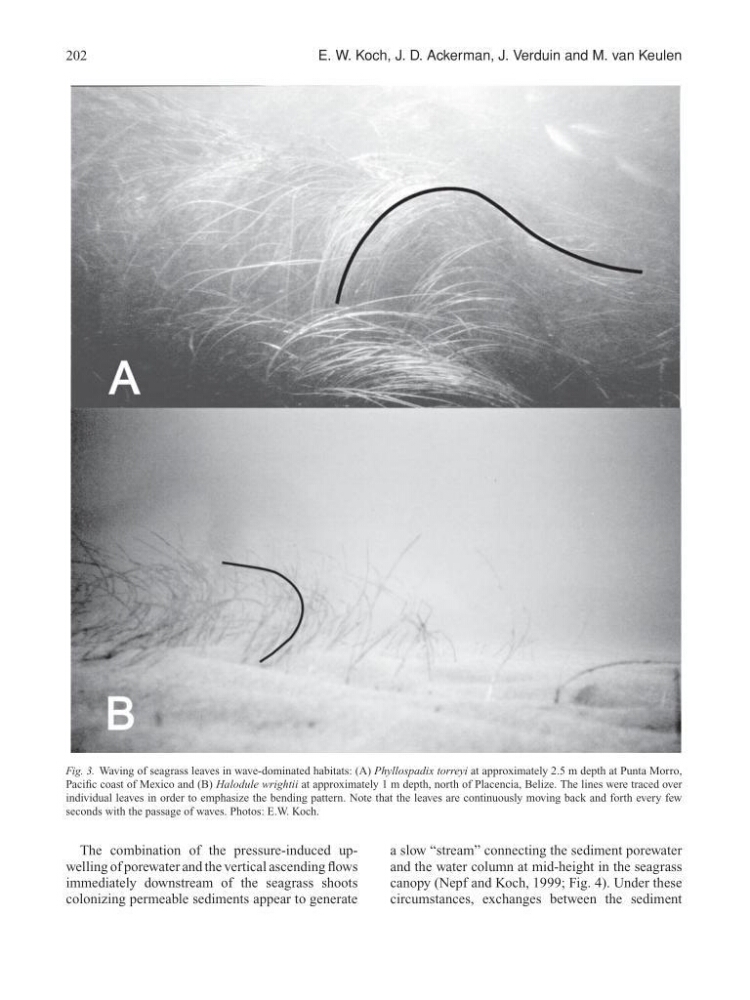
Fig. 3. Waving of seagrass leaves in wave-dominated habitats: (A) Phyllospadix torreyi at approximately 2.5 m depth at Punta Morro,
Pacific coast of Mexico and (B) Halodule wrightii at approximately 1 m depth, north of Placencia, Belize. The lines were traced over
individual leaves in order to emphasize the bending pattern. Note that the leaves are continuously moving back and forth every few
seconds with the passage of waves. Photos: E.W. Koch.
The combination of the pressure-induced upwelling of porewater and the vertical ascending flows
immediately downstream of the seagrass shoots
colonizing permeable sediments appear to generate
a slow “stream” connecting the sediment porewater
and the water column at mid-height in the seagrass
canopy (Nepf and Koch, 1999; Fig. 4). Under these
circumstances, exchanges between the sediment
E. W. Koch, J. D. Ackerman, J. Verduin and M. van Keulen
Fig. 3. Waving of seagrass leaves in wave-dominated habitats: (A) Phyllospadix torreyi at approximately 2.5 m depth at Punta Morro,
Pacific coast of Mexico and (B) Halodule wrightii at approximately 1 m depth, north of Placencia, Belize. The lines were traced over
individual leaves in order to emphasize the bending pattern. Note that the leaves are continuously moving back and forth every few
seconds with the passage of waves. Photos: E.W. Koch.
The combination of the pressure-induced upwelling of porewater and the vertical ascending flows
immediately downstream of the seagrass shoots
colonizing permeable sediments appear to generate
a slow “stream” connecting the sediment porewater
and the water column at mid-height in the seagrass
canopy (Nepf and Koch, 1999; Fig. 4). Under these
circumstances, exchanges between the sediment