

184
M. A. Mateo, J. Cebri ´
an, K. Dunton, and T. Mutchler
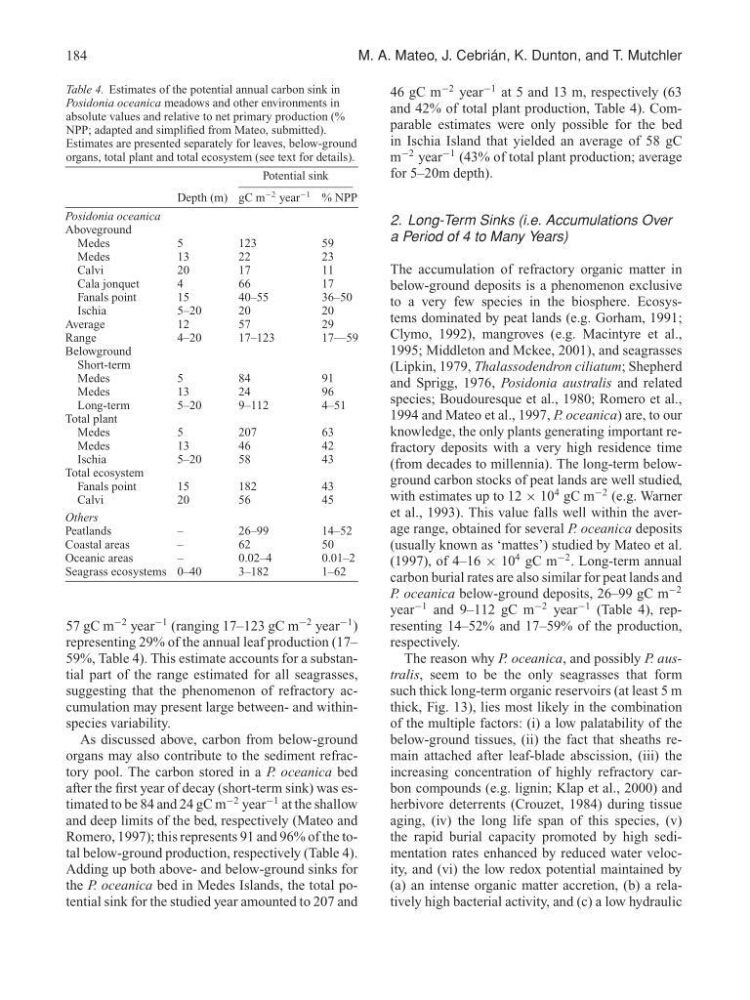
Table 4. Estimates of the potential annual carbon sink in
Posidonia oceanica meadows and other environments in
absolute values and relative to net primary production (%
NPP; adapted and simplified from Mateo, submitted).
Estimates are presented separately for leaves, below-ground
organs, total plant and total ecosystem (see text for details).
Potential sink
Depth (m) gC m
−2 year
−1 % NPP
Posidonia oceanica
Aboveground
Medes
5
123
59
Medes
13
22
23
Calvi
20
17
11
Cala jonquet
4
66
17
Fanals point
15
40–55
36–50
Ischia
5–20
20
20
Average
12
57
29
Range
4–20
17–123
17—59
Belowground
Short-term
Medes
5
84
91
Medes
13
24
96
Long-term
5–20
9–112
4–51
Total plant
Medes
5
207
63
Medes
13
46
42
Ischia
5–20
58
43
Total ecosystem
Fanals point
15
182
43
Calvi
20
56
45
Others
Peatlands
–
26–99
14–52
Coastal areas
–
62
50
Oceanic areas
–
0.02–4
0.01–2
Seagrass ecosystems 0–40
3–182
1–62
57 gC m
−2 year
−1 (ranging 17–123 gC m
−2 year
−1 )
representing 29% of the annual leaf production (17–
59%, Table 4). This estimate accounts for a substantial part of the range estimated for all seagrasses,
suggesting that the phenomenon of refractory accumulation may present large between- and withinspecies variability.
As discussed above, carbon from below-ground
organs may also contribute to the sediment refractory pool. The carbon stored in a P. oceanica bed
after the first year of decay (short-term sink) was estimated to be 84 and 24 gC m
−2 year
−1 at the shallow
and deep limits of the bed, respectively (Mateo and
Romero, 1997); this represents 91 and 96% of the total below-ground production, respectively (Table 4).
Adding up both above- and below-ground sinks for
the P. oceanica bed in Medes Islands, the total potential sink for the studied year amounted to 207 and
46 gC m
−2 year
−1 at 5 and 13 m, respectively (63
and 42% of total plant production, Table 4). Comparable estimates were only possible for the bed
in Ischia Island that yielded an average of 58 gC
m
−2 year
−1 (43% of total plant production; average
for 5–20m depth).
2. Long-Term Sinks (i.e. Accumulations Over
a Period of 4 to Many Years)
The accumulation of refractory organic matter in
below-ground deposits is a phenomenon exclusive
to a very few species in the biosphere. Ecosystems dominated by peat lands (e.g. Gorham, 1991;
Clymo, 1992), mangroves (e.g. Macintyre et al.,
1995; Middleton and Mckee, 2001), and seagrasses
(Lipkin, 1979, Thalassodendron ciliatum; Shepherd
and Sprigg, 1976, Posidonia australis and related
species; Boudouresque et al., 1980; Romero et al.,
1994 and Mateo et al., 1997, P. oceanica) are, to our
knowledge, the only plants generating important refractory deposits with a very high residence time
(from decades to millennia). The long-term belowground carbon stocks of peat lands are well studied,
with estimates up to 12 × 10
4 gC m
−2 (e.g. Warner
et al., 1993). This value falls well within the average range, obtained for several P. oceanica deposits
(usually known as ‘mattes’) studied by Mateo et al.
(1997), of 4–16 × 10
4 gC m
−2 . Long-term annual
carbon burial rates are also similar for peat lands and
P. oceanica below-ground deposits, 26–99 gC m
−2
year
−1 and 9–112 gC m
−2 year
−1 (Table 4), representing 14–52% and 17–59% of the production,
respectively.
The reason why P. oceanica, and possibly P. australis, seem to be the only seagrasses that form
such thick long-term organic reservoirs (at least 5 m
thick, Fig. 13), lies most likely in the combination
of the multiple factors: (i) a low palatability of the
below-ground tissues, (ii) the fact that sheaths remain attached after leaf-blade abscission, (iii) the
increasing concentration of highly refractory carbon compounds (e.g. lignin; Klap et al., 2000) and
herbivore deterrents (Crouzet, 1984) during tissue
aging, (iv) the long life span of this species, (v)
the rapid burial capacity promoted by high sedimentation rates enhanced by reduced water velocity, and (vi) the low redox potential maintained by
(a) an intense organic matter accretion, (b) a relatively high bacterial activity, and (c) a low hydraulic
M. A. Mateo, J. Cebri ´
an, K. Dunton, and T. Mutchler
Table 4. Estimates of the potential annual carbon sink in
Posidonia oceanica meadows and other environments in
absolute values and relative to net primary production (%
NPP; adapted and simplified from Mateo, submitted).
Estimates are presented separately for leaves, below-ground
organs, total plant and total ecosystem (see text for details).
Potential sink
Depth (m) gC m
−2 year
−1 % NPP
Posidonia oceanica
Aboveground
Medes
5
123
59
Medes
13
22
23
Calvi
20
17
11
Cala jonquet
4
66
17
Fanals point
15
40–55
36–50
Ischia
5–20
20
20
Average
12
57
29
Range
4–20
17–123
17—59
Belowground
Short-term
Medes
5
84
91
Medes
13
24
96
Long-term
5–20
9–112
4–51
Total plant
Medes
5
207
63
Medes
13
46
42
Ischia
5–20
58
43
Total ecosystem
Fanals point
15
182
43
Calvi
20
56
45
Others
Peatlands
–
26–99
14–52
Coastal areas
–
62
50
Oceanic areas
–
0.02–4
0.01–2
Seagrass ecosystems 0–40
3–182
1–62
57 gC m
−2 year
−1 (ranging 17–123 gC m
−2 year
−1 )
representing 29% of the annual leaf production (17–
59%, Table 4). This estimate accounts for a substantial part of the range estimated for all seagrasses,
suggesting that the phenomenon of refractory accumulation may present large between- and withinspecies variability.
As discussed above, carbon from below-ground
organs may also contribute to the sediment refractory pool. The carbon stored in a P. oceanica bed
after the first year of decay (short-term sink) was estimated to be 84 and 24 gC m
−2 year
−1 at the shallow
and deep limits of the bed, respectively (Mateo and
Romero, 1997); this represents 91 and 96% of the total below-ground production, respectively (Table 4).
Adding up both above- and below-ground sinks for
the P. oceanica bed in Medes Islands, the total potential sink for the studied year amounted to 207 and
46 gC m
−2 year
−1 at 5 and 13 m, respectively (63
and 42% of total plant production, Table 4). Comparable estimates were only possible for the bed
in Ischia Island that yielded an average of 58 gC
m
−2 year
−1 (43% of total plant production; average
for 5–20m depth).
2. Long-Term Sinks (i.e. Accumulations Over
a Period of 4 to Many Years)
The accumulation of refractory organic matter in
below-ground deposits is a phenomenon exclusive
to a very few species in the biosphere. Ecosystems dominated by peat lands (e.g. Gorham, 1991;
Clymo, 1992), mangroves (e.g. Macintyre et al.,
1995; Middleton and Mckee, 2001), and seagrasses
(Lipkin, 1979, Thalassodendron ciliatum; Shepherd
and Sprigg, 1976, Posidonia australis and related
species; Boudouresque et al., 1980; Romero et al.,
1994 and Mateo et al., 1997, P. oceanica) are, to our
knowledge, the only plants generating important refractory deposits with a very high residence time
(from decades to millennia). The long-term belowground carbon stocks of peat lands are well studied,
with estimates up to 12 × 10
4 gC m
−2 (e.g. Warner
et al., 1993). This value falls well within the average range, obtained for several P. oceanica deposits
(usually known as ‘mattes’) studied by Mateo et al.
(1997), of 4–16 × 10
4 gC m
−2 . Long-term annual
carbon burial rates are also similar for peat lands and
P. oceanica below-ground deposits, 26–99 gC m
−2
year
−1 and 9–112 gC m
−2 year
−1 (Table 4), representing 14–52% and 17–59% of the production,
respectively.
The reason why P. oceanica, and possibly P. australis, seem to be the only seagrasses that form
such thick long-term organic reservoirs (at least 5 m
thick, Fig. 13), lies most likely in the combination
of the multiple factors: (i) a low palatability of the
below-ground tissues, (ii) the fact that sheaths remain attached after leaf-blade abscission, (iii) the
increasing concentration of highly refractory carbon compounds (e.g. lignin; Klap et al., 2000) and
herbivore deterrents (Crouzet, 1984) during tissue
aging, (iv) the long life span of this species, (v)
the rapid burial capacity promoted by high sedimentation rates enhanced by reduced water velocity, and (vi) the low redox potential maintained by
(a) an intense organic matter accretion, (b) a relatively high bacterial activity, and (c) a low hydraulic