

Chapter 7 Carbon Flux in Seagrasses
181
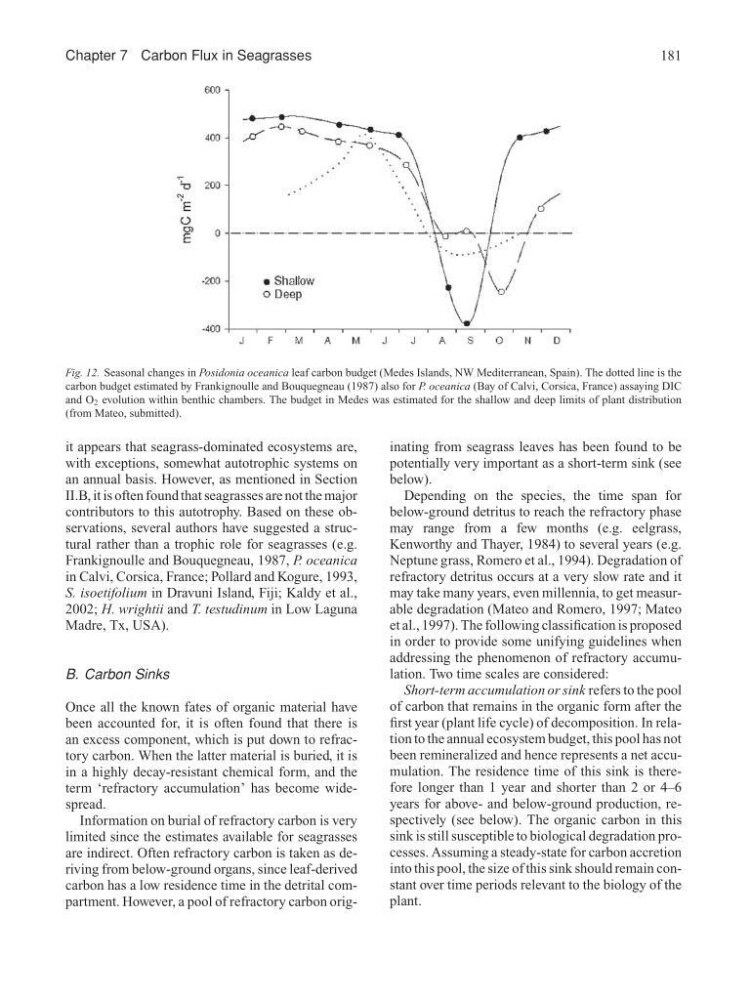
Fig. 12. Seasonal changes in Posidonia oceanica leaf carbon budget (Medes Islands, NW Mediterranean, Spain). The dotted line is the
carbon budget estimated by Frankignoulle and Bouquegneau (1987) also for P. oceanica (Bay of Calvi, Corsica, France) assaying DIC
and O 2 evolution within benthic chambers. The budget in Medes was estimated for the shallow and deep limits of plant distribution
(from Mateo, submitted).
it appears that seagrass-dominated ecosystems are,
with exceptions, somewhat autotrophic systems on
an annual basis. However, as mentioned in Section
II.B, it is often found that seagrasses are not the major
contributors to this autotrophy. Based on these observations, several authors have suggested a structural rather than a trophic role for seagrasses (e.g.
Frankignoulle and Bouquegneau, 1987, P. oceanica
in Calvi, Corsica, France; Pollard and Kogure, 1993,
S. isoetifolium in Dravuni Island, Fiji; Kaldy et al.,
2002; H. wrightii and T. testudinum in Low Laguna
Madre, Tx, USA).
B. Carbon Sinks
Once all the known fates of organic material have
been accounted for, it is often found that there is
an excess component, which is put down to refractory carbon. When the latter material is buried, it is
in a highly decay-resistant chemical form, and the
term ‘refractory accumulation’ has become widespread.
Information on burial of refractory carbon is very
limited since the estimates available for seagrasses
are indirect. Often refractory carbon is taken as deriving from below-ground organs, since leaf-derived
carbon has a low residence time in the detrital compartment. However, a pool of refractory carbon originating from seagrass leaves has been found to be
potentially very important as a short-term sink (see
below).
Depending on the species, the time span for
below-ground detritus to reach the refractory phase
may range from a few months (e.g. eelgrass,
Kenworthy and Thayer, 1984) to several years (e.g.
Neptune grass, Romero et al., 1994). Degradation of
refractory detritus occurs at a very slow rate and it
may take many years, even millennia, to get measurable degradation (Mateo and Romero, 1997; Mateo
et al., 1997). The following classification is proposed
in order to provide some unifying guidelines when
addressing the phenomenon of refractory accumulation. Two time scales are considered:
Short-term accumulation or sink refers to the pool
of carbon that remains in the organic form after the
first year (plant life cycle) of decomposition. In relation to the annual ecosystem budget, this pool has not
been remineralized and hence represents a net accumulation. The residence time of this sink is therefore longer than 1 year and shorter than 2 or 4–6
years for above- and below-ground production, respectively (see below). The organic carbon in this
sink is still susceptible to biological degradation processes. Assuming a steady-state for carbon accretion
into this pool, the size of this sink should remain constant over time periods relevant to the biology of the
plant.
181
Fig. 12. Seasonal changes in Posidonia oceanica leaf carbon budget (Medes Islands, NW Mediterranean, Spain). The dotted line is the
carbon budget estimated by Frankignoulle and Bouquegneau (1987) also for P. oceanica (Bay of Calvi, Corsica, France) assaying DIC
and O 2 evolution within benthic chambers. The budget in Medes was estimated for the shallow and deep limits of plant distribution
(from Mateo, submitted).
it appears that seagrass-dominated ecosystems are,
with exceptions, somewhat autotrophic systems on
an annual basis. However, as mentioned in Section
II.B, it is often found that seagrasses are not the major
contributors to this autotrophy. Based on these observations, several authors have suggested a structural rather than a trophic role for seagrasses (e.g.
Frankignoulle and Bouquegneau, 1987, P. oceanica
in Calvi, Corsica, France; Pollard and Kogure, 1993,
S. isoetifolium in Dravuni Island, Fiji; Kaldy et al.,
2002; H. wrightii and T. testudinum in Low Laguna
Madre, Tx, USA).
B. Carbon Sinks
Once all the known fates of organic material have
been accounted for, it is often found that there is
an excess component, which is put down to refractory carbon. When the latter material is buried, it is
in a highly decay-resistant chemical form, and the
term ‘refractory accumulation’ has become widespread.
Information on burial of refractory carbon is very
limited since the estimates available for seagrasses
are indirect. Often refractory carbon is taken as deriving from below-ground organs, since leaf-derived
carbon has a low residence time in the detrital compartment. However, a pool of refractory carbon originating from seagrass leaves has been found to be
potentially very important as a short-term sink (see
below).
Depending on the species, the time span for
below-ground detritus to reach the refractory phase
may range from a few months (e.g. eelgrass,
Kenworthy and Thayer, 1984) to several years (e.g.
Neptune grass, Romero et al., 1994). Degradation of
refractory detritus occurs at a very slow rate and it
may take many years, even millennia, to get measurable degradation (Mateo and Romero, 1997; Mateo
et al., 1997). The following classification is proposed
in order to provide some unifying guidelines when
addressing the phenomenon of refractory accumulation. Two time scales are considered:
Short-term accumulation or sink refers to the pool
of carbon that remains in the organic form after the
first year (plant life cycle) of decomposition. In relation to the annual ecosystem budget, this pool has not
been remineralized and hence represents a net accumulation. The residence time of this sink is therefore longer than 1 year and shorter than 2 or 4–6
years for above- and below-ground production, respectively (see below). The organic carbon in this
sink is still susceptible to biological degradation processes. Assuming a steady-state for carbon accretion
into this pool, the size of this sink should remain constant over time periods relevant to the biology of the
plant.