

180
M. A. Mateo, J. Cebri ´
an, K. Dunton, and T. Mutchler
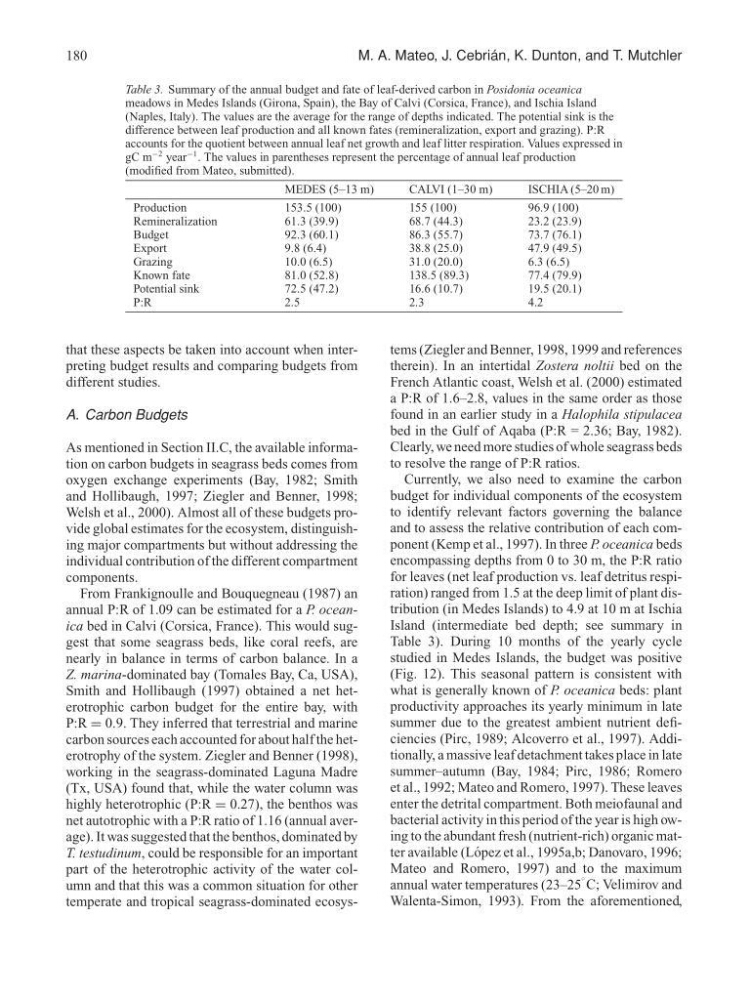
Table 3. Summary of the annual budget and fate of leaf-derived carbon in Posidonia oceanica
meadows in Medes Islands (Girona, Spain), the Bay of Calvi (Corsica, France), and Ischia Island
(Naples, Italy). The values are the average for the range of depths indicated. The potential sink is the
difference between leaf production and all known fates (remineralization, export and grazing). P:R
accounts for the quotient between annual leaf net growth and leaf litter respiration. Values expressed in
gC m
−2 year
−1 . The values in parentheses represent the percentage of annual leaf production
(modified from Mateo, submitted).
MEDES (5–13 m)
CALVI (1–30 m)
ISCHIA (5–20 m)
Production
153.5 (100)
155 (100)
96.9 (100)
Remineralization
61.3 (39.9)
68.7 (44.3)
23.2 (23.9)
Budget
92.3 (60.1)
86.3 (55.7)
73.7 (76.1)
Export
9.8 (6.4)
38.8 (25.0)
47.9 (49.5)
Grazing
10.0 (6.5)
31.0 (20.0)
6.3 (6.5)
Known fate
81.0 (52.8)
138.5 (89.3)
77.4 (79.9)
Potential sink
72.5 (47.2)
16.6 (10.7)
19.5 (20.1)
P:R
2.5
2.3
4.2
that these aspects be taken into account when interpreting budget results and comparing budgets from
different studies.
A. Carbon Budgets
As mentioned in Section II.C, the available information on carbon budgets in seagrass beds comes from
oxygen exchange experiments (Bay, 1982; Smith
and Hollibaugh, 1997; Ziegler and Benner, 1998;
Welsh et al., 2000). Almost all of these budgets provide global estimates for the ecosystem, distinguishing major compartments but without addressing the
individual contribution of the different compartment
components.
From Frankignoulle and Bouquegneau (1987) an
annual P:R of 1.09 can be estimated for a P. oceanica bed in Calvi (Corsica, France). This would suggest that some seagrass beds, like coral reefs, are
nearly in balance in terms of carbon balance. In a
Z. marina-dominated bay (Tomales Bay, Ca, USA),
Smith and Hollibaugh (1997) obtained a net heterotrophic carbon budget for the entire bay, with
P:R = 0.9. They inferred that terrestrial and marine
carbon sources each accounted for about half the heterotrophy of the system. Ziegler and Benner (1998),
working in the seagrass-dominated Laguna Madre
(Tx, USA) found that, while the water column was
highly heterotrophic (P:R = 0.27), the benthos was
net autotrophic with a P:R ratio of 1.16 (annual average). It was suggested that the benthos, dominated by
T. testudinum, could be responsible for an important
part of the heterotrophic activity of the water column and that this was a common situation for other
temperate and tropical seagrass-dominated ecosystems (Ziegler and Benner, 1998, 1999 and references
therein). In an intertidal Zostera noltii bed on the
French Atlantic coast, Welsh et al. (2000) estimated
a P:R of 1.6–2.8, values in the same order as those
found in an earlier study in a Halophila stipulacea
bed in the Gulf of Aqaba (P:R = 2.36; Bay, 1982).
Clearly, we need more studies of whole seagrass beds
to resolve the range of P:R ratios.
Currently, we also need to examine the carbon
budget for individual components of the ecosystem
to identify relevant factors governing the balance
and to assess the relative contribution of each component (Kemp et al., 1997). In three P. oceanica beds
encompassing depths from 0 to 30 m, the P:R ratio
for leaves (net leaf production vs. leaf detritus respiration) ranged from 1.5 at the deep limit of plant distribution (in Medes Islands) to 4.9 at 10 m at Ischia
Island (intermediate bed depth; see summary in
Table 3). During 10 months of the yearly cycle
studied in Medes Islands, the budget was positive
(Fig. 12). This seasonal pattern is consistent with
what is generally known of P. oceanica beds: plant
productivity approaches its yearly minimum in late
summer due to the greatest ambient nutrient deficiencies (Pirc, 1989; Alcoverro et al., 1997). Additionally, a massive leaf detachment takes place in late
summer–autumn (Bay, 1984; Pirc, 1986; Romero
et al., 1992; Mateo and Romero, 1997). These leaves
enter the detrital compartment. Both meiofaunal and
bacterial activity in this period of the year is high owing to the abundant fresh (nutrient-rich) organic matter available (L´ opez et al., 1995a,b; Danovaro, 1996;
Mateo and Romero, 1997) and to the maximum
annual water temperatures (23–25
◦ C; Velimirov and
Walenta-Simon, 1993). From the aforementioned,
M. A. Mateo, J. Cebri ´
an, K. Dunton, and T. Mutchler
Table 3. Summary of the annual budget and fate of leaf-derived carbon in Posidonia oceanica
meadows in Medes Islands (Girona, Spain), the Bay of Calvi (Corsica, France), and Ischia Island
(Naples, Italy). The values are the average for the range of depths indicated. The potential sink is the
difference between leaf production and all known fates (remineralization, export and grazing). P:R
accounts for the quotient between annual leaf net growth and leaf litter respiration. Values expressed in
gC m
−2 year
−1 . The values in parentheses represent the percentage of annual leaf production
(modified from Mateo, submitted).
MEDES (5–13 m)
CALVI (1–30 m)
ISCHIA (5–20 m)
Production
153.5 (100)
155 (100)
96.9 (100)
Remineralization
61.3 (39.9)
68.7 (44.3)
23.2 (23.9)
Budget
92.3 (60.1)
86.3 (55.7)
73.7 (76.1)
Export
9.8 (6.4)
38.8 (25.0)
47.9 (49.5)
Grazing
10.0 (6.5)
31.0 (20.0)
6.3 (6.5)
Known fate
81.0 (52.8)
138.5 (89.3)
77.4 (79.9)
Potential sink
72.5 (47.2)
16.6 (10.7)
19.5 (20.1)
P:R
2.5
2.3
4.2
that these aspects be taken into account when interpreting budget results and comparing budgets from
different studies.
A. Carbon Budgets
As mentioned in Section II.C, the available information on carbon budgets in seagrass beds comes from
oxygen exchange experiments (Bay, 1982; Smith
and Hollibaugh, 1997; Ziegler and Benner, 1998;
Welsh et al., 2000). Almost all of these budgets provide global estimates for the ecosystem, distinguishing major compartments but without addressing the
individual contribution of the different compartment
components.
From Frankignoulle and Bouquegneau (1987) an
annual P:R of 1.09 can be estimated for a P. oceanica bed in Calvi (Corsica, France). This would suggest that some seagrass beds, like coral reefs, are
nearly in balance in terms of carbon balance. In a
Z. marina-dominated bay (Tomales Bay, Ca, USA),
Smith and Hollibaugh (1997) obtained a net heterotrophic carbon budget for the entire bay, with
P:R = 0.9. They inferred that terrestrial and marine
carbon sources each accounted for about half the heterotrophy of the system. Ziegler and Benner (1998),
working in the seagrass-dominated Laguna Madre
(Tx, USA) found that, while the water column was
highly heterotrophic (P:R = 0.27), the benthos was
net autotrophic with a P:R ratio of 1.16 (annual average). It was suggested that the benthos, dominated by
T. testudinum, could be responsible for an important
part of the heterotrophic activity of the water column and that this was a common situation for other
temperate and tropical seagrass-dominated ecosystems (Ziegler and Benner, 1998, 1999 and references
therein). In an intertidal Zostera noltii bed on the
French Atlantic coast, Welsh et al. (2000) estimated
a P:R of 1.6–2.8, values in the same order as those
found in an earlier study in a Halophila stipulacea
bed in the Gulf of Aqaba (P:R = 2.36; Bay, 1982).
Clearly, we need more studies of whole seagrass beds
to resolve the range of P:R ratios.
Currently, we also need to examine the carbon
budget for individual components of the ecosystem
to identify relevant factors governing the balance
and to assess the relative contribution of each component (Kemp et al., 1997). In three P. oceanica beds
encompassing depths from 0 to 30 m, the P:R ratio
for leaves (net leaf production vs. leaf detritus respiration) ranged from 1.5 at the deep limit of plant distribution (in Medes Islands) to 4.9 at 10 m at Ischia
Island (intermediate bed depth; see summary in
Table 3). During 10 months of the yearly cycle
studied in Medes Islands, the budget was positive
(Fig. 12). This seasonal pattern is consistent with
what is generally known of P. oceanica beds: plant
productivity approaches its yearly minimum in late
summer due to the greatest ambient nutrient deficiencies (Pirc, 1989; Alcoverro et al., 1997). Additionally, a massive leaf detachment takes place in late
summer–autumn (Bay, 1984; Pirc, 1986; Romero
et al., 1992; Mateo and Romero, 1997). These leaves
enter the detrital compartment. Both meiofaunal and
bacterial activity in this period of the year is high owing to the abundant fresh (nutrient-rich) organic matter available (L´ opez et al., 1995a,b; Danovaro, 1996;
Mateo and Romero, 1997) and to the maximum
annual water temperatures (23–25
◦ C; Velimirov and
Walenta-Simon, 1993). From the aforementioned,