

172
M. A. Mateo, J. Cebri ´
an, K. Dunton, and T. Mutchler
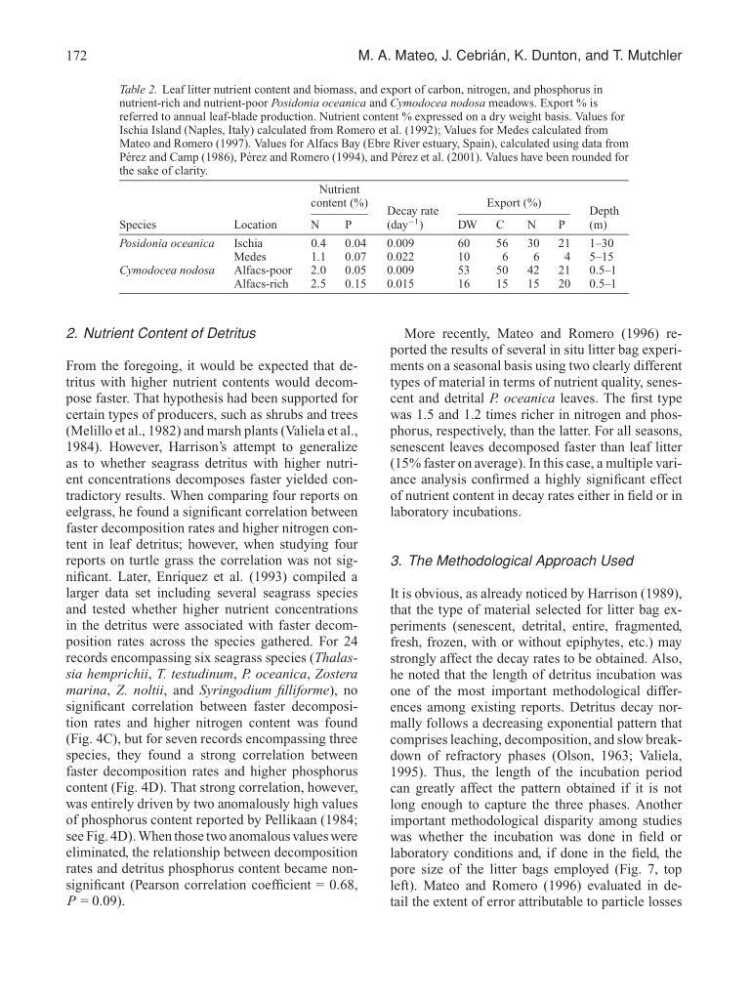
Table 2. Leaf litter nutrient content and biomass, and export of carbon, nitrogen, and phosphorus in
nutrient-rich and nutrient-poor Posidonia oceanica and Cymodocea nodosa meadows. Export % is
referred to annual leaf-blade production. Nutrient content % expressed on a dry weight basis. Values for
Ischia Island (Naples, Italy) calculated from Romero et al. (1992); Values for Medes calculated from
Mateo and Romero (1997). Values for Alfacs Bay (Ebre River estuary, Spain), calculated using data from
P´ erez and Camp (1986), P´ erez and Romero (1994), and P´ erez et al. (2001). Values have been rounded for
the sake of clarity.
Nutrient
content (%)
Export (%)
Decay rate
Depth
Species
Location
N
P
(day
−1 )
DW
C
N
P
(m)
Posidonia oceanica
Ischia
0.4
0.04
0.009
60
56
30
21
1–30
Medes
1.1
0.07
0.022
10
6
6
4
5–15
Cymodocea nodosa
Alfacs-poor
2.0
0.05
0.009
53
50
42
21
0.5–1
Alfacs-rich
2.5
0.15
0.015
16
15
15
20
0.5–1
2. Nutrient Content of Detritus
From the foregoing, it would be expected that detritus with higher nutrient contents would decompose faster. That hypothesis had been supported for
certain types of producers, such as shrubs and trees
(Melillo et al., 1982) and marsh plants (Valiela et al.,
1984). However, Harrison’s attempt to generalize
as to whether seagrass detritus with higher nutrient concentrations decomposes faster yielded contradictory results. When comparing four reports on
eelgrass, he found a significant correlation between
faster decomposition rates and higher nitrogen content in leaf detritus; however, when studying four
reports on turtle grass the correlation was not significant. Later, Enr´ ıquez et al. (1993) compiled a
larger data set including several seagrass species
and tested whether higher nutrient concentrations
in the detritus were associated with faster decomposition rates across the species gathered. For 24
records encompassing six seagrass species (Thalassia hemprichii, T. testudinum, P. oceanica, Zostera
marina, Z. noltii, and Syringodium filliforme), no
significant correlation between faster decomposition rates and higher nitrogen content was found
(Fig. 4C), but for seven records encompassing three
species, they found a strong correlation between
faster decomposition rates and higher phosphorus
content (Fig. 4D). That strong correlation, however,
was entirely driven by two anomalously high values
of phosphorus content reported by Pellikaan (1984;
see Fig. 4D). When those two anomalous values were
eliminated, the relationship between decomposition
rates and detritus phosphorus content became nonsignificant (Pearson correlation coefficient = 0.68,
P = 0.09).
More recently, Mateo and Romero (1996) reported the results of several in situ litter bag experiments on a seasonal basis using two clearly different
types of material in terms of nutrient quality, senescent and detrital P. oceanica leaves. The first type
was 1.5 and 1.2 times richer in nitrogen and phosphorus, respectively, than the latter. For all seasons,
senescent leaves decomposed faster than leaf litter
(15% faster on average). In this case, a multiple variance analysis confirmed a highly significant effect
of nutrient content in decay rates either in field or in
laboratory incubations.
3. The Methodological Approach Used
It is obvious, as already noticed by Harrison (1989),
that the type of material selected for litter bag experiments (senescent, detrital, entire, fragmented,
fresh, frozen, with or without epiphytes, etc.) may
strongly affect the decay rates to be obtained. Also,
he noted that the length of detritus incubation was
one of the most important methodological differences among existing reports. Detritus decay normally follows a decreasing exponential pattern that
comprises leaching, decomposition, and slow breakdown of refractory phases (Olson, 1963; Valiela,
1995). Thus, the length of the incubation period
can greatly affect the pattern obtained if it is not
long enough to capture the three phases. Another
important methodological disparity among studies
was whether the incubation was done in field or
laboratory conditions and, if done in the field, the
pore size of the litter bags employed (Fig. 7, top
left). Mateo and Romero (1996) evaluated in detail the extent of error attributable to particle losses
M. A. Mateo, J. Cebri ´
an, K. Dunton, and T. Mutchler
Table 2. Leaf litter nutrient content and biomass, and export of carbon, nitrogen, and phosphorus in
nutrient-rich and nutrient-poor Posidonia oceanica and Cymodocea nodosa meadows. Export % is
referred to annual leaf-blade production. Nutrient content % expressed on a dry weight basis. Values for
Ischia Island (Naples, Italy) calculated from Romero et al. (1992); Values for Medes calculated from
Mateo and Romero (1997). Values for Alfacs Bay (Ebre River estuary, Spain), calculated using data from
P´ erez and Camp (1986), P´ erez and Romero (1994), and P´ erez et al. (2001). Values have been rounded for
the sake of clarity.
Nutrient
content (%)
Export (%)
Decay rate
Depth
Species
Location
N
P
(day
−1 )
DW
C
N
P
(m)
Posidonia oceanica
Ischia
0.4
0.04
0.009
60
56
30
21
1–30
Medes
1.1
0.07
0.022
10
6
6
4
5–15
Cymodocea nodosa
Alfacs-poor
2.0
0.05
0.009
53
50
42
21
0.5–1
Alfacs-rich
2.5
0.15
0.015
16
15
15
20
0.5–1
2. Nutrient Content of Detritus
From the foregoing, it would be expected that detritus with higher nutrient contents would decompose faster. That hypothesis had been supported for
certain types of producers, such as shrubs and trees
(Melillo et al., 1982) and marsh plants (Valiela et al.,
1984). However, Harrison’s attempt to generalize
as to whether seagrass detritus with higher nutrient concentrations decomposes faster yielded contradictory results. When comparing four reports on
eelgrass, he found a significant correlation between
faster decomposition rates and higher nitrogen content in leaf detritus; however, when studying four
reports on turtle grass the correlation was not significant. Later, Enr´ ıquez et al. (1993) compiled a
larger data set including several seagrass species
and tested whether higher nutrient concentrations
in the detritus were associated with faster decomposition rates across the species gathered. For 24
records encompassing six seagrass species (Thalassia hemprichii, T. testudinum, P. oceanica, Zostera
marina, Z. noltii, and Syringodium filliforme), no
significant correlation between faster decomposition rates and higher nitrogen content was found
(Fig. 4C), but for seven records encompassing three
species, they found a strong correlation between
faster decomposition rates and higher phosphorus
content (Fig. 4D). That strong correlation, however,
was entirely driven by two anomalously high values
of phosphorus content reported by Pellikaan (1984;
see Fig. 4D). When those two anomalous values were
eliminated, the relationship between decomposition
rates and detritus phosphorus content became nonsignificant (Pearson correlation coefficient = 0.68,
P = 0.09).
More recently, Mateo and Romero (1996) reported the results of several in situ litter bag experiments on a seasonal basis using two clearly different
types of material in terms of nutrient quality, senescent and detrital P. oceanica leaves. The first type
was 1.5 and 1.2 times richer in nitrogen and phosphorus, respectively, than the latter. For all seasons,
senescent leaves decomposed faster than leaf litter
(15% faster on average). In this case, a multiple variance analysis confirmed a highly significant effect
of nutrient content in decay rates either in field or in
laboratory incubations.
3. The Methodological Approach Used
It is obvious, as already noticed by Harrison (1989),
that the type of material selected for litter bag experiments (senescent, detrital, entire, fragmented,
fresh, frozen, with or without epiphytes, etc.) may
strongly affect the decay rates to be obtained. Also,
he noted that the length of detritus incubation was
one of the most important methodological differences among existing reports. Detritus decay normally follows a decreasing exponential pattern that
comprises leaching, decomposition, and slow breakdown of refractory phases (Olson, 1963; Valiela,
1995). Thus, the length of the incubation period
can greatly affect the pattern obtained if it is not
long enough to capture the three phases. Another
important methodological disparity among studies
was whether the incubation was done in field or
laboratory conditions and, if done in the field, the
pore size of the litter bags employed (Fig. 7, top
left). Mateo and Romero (1996) evaluated in detail the extent of error attributable to particle losses