

170
M. A. Mateo, J. Cebri ´
an, K. Dunton, and T. Mutchler
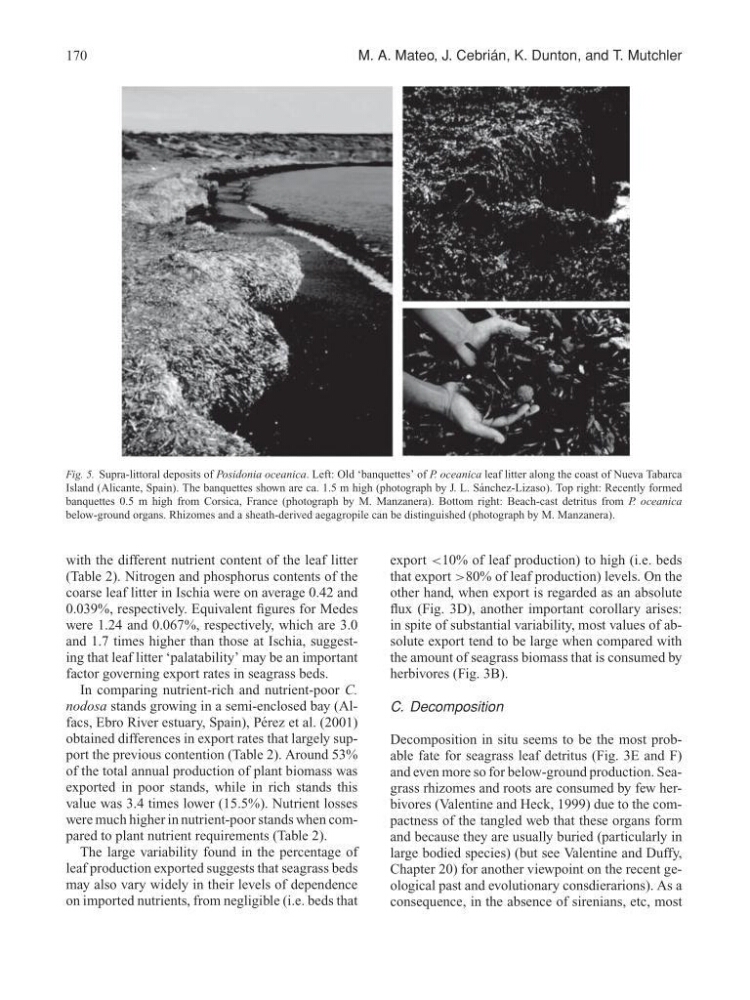
Fig. 5. Supra-littoral deposits of Posidonia oceanica. Left: Old ‘banquettes’ of P. oceanica leaf litter along the coast of Nueva Tabarca
Island (Alicante, Spain). The banquettes shown are ca. 1.5 m high (photograph by J. L. S´ anchez-Lizaso). Top right: Recently formed
banquettes 0.5 m high from Corsica, France (photograph by M. Manzanera). Bottom right: Beach-cast detritus from P. oceanica
below-ground organs. Rhizomes and a sheath-derived aegagropile can be distinguished (photograph by M. Manzanera).
with the different nutrient content of the leaf litter
(Table 2). Nitrogen and phosphorus contents of the
coarse leaf litter in Ischia were on average 0.42 and
0.039%, respectively. Equivalent figures for Medes
were 1.24 and 0.067%, respectively, which are 3.0
and 1.7 times higher than those at Ischia, suggesting that leaf litter ‘palatability’ may be an important
factor governing export rates in seagrass beds.
In comparing nutrient-rich and nutrient-poor C.
nodosa stands growing in a semi-enclosed bay (Alfacs, Ebro River estuary, Spain), P´ erez et al. (2001)
obtained differences in export rates that largely support the previous contention (Table 2). Around 53%
of the total annual production of plant biomass was
exported in poor stands, while in rich stands this
value was 3.4 times lower (15.5%). Nutrient losses
were much higher in nutrient-poor stands when compared to plant nutrient requirements (Table 2).
The large variability found in the percentage of
leaf production exported suggests that seagrass beds
may also vary widely in their levels of dependence
on imported nutrients, from negligible (i.e. beds that
export <10% of leaf production) to high (i.e. beds
that export >80% of leaf production) levels. On the
other hand, when export is regarded as an absolute
flux (Fig. 3D), another important corollary arises:
in spite of substantial variability, most values of absolute export tend to be large when compared with
the amount of seagrass biomass that is consumed by
herbivores (Fig. 3B).
C. Decomposition
Decomposition in situ seems to be the most probable fate for seagrass leaf detritus (Fig. 3E and F)
and even more so for below-ground production. Seagrass rhizomes and roots are consumed by few herbivores (Valentine and Heck, 1999) due to the compactness of the tangled web that these organs form
and because they are usually buried (particularly in
large bodied species) (but see Valentine and Duffy,
Chapter 20) for another viewpoint on the recent geological past and evolutionary consdierarions). As a
consequence, in the absence of sirenians, etc, most
M. A. Mateo, J. Cebri ´
an, K. Dunton, and T. Mutchler
Fig. 5. Supra-littoral deposits of Posidonia oceanica. Left: Old ‘banquettes’ of P. oceanica leaf litter along the coast of Nueva Tabarca
Island (Alicante, Spain). The banquettes shown are ca. 1.5 m high (photograph by J. L. S´ anchez-Lizaso). Top right: Recently formed
banquettes 0.5 m high from Corsica, France (photograph by M. Manzanera). Bottom right: Beach-cast detritus from P. oceanica
below-ground organs. Rhizomes and a sheath-derived aegagropile can be distinguished (photograph by M. Manzanera).
with the different nutrient content of the leaf litter
(Table 2). Nitrogen and phosphorus contents of the
coarse leaf litter in Ischia were on average 0.42 and
0.039%, respectively. Equivalent figures for Medes
were 1.24 and 0.067%, respectively, which are 3.0
and 1.7 times higher than those at Ischia, suggesting that leaf litter ‘palatability’ may be an important
factor governing export rates in seagrass beds.
In comparing nutrient-rich and nutrient-poor C.
nodosa stands growing in a semi-enclosed bay (Alfacs, Ebro River estuary, Spain), P´ erez et al. (2001)
obtained differences in export rates that largely support the previous contention (Table 2). Around 53%
of the total annual production of plant biomass was
exported in poor stands, while in rich stands this
value was 3.4 times lower (15.5%). Nutrient losses
were much higher in nutrient-poor stands when compared to plant nutrient requirements (Table 2).
The large variability found in the percentage of
leaf production exported suggests that seagrass beds
may also vary widely in their levels of dependence
on imported nutrients, from negligible (i.e. beds that
export <10% of leaf production) to high (i.e. beds
that export >80% of leaf production) levels. On the
other hand, when export is regarded as an absolute
flux (Fig. 3D), another important corollary arises:
in spite of substantial variability, most values of absolute export tend to be large when compared with
the amount of seagrass biomass that is consumed by
herbivores (Fig. 3B).
C. Decomposition
Decomposition in situ seems to be the most probable fate for seagrass leaf detritus (Fig. 3E and F)
and even more so for below-ground production. Seagrass rhizomes and roots are consumed by few herbivores (Valentine and Heck, 1999) due to the compactness of the tangled web that these organs form
and because they are usually buried (particularly in
large bodied species) (but see Valentine and Duffy,
Chapter 20) for another viewpoint on the recent geological past and evolutionary consdierarions). As a
consequence, in the absence of sirenians, etc, most