

Chapter 6 Seagrasses and Biogeochemistry
149
sediments. Sulfide is considered to be a phytotoxin as
it interferes with cytochromes in the electron transfer
chain in the plants and thus affects the energy balance
of the plants (Erskine and Koch, 2000; Koch et al.,
Chapter 8). A negative energy balance may eventually lead to increased mortality in the meadows. High
concentrations of sulfides have been suggested to be
responsible for large die-back events, in particular
in carbonate sediments with low buffering capacity – due to low pools of oxidized iron (Barber and
Carlson, 1993; Carlson et al., 1994). Experimental
studies with additions of sugar to the sediments to
enhance anoxia and sulfide concentrations are consistent with these observations; Terrados et al. (1999)
found reduced leaf growth and increased mortality
in tropical species growing on carbonate sediments
such as T. hemprichii, whereas temperate species
growing on terrigenic sediments such as C. nodosa
and Z. marina showed only a minor response. Recent
studies on carbonate sediments, however, show that
some seagrasses such as T. testudinum which have
been subjected to die-back events (Carlson et al.,
1994) are quite sulfide tolerant and only long-term
exposures to high concentrations lead to significant
die-back (Erskine and Koch, 2000). One possible explanation for this observation may be found in the
diurnal changes in sulfide concentrations in rhizosphere sediments of T. testudinum. Lower concentrations during the day (Lee and Dunton, 2000) suggest that the sulfide exposure is less during the day
due to photosynthetically-driven release of oxygen
from the roots (Section II.D).
The finding by Pedersen et al. (1998) of an oxic
microzone around the roots also during the night
suggests that some seagrasses tranport oxygen out
of the roots even in the dark and that these plants
are exposed to high sulfide concentrations only under extreme conditions, e.g. if the sulfide production in the sediments is unusually high and exceeds
the oxidation capacity from the root related oxygen
translocation. Sulfide concentrations may also increase during night if oxygen is depleted in the water
column due to high respiratory activity in the seagrass meadow or during calm wind conditions with
low water exchange. If no oxygen is present in the
water column the oxygen translocation to the roots
will be limited to the active photosynthetic period. Z.
marina was found to die during prolonged exposure
to low oxygen concentrations in the water column,
and the die-back was of similar magnitude as exposure to water column sulfide suggesting that anoxia
was just as critical as the presence of sulfide (Holmer
and Bondgaard, 2001). This is consistent with findings by Greve et al. (2003) that anoxic conditions
around Z. marina plant leads to degradation of cells
in the meristematic region and plant death. The dieoff is exaggerated as water temperature increases
suggesting that a number of factors may contribute
to the die-back events observed in nature.
During anoxic conditions sulfide has been found
inside the meristematic region of T. testudinum, and
this had an immediate detrimental effect on the seagrasses (Borum et al., Chapter 10). The plants were
only able to survive if sulfide was rapidly reoxidized,
e.g. by onset of photosynthesis by dawn. This suggests that seagrasses are able to survive short periods
of sulfide exposure as long as oxygen is present in
the water column or is produced by the plant itself.
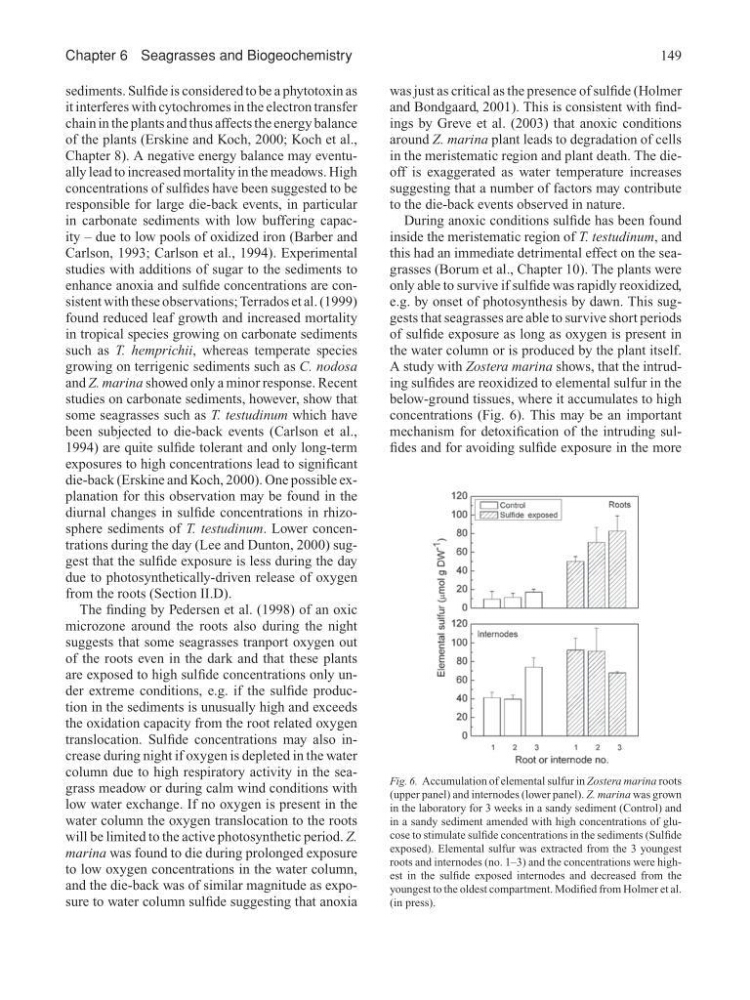
A study with Zostera marina shows, that the intruding sulfides are reoxidized to elemental sulfur in the
below-ground tissues, where it accumulates to high
concentrations (Fig. 6). This may be an important
mechanism for detoxification of the intruding sulfides and for avoiding sulfide exposure in the more
Fig. 6. Accumulation of elemental sulfur in Zostera marina roots
(upper panel) and internodes (lower panel). Z. marina was grown
in the laboratory for 3 weeks in a sandy sediment (Control) and
in a sandy sediment amended with high concentrations of glucose to stimulate sulfide concentrations in the sediments (Sulfide
exposed). Elemental sulfur was extracted from the 3 youngest
roots and internodes (no. 1–3) and the concentrations were highest in the sulfide exposed internodes and decreased from the
youngest to the oldest compartment. Modified from Holmer et al.
(in press).
149
sediments. Sulfide is considered to be a phytotoxin as
it interferes with cytochromes in the electron transfer
chain in the plants and thus affects the energy balance
of the plants (Erskine and Koch, 2000; Koch et al.,
Chapter 8). A negative energy balance may eventually lead to increased mortality in the meadows. High
concentrations of sulfides have been suggested to be
responsible for large die-back events, in particular
in carbonate sediments with low buffering capacity – due to low pools of oxidized iron (Barber and
Carlson, 1993; Carlson et al., 1994). Experimental
studies with additions of sugar to the sediments to
enhance anoxia and sulfide concentrations are consistent with these observations; Terrados et al. (1999)
found reduced leaf growth and increased mortality
in tropical species growing on carbonate sediments
such as T. hemprichii, whereas temperate species
growing on terrigenic sediments such as C. nodosa
and Z. marina showed only a minor response. Recent
studies on carbonate sediments, however, show that
some seagrasses such as T. testudinum which have
been subjected to die-back events (Carlson et al.,
1994) are quite sulfide tolerant and only long-term
exposures to high concentrations lead to significant
die-back (Erskine and Koch, 2000). One possible explanation for this observation may be found in the
diurnal changes in sulfide concentrations in rhizosphere sediments of T. testudinum. Lower concentrations during the day (Lee and Dunton, 2000) suggest that the sulfide exposure is less during the day
due to photosynthetically-driven release of oxygen
from the roots (Section II.D).
The finding by Pedersen et al. (1998) of an oxic
microzone around the roots also during the night
suggests that some seagrasses tranport oxygen out
of the roots even in the dark and that these plants
are exposed to high sulfide concentrations only under extreme conditions, e.g. if the sulfide production in the sediments is unusually high and exceeds
the oxidation capacity from the root related oxygen
translocation. Sulfide concentrations may also increase during night if oxygen is depleted in the water
column due to high respiratory activity in the seagrass meadow or during calm wind conditions with
low water exchange. If no oxygen is present in the
water column the oxygen translocation to the roots
will be limited to the active photosynthetic period. Z.
marina was found to die during prolonged exposure
to low oxygen concentrations in the water column,
and the die-back was of similar magnitude as exposure to water column sulfide suggesting that anoxia
was just as critical as the presence of sulfide (Holmer
and Bondgaard, 2001). This is consistent with findings by Greve et al. (2003) that anoxic conditions
around Z. marina plant leads to degradation of cells
in the meristematic region and plant death. The dieoff is exaggerated as water temperature increases
suggesting that a number of factors may contribute
to the die-back events observed in nature.
During anoxic conditions sulfide has been found
inside the meristematic region of T. testudinum, and
this had an immediate detrimental effect on the seagrasses (Borum et al., Chapter 10). The plants were
only able to survive if sulfide was rapidly reoxidized,
e.g. by onset of photosynthesis by dawn. This suggests that seagrasses are able to survive short periods
of sulfide exposure as long as oxygen is present in
the water column or is produced by the plant itself.
A study with Zostera marina shows, that the intruding sulfides are reoxidized to elemental sulfur in the
below-ground tissues, where it accumulates to high
concentrations (Fig. 6). This may be an important
mechanism for detoxification of the intruding sulfides and for avoiding sulfide exposure in the more
Fig. 6. Accumulation of elemental sulfur in Zostera marina roots
(upper panel) and internodes (lower panel). Z. marina was grown
in the laboratory for 3 weeks in a sandy sediment (Control) and
in a sandy sediment amended with high concentrations of glucose to stimulate sulfide concentrations in the sediments (Sulfide
exposed). Elemental sulfur was extracted from the 3 youngest
roots and internodes (no. 1–3) and the concentrations were highest in the sulfide exposed internodes and decreased from the
youngest to the oldest compartment. Modified from Holmer et al.
(in press).