

Chapter 5 Seagrass Seeds and Dispersal Strategies
125
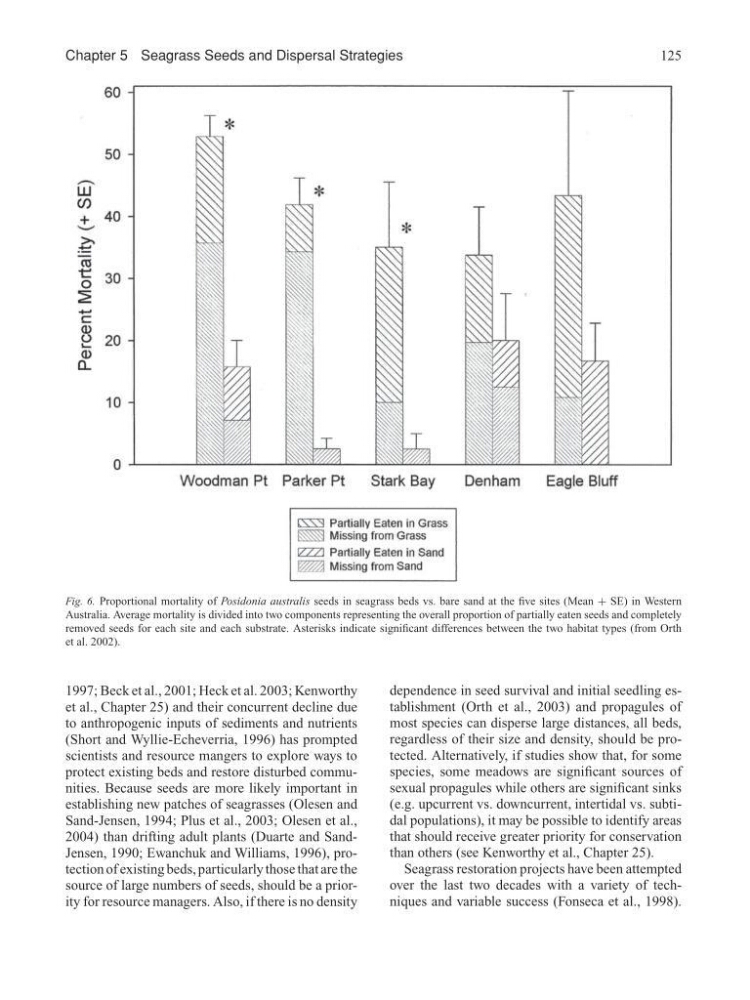
Fig. 6. Proportional mortality of Posidonia australis seeds in seagrass beds vs. bare sand at the five sites (Mean + SE) in Western
Australia. Average mortality is divided into two components representing the overall proportion of partially eaten seeds and completely
removed seeds for each site and each substrate. Asterisks indicate significant differences between the two habitat types (from Orth
et al. 2002).
1997; Beck et al., 2001; Heck et al. 2003; Kenworthy
et al., Chapter 25) and their concurrent decline due
to anthropogenic inputs of sediments and nutrients
(Short and Wyllie-Echeverria, 1996) has prompted
scientists and resource mangers to explore ways to
protect existing beds and restore disturbed communities. Because seeds are more likely important in
establishing new patches of seagrasses (Olesen and
Sand-Jensen, 1994; Plus et al., 2003; Olesen et al.,
2004) than drifting adult plants (Duarte and SandJensen, 1990; Ewanchuk and Williams, 1996), protection of existing beds, particularly those that are the
source of large numbers of seeds, should be a priority for resource managers. Also, if there is no density
dependence in seed survival and initial seedling establishment (Orth et al., 2003) and propagules of
most species can disperse large distances, all beds,
regardless of their size and density, should be protected. Alternatively, if studies show that, for some
species, some meadows are significant sources of
sexual propagules while others are significant sinks
(e.g. upcurrent vs. downcurrent, intertidal vs. subtidal populations), it may be possible to identify areas
that should receive greater priority for conservation
than others (see Kenworthy et al., Chapter 25).
Seagrass restoration projects have been attempted
over the last two decades with a variety of techniques and variable success (Fonseca et al., 1998).
125
Fig. 6. Proportional mortality of Posidonia australis seeds in seagrass beds vs. bare sand at the five sites (Mean + SE) in Western
Australia. Average mortality is divided into two components representing the overall proportion of partially eaten seeds and completely
removed seeds for each site and each substrate. Asterisks indicate significant differences between the two habitat types (from Orth
et al. 2002).
1997; Beck et al., 2001; Heck et al. 2003; Kenworthy
et al., Chapter 25) and their concurrent decline due
to anthropogenic inputs of sediments and nutrients
(Short and Wyllie-Echeverria, 1996) has prompted
scientists and resource mangers to explore ways to
protect existing beds and restore disturbed communities. Because seeds are more likely important in
establishing new patches of seagrasses (Olesen and
Sand-Jensen, 1994; Plus et al., 2003; Olesen et al.,
2004) than drifting adult plants (Duarte and SandJensen, 1990; Ewanchuk and Williams, 1996), protection of existing beds, particularly those that are the
source of large numbers of seeds, should be a priority for resource managers. Also, if there is no density
dependence in seed survival and initial seedling establishment (Orth et al., 2003) and propagules of
most species can disperse large distances, all beds,
regardless of their size and density, should be protected. Alternatively, if studies show that, for some
species, some meadows are significant sources of
sexual propagules while others are significant sinks
(e.g. upcurrent vs. downcurrent, intertidal vs. subtidal populations), it may be possible to identify areas
that should receive greater priority for conservation
than others (see Kenworthy et al., Chapter 25).
Seagrass restoration projects have been attempted
over the last two decades with a variety of techniques and variable success (Fonseca et al., 1998).