

124
R. J. Orth, M. C. Harwell and G. J. Inglis
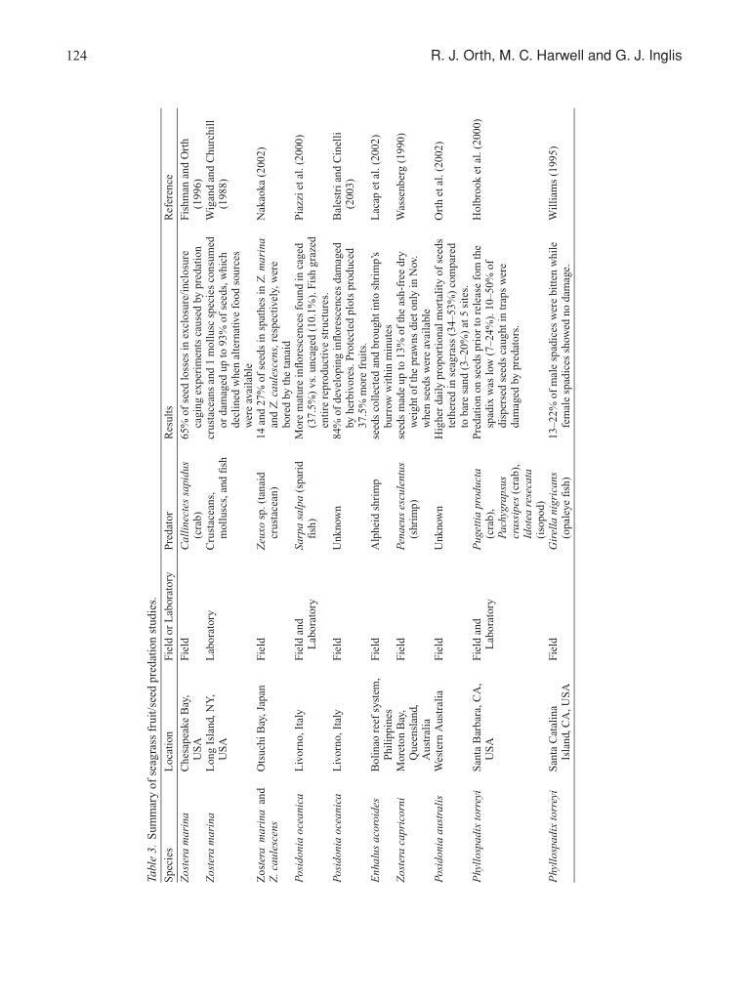
Table 3. Summary of seagrass fruit/seed predation studies.
Species
Location
Field or Laboratory
Predator
Results
Reference
Zostera marina
Chesapeake Bay,
USA
Field
Callinectes sapidus
(crab)
65% of seed losses in exclosure/inclosure
caging experiments caused by predation
Fishman and Orth
(1996)
Zostera marina
Long Island, NY,
USA
Laboratory
Crustaceans,
molluscs, and fish
crustaceans and 1 mollusc species consumed
or damaged up to 93% of seeds, which
declined when alternative food sources
were available
Wigand and Churchill
(1988)
Zostera marina and
Z. caulescens
Otsuchi Bay, Japan
Field
Zeuxo sp. (tanaid
crustacean)
14 and 27% of seeds in spathes in Z. marina
and Z. caulescens, respectively, were
bored by the tanaid
Nakaoka (2002)
Posidonia oceanica
Livorno, Italy
Field and
Laboratory
Sarpa salpa (sparid
fish)
More mature inflorescences found in caged
(37.5%) vs. uncaged (10.1%). Fish grazed
entire reproductive structures.
Piazzi et al. (2000)
Posidonia oceanica
Livorno, Italy
Field
Unknown
84% of developing inflorescences damaged
by herbivores. Protected plots produced
37.5% more fruits.
Balestri and Cinelli
(2003)
Enhalus acoroides
Bolinao reef system,
Philippines
Field
Alpheid shrimp
seeds collected and brought into shrimp’s
burrow within minutes
Lacap et al. (2002)
Zostera capricorni
Moreton Bay,
Queensland,
Australia
Field
Penaeus esculentus
(shrimp)
seeds made up to 13% of the ash-free dry
weight of the prawns diet only in Nov.
when seeds were available
Wassenberg (1990)
Posidonia australis
Western Australia
Field
Unknown
Higher daily proportional mortality of seeds
tethered in seagrass (34–53%) compared
to bare sand (3–20%) at 5 sites.
Orth et al. (2002)
Phyllospadix torreyi
Santa Barbara, CA,
USA
Field and
Laboratory
Pugettia producta
(crab),
Pachygrapsus
crassipes (crab),
Idotea resecata
(isopod)
Predation on seeds prior to release fom the
spadix was low (7–24%). 10–50% of
dispersed seeds caught in traps were
damaged by predators.
Holbrook et al. (2000)
Phyllospadix torreyi
Santa Catalina
Island, CA, USA
Field
Girella nigricans
(opaleye fish)
13–22% of male spadices were bitten while
female spadices showed no damage.
Williams (1995)
R. J. Orth, M. C. Harwell and G. J. Inglis
Table 3. Summary of seagrass fruit/seed predation studies.
Species
Location
Field or Laboratory
Predator
Results
Reference
Zostera marina
Chesapeake Bay,
USA
Field
Callinectes sapidus
(crab)
65% of seed losses in exclosure/inclosure
caging experiments caused by predation
Fishman and Orth
(1996)
Zostera marina
Long Island, NY,
USA
Laboratory
Crustaceans,
molluscs, and fish
crustaceans and 1 mollusc species consumed
or damaged up to 93% of seeds, which
declined when alternative food sources
were available
Wigand and Churchill
(1988)
Zostera marina and
Z. caulescens
Otsuchi Bay, Japan
Field
Zeuxo sp. (tanaid
crustacean)
14 and 27% of seeds in spathes in Z. marina
and Z. caulescens, respectively, were
bored by the tanaid
Nakaoka (2002)
Posidonia oceanica
Livorno, Italy
Field and
Laboratory
Sarpa salpa (sparid
fish)
More mature inflorescences found in caged
(37.5%) vs. uncaged (10.1%). Fish grazed
entire reproductive structures.
Piazzi et al. (2000)
Posidonia oceanica
Livorno, Italy
Field
Unknown
84% of developing inflorescences damaged
by herbivores. Protected plots produced
37.5% more fruits.
Balestri and Cinelli
(2003)
Enhalus acoroides
Bolinao reef system,
Philippines
Field
Alpheid shrimp
seeds collected and brought into shrimp’s
burrow within minutes
Lacap et al. (2002)
Zostera capricorni
Moreton Bay,
Queensland,
Australia
Field
Penaeus esculentus
(shrimp)
seeds made up to 13% of the ash-free dry
weight of the prawns diet only in Nov.
when seeds were available
Wassenberg (1990)
Posidonia australis
Western Australia
Field
Unknown
Higher daily proportional mortality of seeds
tethered in seagrass (34–53%) compared
to bare sand (3–20%) at 5 sites.
Orth et al. (2002)
Phyllospadix torreyi
Santa Barbara, CA,
USA
Field and
Laboratory
Pugettia producta
(crab),
Pachygrapsus
crassipes (crab),
Idotea resecata
(isopod)
Predation on seeds prior to release fom the
spadix was low (7–24%). 10–50% of
dispersed seeds caught in traps were
damaged by predators.
Holbrook et al. (2000)
Phyllospadix torreyi
Santa Catalina
Island, CA, USA
Field
Girella nigricans
(opaleye fish)
13–22% of male spadices were bitten while
female spadices showed no damage.
Williams (1995)