

100
Josef Daniel Ackerman
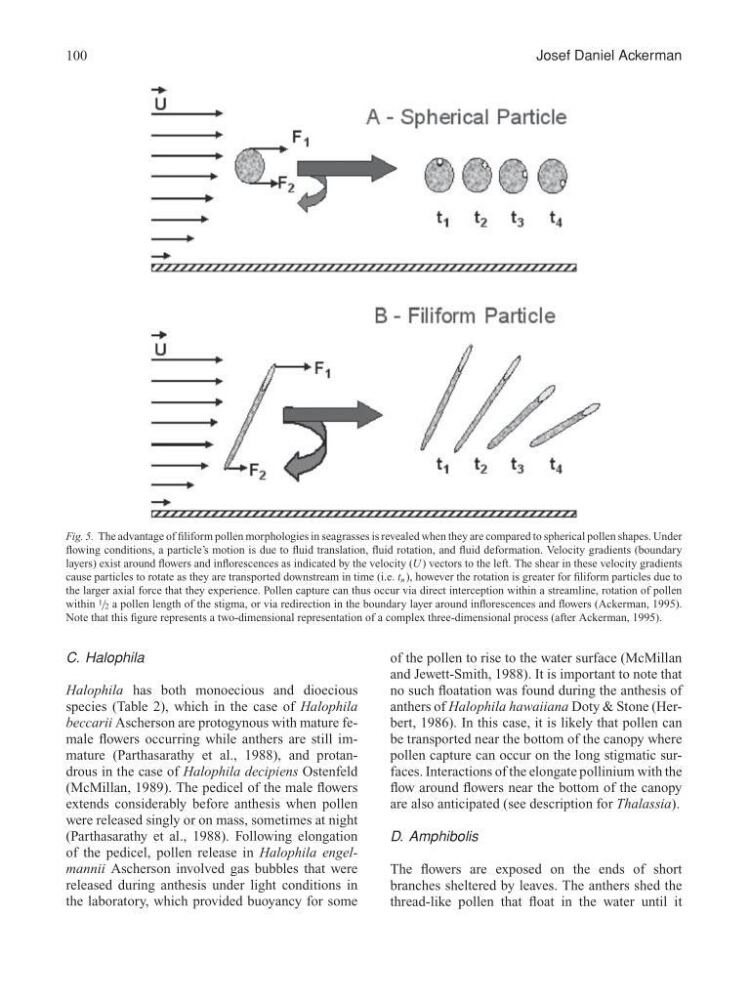
Fig. 5. The advantage of filiform pollen morphologies in seagrasses is revealed when they are compared to spherical pollen shapes. Under
flowing conditions, a particle’s motion is due to fluid translation, fluid rotation, and fluid deformation. Velocity gradients (boundary
layers) exist around flowers and inflorescences as indicated by the velocity (U ) vectors to the left. The shear in these velocity gradients
cause particles to rotate as they are transported downstream in time (i.e. t n ), however the rotation is greater for filiform particles due to
the larger axial force that they experience. Pollen capture can thus occur via direct interception within a streamline, rotation of pollen
within 1 /2 a pollen length of the stigma, or via redirection in the boundary layer around inflorescences and flowers (Ackerman, 1995).
Note that this figure represents a two-dimensional representation of a complex three-dimensional process (after Ackerman, 1995).
C. Halophila
Halophila has both monoecious and dioecious
species (Table 2), which in the case of Halophila
beccarii Ascherson are protogynous with mature female flowers occurring while anthers are still immature (Parthasarathy et al., 1988), and protandrous in the case of Halophila decipiens Ostenfeld
(McMillan, 1989). The pedicel of the male flowers
extends considerably before anthesis when pollen
were released singly or on mass, sometimes at night
(Parthasarathy et al., 1988). Following elongation
of the pedicel, pollen release in Halophila engelmannii Ascherson involved gas bubbles that were
released during anthesis under light conditions in
the laboratory, which provided buoyancy for some
of the pollen to rise to the water surface (McMillan
and Jewett-Smith, 1988). It is important to note that
no such floatation was found during the anthesis of
anthers of Halophila hawaiiana Doty & Stone (Herbert, 1986). In this case, it is likely that pollen can
be transported near the bottom of the canopy where
pollen capture can occur on the long stigmatic surfaces. Interactions of the elongate pollinium with the
flow around flowers near the bottom of the canopy
are also anticipated (see description for Thalassia).
D. Amphibolis
The flowers are exposed on the ends of short
branches sheltered by leaves. The anthers shed the
thread-like pollen that float in the water until it
Josef Daniel Ackerman
Fig. 5. The advantage of filiform pollen morphologies in seagrasses is revealed when they are compared to spherical pollen shapes. Under
flowing conditions, a particle’s motion is due to fluid translation, fluid rotation, and fluid deformation. Velocity gradients (boundary
layers) exist around flowers and inflorescences as indicated by the velocity (U ) vectors to the left. The shear in these velocity gradients
cause particles to rotate as they are transported downstream in time (i.e. t n ), however the rotation is greater for filiform particles due to
the larger axial force that they experience. Pollen capture can thus occur via direct interception within a streamline, rotation of pollen
within 1 /2 a pollen length of the stigma, or via redirection in the boundary layer around inflorescences and flowers (Ackerman, 1995).
Note that this figure represents a two-dimensional representation of a complex three-dimensional process (after Ackerman, 1995).
C. Halophila
Halophila has both monoecious and dioecious
species (Table 2), which in the case of Halophila
beccarii Ascherson are protogynous with mature female flowers occurring while anthers are still immature (Parthasarathy et al., 1988), and protandrous in the case of Halophila decipiens Ostenfeld
(McMillan, 1989). The pedicel of the male flowers
extends considerably before anthesis when pollen
were released singly or on mass, sometimes at night
(Parthasarathy et al., 1988). Following elongation
of the pedicel, pollen release in Halophila engelmannii Ascherson involved gas bubbles that were
released during anthesis under light conditions in
the laboratory, which provided buoyancy for some
of the pollen to rise to the water surface (McMillan
and Jewett-Smith, 1988). It is important to note that
no such floatation was found during the anthesis of
anthers of Halophila hawaiiana Doty & Stone (Herbert, 1986). In this case, it is likely that pollen can
be transported near the bottom of the canopy where
pollen capture can occur on the long stigmatic surfaces. Interactions of the elongate pollinium with the
flow around flowers near the bottom of the canopy
are also anticipated (see description for Thalassia).
D. Amphibolis
The flowers are exposed on the ends of short
branches sheltered by leaves. The anthers shed the
thread-like pollen that float in the water until it