

Chapter 4 Seagrass Sexual Reproduction
99
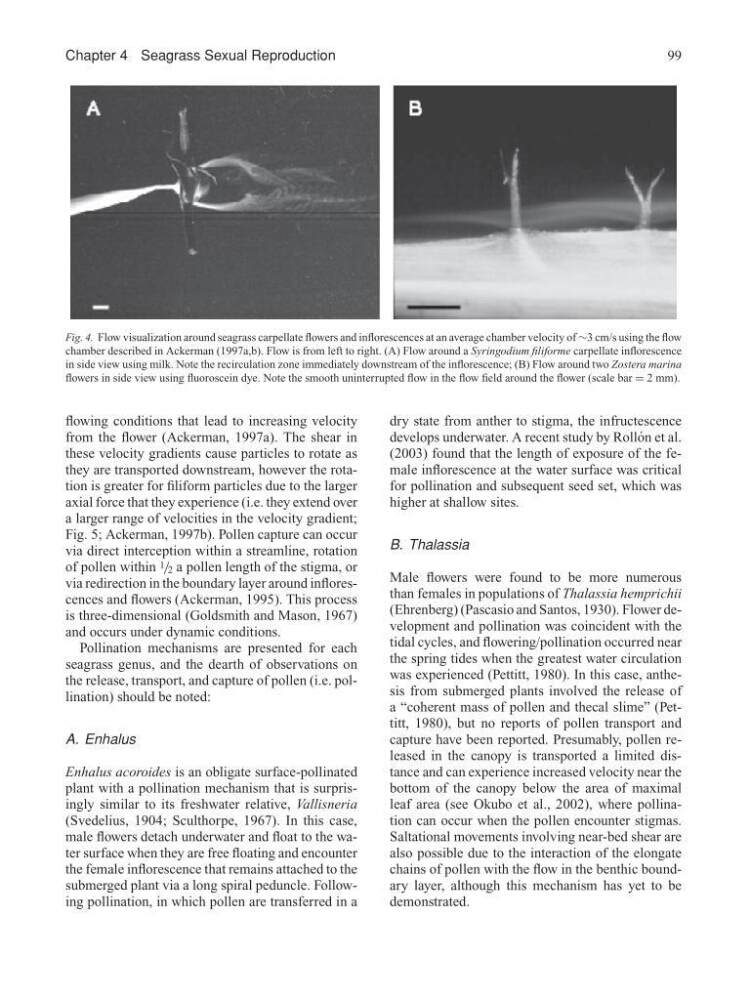
Fig. 4. Flow visualization around seagrass carpellate flowers and inflorescences at an average chamber velocity of ∼3 cm/s using the flow
chamber described in Ackerman (1997a,b). Flow is from left to right. (A) Flow around a Syringodium filiforme carpellate inflorescence
in side view using milk. Note the recirculation zone immediately downstream of the inflorescence; (B) Flow around two Zostera marina
flowers in side view using fluoroscein dye. Note the smooth uninterrupted flow in the flow field around the flower (scale bar = 2 mm).
flowing conditions that lead to increasing velocity
from the flower (Ackerman, 1997a). The shear in
these velocity gradients cause particles to rotate as
they are transported downstream, however the rotation is greater for filiform particles due to the larger
axial force that they experience (i.e. they extend over
a larger range of velocities in the velocity gradient;
Fig. 5; Ackerman, 1997b). Pollen capture can occur
via direct interception within a streamline, rotation
of pollen within 1 / 2 a pollen length of the stigma, or
via redirection in the boundary layer around inflorescences and flowers (Ackerman, 1995). This process
is three-dimensional (Goldsmith and Mason, 1967)
and occurs under dynamic conditions.
Pollination mechanisms are presented for each
seagrass genus, and the dearth of observations on
the release, transport, and capture of pollen (i.e. pollination) should be noted:
A. Enhalus
Enhalus acoroides is an obligate surface-pollinated
plant with a pollination mechanism that is surprisingly similar to its freshwater relative, Vallisneria
(Svedelius, 1904; Sculthorpe, 1967). In this case,
male flowers detach underwater and float to the water surface when they are free floating and encounter
the female inflorescence that remains attached to the
submerged plant via a long spiral peduncle. Following pollination, in which pollen are transferred in a
dry state from anther to stigma, the infructescence
develops underwater. A recent study by Roll´ on et al.
(2003) found that the length of exposure of the female inflorescence at the water surface was critical
for pollination and subsequent seed set, which was
higher at shallow sites.
B. Thalassia
Male flowers were found to be more numerous
than females in populations of Thalassia hemprichii
(Ehrenberg) (Pascasio and Santos, 1930). Flower development and pollination was coincident with the
tidal cycles, and flowering/pollination occurred near
the spring tides when the greatest water circulation
was experienced (Pettitt, 1980). In this case, anthesis from submerged plants involved the release of
a “coherent mass of pollen and thecal slime” (Pettitt, 1980), but no reports of pollen transport and
capture have been reported. Presumably, pollen released in the canopy is transported a limited distance and can experience increased velocity near the
bottom of the canopy below the area of maximal
leaf area (see Okubo et al., 2002), where pollination can occur when the pollen encounter stigmas.
Saltational movements involving near-bed shear are
also possible due to the interaction of the elongate
chains of pollen with the flow in the benthic boundary layer, although this mechanism has yet to be
demonstrated.
99
Fig. 4. Flow visualization around seagrass carpellate flowers and inflorescences at an average chamber velocity of ∼3 cm/s using the flow
chamber described in Ackerman (1997a,b). Flow is from left to right. (A) Flow around a Syringodium filiforme carpellate inflorescence
in side view using milk. Note the recirculation zone immediately downstream of the inflorescence; (B) Flow around two Zostera marina
flowers in side view using fluoroscein dye. Note the smooth uninterrupted flow in the flow field around the flower (scale bar = 2 mm).
flowing conditions that lead to increasing velocity
from the flower (Ackerman, 1997a). The shear in
these velocity gradients cause particles to rotate as
they are transported downstream, however the rotation is greater for filiform particles due to the larger
axial force that they experience (i.e. they extend over
a larger range of velocities in the velocity gradient;
Fig. 5; Ackerman, 1997b). Pollen capture can occur
via direct interception within a streamline, rotation
of pollen within 1 / 2 a pollen length of the stigma, or
via redirection in the boundary layer around inflorescences and flowers (Ackerman, 1995). This process
is three-dimensional (Goldsmith and Mason, 1967)
and occurs under dynamic conditions.
Pollination mechanisms are presented for each
seagrass genus, and the dearth of observations on
the release, transport, and capture of pollen (i.e. pollination) should be noted:
A. Enhalus
Enhalus acoroides is an obligate surface-pollinated
plant with a pollination mechanism that is surprisingly similar to its freshwater relative, Vallisneria
(Svedelius, 1904; Sculthorpe, 1967). In this case,
male flowers detach underwater and float to the water surface when they are free floating and encounter
the female inflorescence that remains attached to the
submerged plant via a long spiral peduncle. Following pollination, in which pollen are transferred in a
dry state from anther to stigma, the infructescence
develops underwater. A recent study by Roll´ on et al.
(2003) found that the length of exposure of the female inflorescence at the water surface was critical
for pollination and subsequent seed set, which was
higher at shallow sites.
B. Thalassia
Male flowers were found to be more numerous
than females in populations of Thalassia hemprichii
(Ehrenberg) (Pascasio and Santos, 1930). Flower development and pollination was coincident with the
tidal cycles, and flowering/pollination occurred near
the spring tides when the greatest water circulation
was experienced (Pettitt, 1980). In this case, anthesis from submerged plants involved the release of
a “coherent mass of pollen and thecal slime” (Pettitt, 1980), but no reports of pollen transport and
capture have been reported. Presumably, pollen released in the canopy is transported a limited distance and can experience increased velocity near the
bottom of the canopy below the area of maximal
leaf area (see Okubo et al., 2002), where pollination can occur when the pollen encounter stigmas.
Saltational movements involving near-bed shear are
also possible due to the interaction of the elongate
chains of pollen with the flow in the benthic boundary layer, although this mechanism has yet to be
demonstrated.