

58
R.H. Charlier and Th. Lonhienne
= 10 6 _10 7 cells I I
•
= 10 5 -10 6 cells/l
•
= < 10 5 cellsll
Occasional occurrence
@
= 10 5 - 10 6 cells II
= < 10 5 cells/I
= sporadic
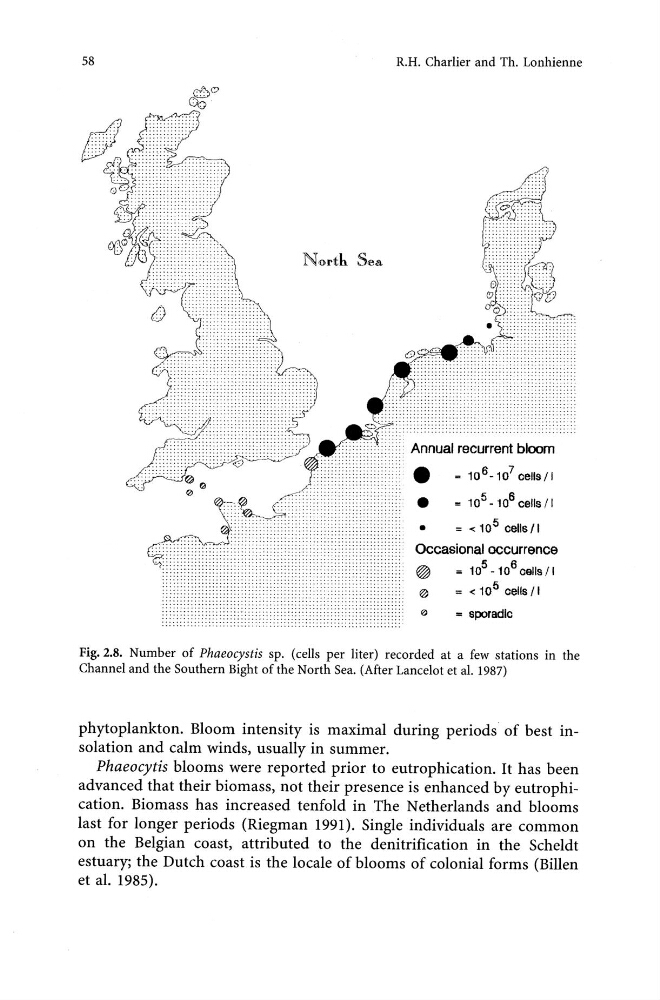
Fig. 2.8. Number of Phaeocystis sp. (cells per liter) recorded at a few stations in the
Channel and the Southern Bight of the North Sea. (After Lancelot et al. 1987)
phytoplankton. Bloom intensity is maximal during periods of best insolation and calm winds, usually in summer.
Phaeocytis blooms were reported prior to eutrophication. It has been
advanced that their biomass, not their presence is enhanced by eutrophication. Biomass has increased tenfold in The Netherlands and blooms
last for longer periods (Riegman 1991). Single individuals are common
on the Belgian coast, attributed to the denitrification in the ScheIdt
estuary; the Dutch coast is the locale of blooms of colonial forms (Billen
et al. 1985).
R.H. Charlier and Th. Lonhienne
= 10 6 _10 7 cells I I
•
= 10 5 -10 6 cells/l
•
= < 10 5 cellsll
Occasional occurrence
@
= 10 5 - 10 6 cells II
= < 10 5 cells/I
= sporadic
Fig. 2.8. Number of Phaeocystis sp. (cells per liter) recorded at a few stations in the
Channel and the Southern Bight of the North Sea. (After Lancelot et al. 1987)
phytoplankton. Bloom intensity is maximal during periods of best insolation and calm winds, usually in summer.
Phaeocytis blooms were reported prior to eutrophication. It has been
advanced that their biomass, not their presence is enhanced by eutrophication. Biomass has increased tenfold in The Netherlands and blooms
last for longer periods (Riegman 1991). Single individuals are common
on the Belgian coast, attributed to the denitrification in the ScheIdt
estuary; the Dutch coast is the locale of blooms of colonial forms (Billen
et al. 1985).