

452
seagrasses
macroalgae
phytoplankton
seagrasses
macroalgae
phytoplankton
t
.~
~
~
.-cJ.
0.001 0.1
10
1000
0
0.1
10
photosynthetic capacity
growth rate
(mg C gC" h" )
jdoublings daY" )
photosynthesis
{!}
growth
*
~
I~
~ .
0.1
10
1000
0.1
1.0
10
100
compensation irradiance
(~mol m·2 s·')
W. Schramm
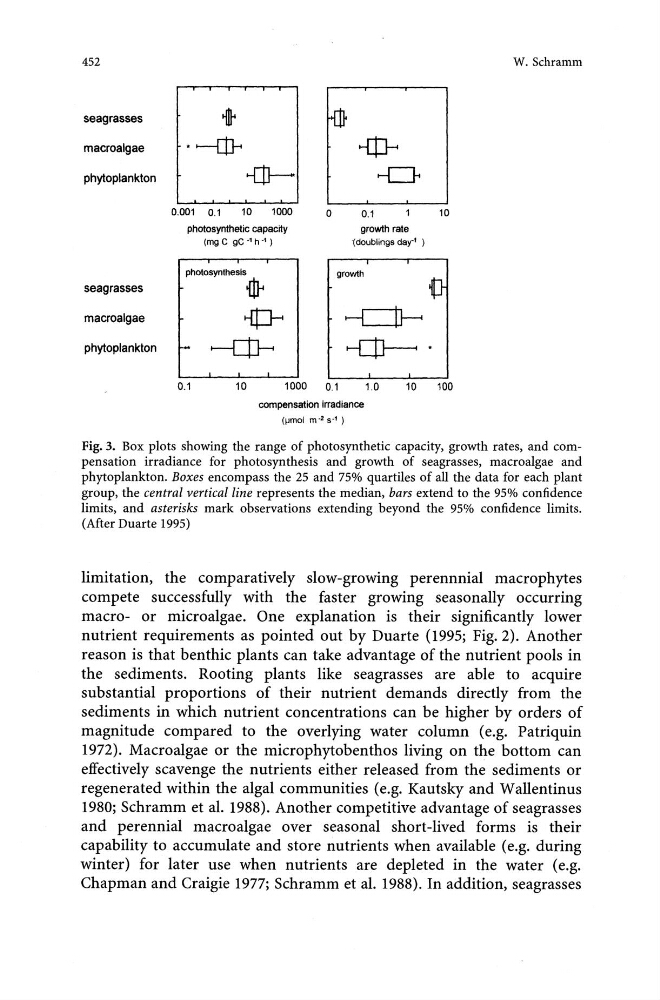
Fig. 3. Box plots showing the range of photosynthetic capacity, growth rates, and compensation irradiance for photosynthesis and growth of seagrasses, macroalgae and
phytoplankton. Boxes encompass the 25 and 75% quartiles of all the data for each plant
group, the central vertical line represents the median, bars extend to the 95% confidence
limits, and asterisks mark observations extending beyond the 95% confidence limits.
(After Duarte 1995)
limitation, the comparatively slow-growing perennnial macrophytes
compete successfully with the faster growing seasonally occurring
macro- or micro algae. One explanation is their significantly lower
nutrient requirements as pointed out by Duarte (1995; Fig. 2). Another
reason is that benthic plants can take advantage of the nutrient pools in
the sediments. Rooting plants like seagrasses are able to acquire
substantial proportions of their nutrient demands directly from the
sediments in which nutrient concentrations can be higher by orders of
magnitude compared to the overlying water column (e.g. Patriquin
1972). Macroalgae or the microphytobenthos living on the bottom can
effectively scavenge the nutrients either released from the sediments or
regenerated within the algal communities (e.g. Kautsky and Wallentinus
1980; Schramm et al. 1988). Another competitive advantage of seagrasses
and perennial macro algae over seasonal short-lived forms is their
capability to accumulate and store nutrients when available (e.g. during
winter) for later use when nutrients are depleted in the water (e.g.
Chapman and Craigie 1977; Schramm et al. 1988). In addition, seagrasses
seagrasses
macroalgae
phytoplankton
seagrasses
macroalgae
phytoplankton
t
.~
~
~
.-cJ.
0.001 0.1
10
1000
0
0.1
10
photosynthetic capacity
growth rate
(mg C gC" h" )
jdoublings daY" )
photosynthesis
{!}
growth
*
~
I~
~ .
0.1
10
1000
0.1
1.0
10
100
compensation irradiance
(~mol m·2 s·')
W. Schramm
Fig. 3. Box plots showing the range of photosynthetic capacity, growth rates, and compensation irradiance for photosynthesis and growth of seagrasses, macroalgae and
phytoplankton. Boxes encompass the 25 and 75% quartiles of all the data for each plant
group, the central vertical line represents the median, bars extend to the 95% confidence
limits, and asterisks mark observations extending beyond the 95% confidence limits.
(After Duarte 1995)
limitation, the comparatively slow-growing perennnial macrophytes
compete successfully with the faster growing seasonally occurring
macro- or micro algae. One explanation is their significantly lower
nutrient requirements as pointed out by Duarte (1995; Fig. 2). Another
reason is that benthic plants can take advantage of the nutrient pools in
the sediments. Rooting plants like seagrasses are able to acquire
substantial proportions of their nutrient demands directly from the
sediments in which nutrient concentrations can be higher by orders of
magnitude compared to the overlying water column (e.g. Patriquin
1972). Macroalgae or the microphytobenthos living on the bottom can
effectively scavenge the nutrients either released from the sediments or
regenerated within the algal communities (e.g. Kautsky and Wallentinus
1980; Schramm et al. 1988). Another competitive advantage of seagrasses
and perennial macro algae over seasonal short-lived forms is their
capability to accumulate and store nutrients when available (e.g. during
winter) for later use when nutrients are depleted in the water (e.g.
Chapman and Craigie 1977; Schramm et al. 1988). In addition, seagrasses