

Conclusions
451
often an increase in unattached or free-floating macro algae can be
observed.
With further increasing nutrient loads towards hypertrophic conditions in phase III, free-floating macroalgae, in particular "green tide"forming taxa (e.g. VIva, Monostroma, Enteromorpha spp.) alternating
with heavy uncontrolled phytoplankton blooms, dominate and more or
less completely replace the perennial and slow-growing benthic macrophytes. Finally, in phase IV under hypertrophic conditions with continuously high nutrient concentrations, phytoplankton constitute the
dominant primary producers.
The first step in the eutrophication process, i.e. the increasing occurrence of seasonal fast-growing nutrient opportunists is without question
a direct effect of increasing nutrient loads. It can be explained by the
specific nutrient economy of these forms, i.e. by their ability to take up
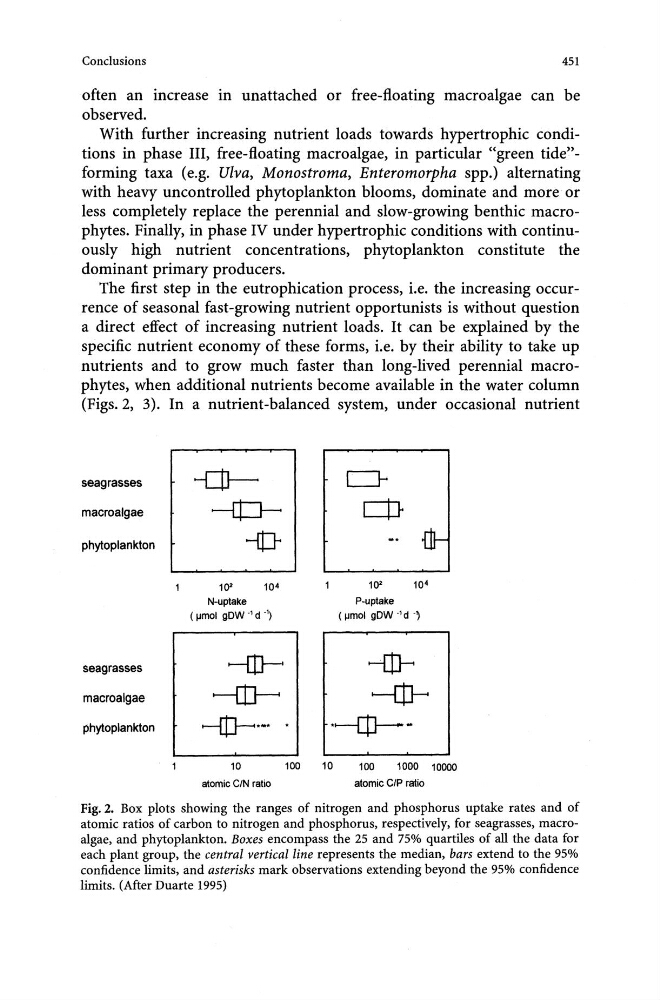
nutrients and to grow much faster than long-lived perennial macrophytes, when additional nutrients become available in the water column
{Figs. 2, 3). In a nutrient-balanced system, under occasional nutrient
seagrasses
macroalgae
phytoplankton
seagrasses
macroalgae
phytoplankton
104
N-uptake
(Ilmol gOW -, d -')
--[J-~
--m-----... .
10
atomic C/N ratio
100
10
1()2
P-uptake
(Ilmol gOW -, d -}
100
1000 10000
atomic C/P ratio
Fig. 2. Box plots showing the ranges of nitrogen and phosphorus uptake rates and of
atomic ratios of carbon to nitrogen and phosphorus, respectively, for seagrasses, macroalgae, and phytoplankton. Boxes encompass the 25 and 75% quartiles of all the data for
each plant group, the central vertical line represents the median, bars extend to the 95%
confidence limits, and asterisks mark observations extending beyond the 95% confidence
limits. (After Duarte 1995)
451
often an increase in unattached or free-floating macro algae can be
observed.
With further increasing nutrient loads towards hypertrophic conditions in phase III, free-floating macroalgae, in particular "green tide"forming taxa (e.g. VIva, Monostroma, Enteromorpha spp.) alternating
with heavy uncontrolled phytoplankton blooms, dominate and more or
less completely replace the perennial and slow-growing benthic macrophytes. Finally, in phase IV under hypertrophic conditions with continuously high nutrient concentrations, phytoplankton constitute the
dominant primary producers.
The first step in the eutrophication process, i.e. the increasing occurrence of seasonal fast-growing nutrient opportunists is without question
a direct effect of increasing nutrient loads. It can be explained by the
specific nutrient economy of these forms, i.e. by their ability to take up
nutrients and to grow much faster than long-lived perennial macrophytes, when additional nutrients become available in the water column
{Figs. 2, 3). In a nutrient-balanced system, under occasional nutrient
seagrasses
macroalgae
phytoplankton
seagrasses
macroalgae
phytoplankton
104
N-uptake
(Ilmol gOW -, d -')
--[J-~
--m-----... .
10
atomic C/N ratio
100
10
1()2
P-uptake
(Ilmol gOW -, d -}
100
1000 10000
atomic C/P ratio
Fig. 2. Box plots showing the ranges of nitrogen and phosphorus uptake rates and of
atomic ratios of carbon to nitrogen and phosphorus, respectively, for seagrasses, macroalgae, and phytoplankton. Boxes encompass the 25 and 75% quartiles of all the data for
each plant group, the central vertical line represents the median, bars extend to the 95%
confidence limits, and asterisks mark observations extending beyond the 95% confidence
limits. (After Duarte 1995)