

The Black Sea
437
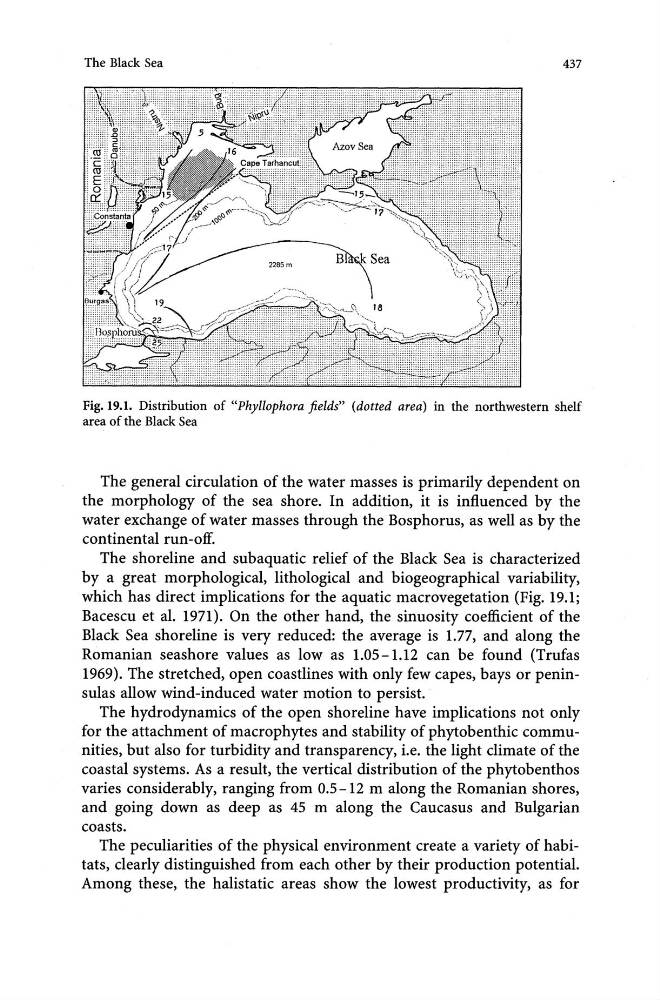
Fig. 19.1. Distribution of "Phyllophora fields" (dotted area) in the northwestern shelf
area of the Black Sea
The general circulation of the water masses is primarily dependent on
the morphology of the sea shore. In addition, it is influenced by the
water exchange of water masses through the Bosphorus, as well as by the
continental run-off.
The shoreline and subaquatic relief of the Black Sea is characterized
by a great morphological, lithological and biogeographical variability,
which has direct implications for the aquatic macrovegetation (Fig. 19.1;
Bacescu et al. 1971). On the other hand, the sinuosity coefficient of the
Black Sea shoreline is very reduced: the average is 1.77, and along the
Romanian seashore values as low as 1.05-1.12 can be found (Trufas
1969). The stretched, open coastlines with only few capes, bays or peninsulas allow wind-induced water motion to persist.
The hydrodynamics of the open shoreline have implications not only
for the attachment of macrophytes and stability of phytobenthic communities, but also for turbidity and transparency, i.e. the light climate of the
coastal systems. As a result, the vertical distribution of the phytobenthos
varies considerably, ranging from 0.5 -12 m along the Romanian shores,
and going down as deep as 45 m along the Caucasus and Bulgarian
coasts.
The peculiarities of the physical environment create a variety of habitats, clearly distinguished from each other by their production potential.
Among these, the halistatic areas show the lowest productivity, as for
437
Fig. 19.1. Distribution of "Phyllophora fields" (dotted area) in the northwestern shelf
area of the Black Sea
The general circulation of the water masses is primarily dependent on
the morphology of the sea shore. In addition, it is influenced by the
water exchange of water masses through the Bosphorus, as well as by the
continental run-off.
The shoreline and subaquatic relief of the Black Sea is characterized
by a great morphological, lithological and biogeographical variability,
which has direct implications for the aquatic macrovegetation (Fig. 19.1;
Bacescu et al. 1971). On the other hand, the sinuosity coefficient of the
Black Sea shoreline is very reduced: the average is 1.77, and along the
Romanian seashore values as low as 1.05-1.12 can be found (Trufas
1969). The stretched, open coastlines with only few capes, bays or peninsulas allow wind-induced water motion to persist.
The hydrodynamics of the open shoreline have implications not only
for the attachment of macrophytes and stability of phytobenthic communities, but also for turbidity and transparency, i.e. the light climate of the
coastal systems. As a result, the vertical distribution of the phytobenthos
varies considerably, ranging from 0.5 -12 m along the Romanian shores,
and going down as deep as 45 m along the Caucasus and Bulgarian
coasts.
The peculiarities of the physical environment create a variety of habitats, clearly distinguished from each other by their production potential.
Among these, the halistatic areas show the lowest productivity, as for