

436
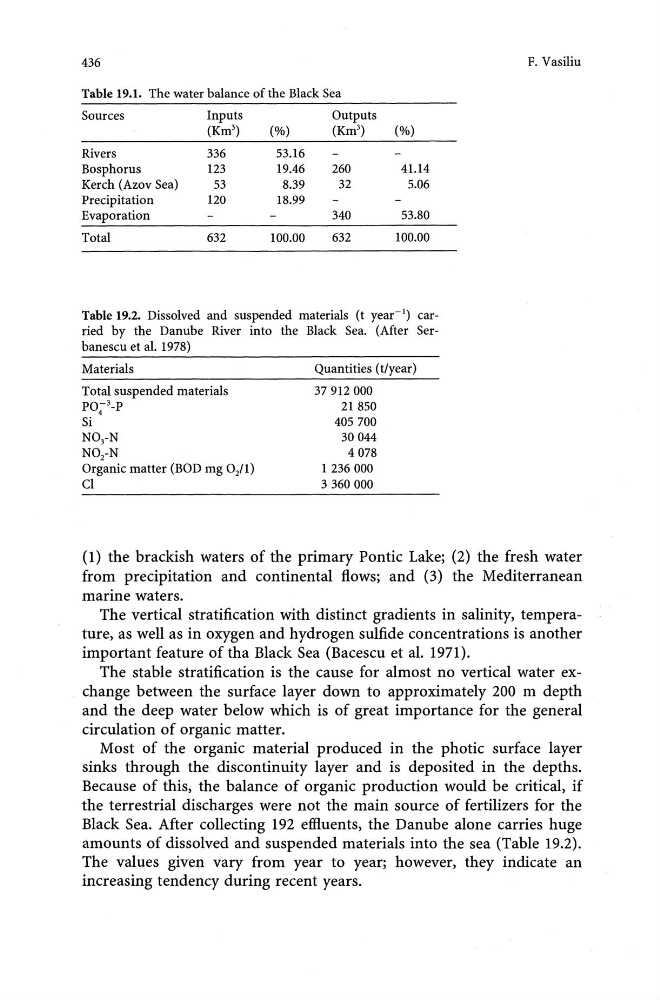
Table 19.1. The water balance of the Black Sea
Sources
Inputs
Outputs
(Km 3 )
(%)
(Km 3 )
(%)
Rivers
336
53.16
Bosphorus
123
19.46
260
41.14
Kerch (Azov Sea)
53
8.39
32
5.06
Precipitation
120
18.99
Evaporation
340
53.80
Total
632
100.00
632
100.00
Table 19.2. Dissolved and suspended materials (t year-I) carried by the Danube River into the Black Sea. (After Serbanescu et al. 1978)
Materials
Total suspended materials
PO;3_p
Si
N0 3 -N
N0 2 -N
Organic matter (BOD mg Oil)
CI
Quantities (t/year)
37912000
21850
405700
30044
4078
1236000
3360000
F. Vasiliu
(1) the brackish waters of the primary Pontic Lake; (2) the fresh water
from precipitation and continental flows; and (3) the Mediterranean
marine waters.
The vertical stratification with distinct gradients in salinity, temperature, as well as in oxygen and hydrogen sulfide concentrations is another
important feature of tha Black Sea (Bacescu et al. 1971).
The stable stratification is the cause for almost no vertical water exchange between the surface layer down to approximately 200 m depth
and the deep water below which is of great importance for the general
circulation of organic matter.
Most of the organic material produced in the photic surface layer
sinks through the discontinuity layer and is deposited in the depths.
Because of this, the balance of organic production would be critical, if
the terrestrial discharges were not the main source of fertilizers for the
Black Sea. After collecting 192 effluents, the Danube alone carries huge
amounts of dissolved and suspended materials into the sea (Table 19.2).
The values given vary from year to year; however, they indicate an
increasing tendency during recent years.
Table 19.1. The water balance of the Black Sea
Sources
Inputs
Outputs
(Km 3 )
(%)
(Km 3 )
(%)
Rivers
336
53.16
Bosphorus
123
19.46
260
41.14
Kerch (Azov Sea)
53
8.39
32
5.06
Precipitation
120
18.99
Evaporation
340
53.80
Total
632
100.00
632
100.00
Table 19.2. Dissolved and suspended materials (t year-I) carried by the Danube River into the Black Sea. (After Serbanescu et al. 1978)
Materials
Total suspended materials
PO;3_p
Si
N0 3 -N
N0 2 -N
Organic matter (BOD mg Oil)
CI
Quantities (t/year)
37912000
21850
405700
30044
4078
1236000
3360000
F. Vasiliu
(1) the brackish waters of the primary Pontic Lake; (2) the fresh water
from precipitation and continental flows; and (3) the Mediterranean
marine waters.
The vertical stratification with distinct gradients in salinity, temperature, as well as in oxygen and hydrogen sulfide concentrations is another
important feature of tha Black Sea (Bacescu et al. 1971).
The stable stratification is the cause for almost no vertical water exchange between the surface layer down to approximately 200 m depth
and the deep water below which is of great importance for the general
circulation of organic matter.
Most of the organic material produced in the photic surface layer
sinks through the discontinuity layer and is deposited in the depths.
Because of this, the balance of organic production would be critical, if
the terrestrial discharges were not the main source of fertilizers for the
Black Sea. After collecting 192 effluents, the Danube alone carries huge
amounts of dissolved and suspended materials into the sea (Table 19.2).
The values given vary from year to year; however, they indicate an
increasing tendency during recent years.