

Turkey
429
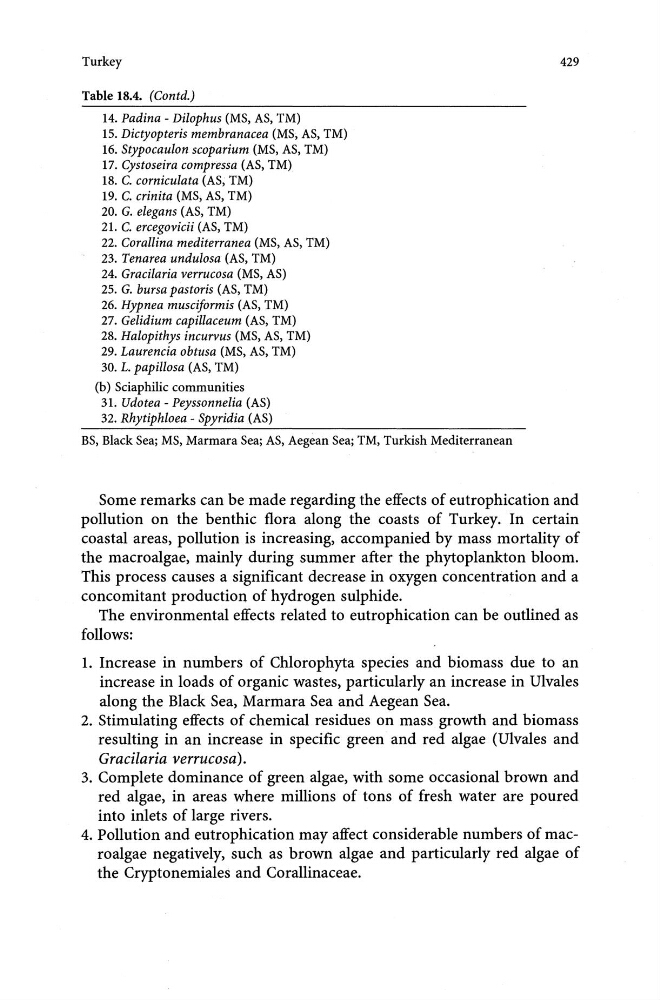
Table 18.4. (Contd.)
14. Padina - Dilophus (MS, AS, TM)
15. Dictyopteris membranacea (MS, AS, TM)
16. Stypocaulon scoparium (MS, AS, TM)
17. Cystoseira compressa (AS, TM)
18. C. corniculata (AS, TM)
19. C. crinita (MS, AS, TM)
20. G. elegans (AS, TM)
21. C. ercegovicii (AS, TM)
22. Corallina mediterranea (MS, AS, TM)
- 23. Tenarea undulosa (AS, TM)
24. Gracilaria verrucosa (MS, AS)
25. G. bursa pastoris (AS, TM)
26. Hypnea musciformis (AS, TM)
27. Gelidium capillaceum (AS, TM)
28. Halopithys incurvus (MS, AS, TM)
29. Laurencia obtusa (MS, AS, TM)
30. L. papillosa (AS, TM)
(b) Sciaphilic communities
31. Udotea - Peyssonnelia (AS)
32. Rhytiphloea - Spyridia (AS)
BS, Black Sea; MS, Marmara Sea; AS, Aegean Sea; TM, Turkish Mediterranean
Some remarks can be made regarding the effects of eutrophication and
pollution on the benthic flora along the coasts of Turkey. In certain
coastal areas, pollution is increasing, accompanied by mass mortality of
the macroalgae, mainly during summer after the phytoplankton bloom.
This process causes a significant decrease in oxygen concentration and a
concomitant production of hydrogen sulphide.
The environmental effects related to eutrophication can be outlined as
follows:
1. Increase in numbers of Chlorophyta species and biomass due to an
increase in loads of organic wastes, particularly an increase in Ulvales
along the Black Sea, Marmara Sea and Aegean Sea.
2. Stimulating effects of chemical residues on mass growth and biomass
resulting in an increase in specific green· and red algae (Ulvales and
Gracilaria verrucosa).
3. Complete dominance of green algae, with some occasional brown and
red algae, in areas where millions of tons of fresh water are poured
into inlets of large rivers.
4. Pollution and eutrophication may affect considerable numbers of macroalgae negatively, such as brown algae and particularly red algae of
the Cryptonemiales and Corallinaceae.
429
Table 18.4. (Contd.)
14. Padina - Dilophus (MS, AS, TM)
15. Dictyopteris membranacea (MS, AS, TM)
16. Stypocaulon scoparium (MS, AS, TM)
17. Cystoseira compressa (AS, TM)
18. C. corniculata (AS, TM)
19. C. crinita (MS, AS, TM)
20. G. elegans (AS, TM)
21. C. ercegovicii (AS, TM)
22. Corallina mediterranea (MS, AS, TM)
- 23. Tenarea undulosa (AS, TM)
24. Gracilaria verrucosa (MS, AS)
25. G. bursa pastoris (AS, TM)
26. Hypnea musciformis (AS, TM)
27. Gelidium capillaceum (AS, TM)
28. Halopithys incurvus (MS, AS, TM)
29. Laurencia obtusa (MS, AS, TM)
30. L. papillosa (AS, TM)
(b) Sciaphilic communities
31. Udotea - Peyssonnelia (AS)
32. Rhytiphloea - Spyridia (AS)
BS, Black Sea; MS, Marmara Sea; AS, Aegean Sea; TM, Turkish Mediterranean
Some remarks can be made regarding the effects of eutrophication and
pollution on the benthic flora along the coasts of Turkey. In certain
coastal areas, pollution is increasing, accompanied by mass mortality of
the macroalgae, mainly during summer after the phytoplankton bloom.
This process causes a significant decrease in oxygen concentration and a
concomitant production of hydrogen sulphide.
The environmental effects related to eutrophication can be outlined as
follows:
1. Increase in numbers of Chlorophyta species and biomass due to an
increase in loads of organic wastes, particularly an increase in Ulvales
along the Black Sea, Marmara Sea and Aegean Sea.
2. Stimulating effects of chemical residues on mass growth and biomass
resulting in an increase in specific green· and red algae (Ulvales and
Gracilaria verrucosa).
3. Complete dominance of green algae, with some occasional brown and
red algae, in areas where millions of tons of fresh water are poured
into inlets of large rivers.
4. Pollution and eutrophication may affect considerable numbers of macroalgae negatively, such as brown algae and particularly red algae of
the Cryptonemiales and Corallinaceae.