

428
H. Giiner and V. Aysel
In the Aegean Sea, Mediterranean algae occur due to the effects of
currents from Mediterranean deep waters, whereas due to the effects of
surface currents of Marmara origin, algae from the Black Sea and the
Marmara Sea dominate in northern Aegean waters and occur sometimes
in the south. The boundary line of the distribution pattern of specific
algae of Mediterranean origin is very sharp between the Aegean Sea and
the Marmara Sea and is related to the effects of ecological factors.
Roughly 90% of the Aegean algae can be found along the Mediterranean
coasts, however, some characteristic species grow exclusively on the
Aegean coasts.
Like the Mediterranean, the Aegean Sea is under the influence of
heavy domestic and industrial pollution: 11 % of the total pollution entering the Mediterranean reaches the Aegean Sea.
There have only been a few investigations on the Turkish Mediterranean algal flora. The first record from the area at the species level was
made by KaramanogIu (1964). Further research was performed by
Zeybek (1969). In recent years, a few researchers (Cirik 1978; Oztiirk
1985; Aysel et al. 1986; Zeybek et al. 1983, 1993; AyseI1992) have studied
the composition of the flora in the region. The flora comprises some
algae of economic importance (e.g. Cystoseira sp., Gelidium sp.).
Surveys of some of the typical communities of benthic vegetation were
carried out between 1978 and 1984 (Giiner and Aysel 1978b, 1984; Aysel
and Guner 1979b, 1982) and in 1992 (Giiner et al. 1992; Sukatar et al.
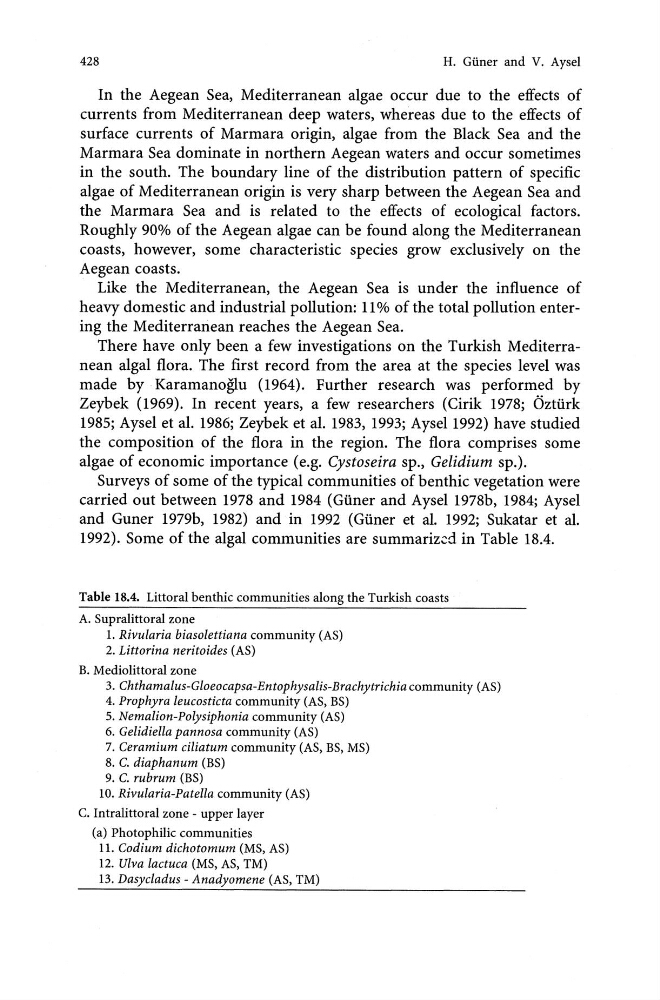
1992). Some of the algal communities are summarizd in Table 18.4.
Table 18.4. Littoral benthic communities along the Turkish coasts
A. Supralittoral zone
1. Rivularia biasolettiana community (AS)
2. Littorina neritoides (AS)
B. Mediolittoral zone
3. Chthamalus-Gloeocapsa-Entophysalis-Brachytrichia community (AS)
4. Prophyra leucosticta community (AS, BS)
5. Nemalion-Polysiphonia community (AS)
6. Gelidiella pannosa community (AS)
7. Ceramium ciliatum community (AS, BS, MS)
8. C. diaphanum (BS)
9. C. rubrum (BS)
10. Rivularia-Patella community (AS)
c. Intralittoral zone - upper layer
(a) Photophilic communities
II. Codium dichotomum (MS, AS)
12. Ulva lactuca (MS, AS, TM)
13. Dasycladus - Anadyomene (AS, TM)
H. Giiner and V. Aysel
In the Aegean Sea, Mediterranean algae occur due to the effects of
currents from Mediterranean deep waters, whereas due to the effects of
surface currents of Marmara origin, algae from the Black Sea and the
Marmara Sea dominate in northern Aegean waters and occur sometimes
in the south. The boundary line of the distribution pattern of specific
algae of Mediterranean origin is very sharp between the Aegean Sea and
the Marmara Sea and is related to the effects of ecological factors.
Roughly 90% of the Aegean algae can be found along the Mediterranean
coasts, however, some characteristic species grow exclusively on the
Aegean coasts.
Like the Mediterranean, the Aegean Sea is under the influence of
heavy domestic and industrial pollution: 11 % of the total pollution entering the Mediterranean reaches the Aegean Sea.
There have only been a few investigations on the Turkish Mediterranean algal flora. The first record from the area at the species level was
made by KaramanogIu (1964). Further research was performed by
Zeybek (1969). In recent years, a few researchers (Cirik 1978; Oztiirk
1985; Aysel et al. 1986; Zeybek et al. 1983, 1993; AyseI1992) have studied
the composition of the flora in the region. The flora comprises some
algae of economic importance (e.g. Cystoseira sp., Gelidium sp.).
Surveys of some of the typical communities of benthic vegetation were
carried out between 1978 and 1984 (Giiner and Aysel 1978b, 1984; Aysel
and Guner 1979b, 1982) and in 1992 (Giiner et al. 1992; Sukatar et al.
1992). Some of the algal communities are summarizd in Table 18.4.
Table 18.4. Littoral benthic communities along the Turkish coasts
A. Supralittoral zone
1. Rivularia biasolettiana community (AS)
2. Littorina neritoides (AS)
B. Mediolittoral zone
3. Chthamalus-Gloeocapsa-Entophysalis-Brachytrichia community (AS)
4. Prophyra leucosticta community (AS, BS)
5. Nemalion-Polysiphonia community (AS)
6. Gelidiella pannosa community (AS)
7. Ceramium ciliatum community (AS, BS, MS)
8. C. diaphanum (BS)
9. C. rubrum (BS)
10. Rivularia-Patella community (AS)
c. Intralittoral zone - upper layer
(a) Photophilic communities
II. Codium dichotomum (MS, AS)
12. Ulva lactuca (MS, AS, TM)
13. Dasycladus - Anadyomene (AS, TM)