

356
A. Sfriso and A. Marcomini
i
...
aD
I
I
180
Sacca
San
Alberoni
Sessola
Giuliano
140
>
100
ID
0
#
60
20
2
6
10
14
3
5
7
2
1600
900
180
•
'j
1400
700
140
>
"
•
-0
"I'e 1000
500
100
.2
•
600
•
300
••
60
>
•
ID
•
0
•
•
200
2
6.
10
14
3
5
7
2
standing crop (kg m-:~w.t weight)
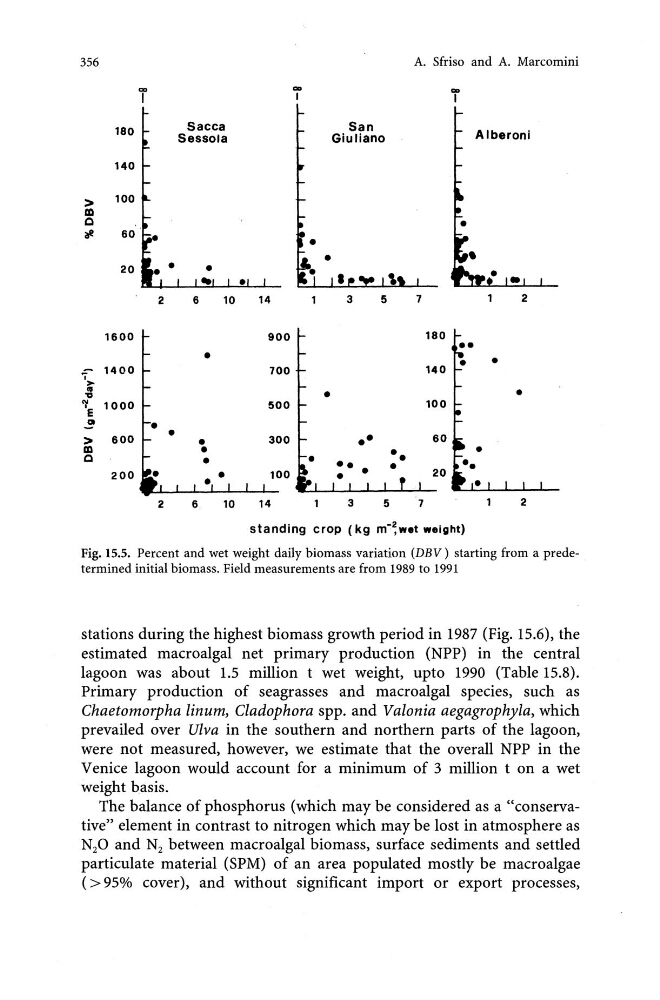
Fig. 15.5. Percent and wet weight daily biomass variation (DBV) starting from a predetermined initial biomass. Field measurements are from 1989 to 1991
stations during the highest biomass growth period in 1987 (Fig. 15.6), the
estimated macro algal net primary production (NPP) in the central
lagoon was about 1.5 million t wet weight, upto 1990 (Table 15.8).
Primary production of seagrasses and macro algal species, such as
Chaetomorpha linum, Cladophora spp. and Valonia aegagrophyla, which
prevailed over Ulva in the southern and northern parts of the lagoon,
were not measured, however, we estimate that the overall NPP in the
Venice lagoon would account for a minimum of 3 million t on a wet
weight basis.
The balance of phosphorus (which may be considered as a "conservative" element in contrast to nitrogen which may be lost in atmosphere as
N 2 0 and N2 between macroalgal biomass, surface sediments and settled
particulate material (SPM) of an area populated mostly be macro algae
(> 95% cover), and without significant import or export processes,
A. Sfriso and A. Marcomini
i
...
aD
I
I
180
Sacca
San
Alberoni
Sessola
Giuliano
140
>
100
ID
0
#
60
20
2
6
10
14
3
5
7
2
1600
900
180
•
'j
1400
700
140
>
"
•
-0
"I'e 1000
500
100
.2
•
600
•
300
••
60
>
•
ID
•
0
•
•
200
2
6.
10
14
3
5
7
2
standing crop (kg m-:~w.t weight)
Fig. 15.5. Percent and wet weight daily biomass variation (DBV) starting from a predetermined initial biomass. Field measurements are from 1989 to 1991
stations during the highest biomass growth period in 1987 (Fig. 15.6), the
estimated macro algal net primary production (NPP) in the central
lagoon was about 1.5 million t wet weight, upto 1990 (Table 15.8).
Primary production of seagrasses and macro algal species, such as
Chaetomorpha linum, Cladophora spp. and Valonia aegagrophyla, which
prevailed over Ulva in the southern and northern parts of the lagoon,
were not measured, however, we estimate that the overall NPP in the
Venice lagoon would account for a minimum of 3 million t on a wet
weight basis.
The balance of phosphorus (which may be considered as a "conservative" element in contrast to nitrogen which may be lost in atmosphere as
N 2 0 and N2 between macroalgal biomass, surface sediments and settled
particulate material (SPM) of an area populated mostly be macro algae
(> 95% cover), and without significant import or export processes,