

Italy - The Lagoon of Venice
355
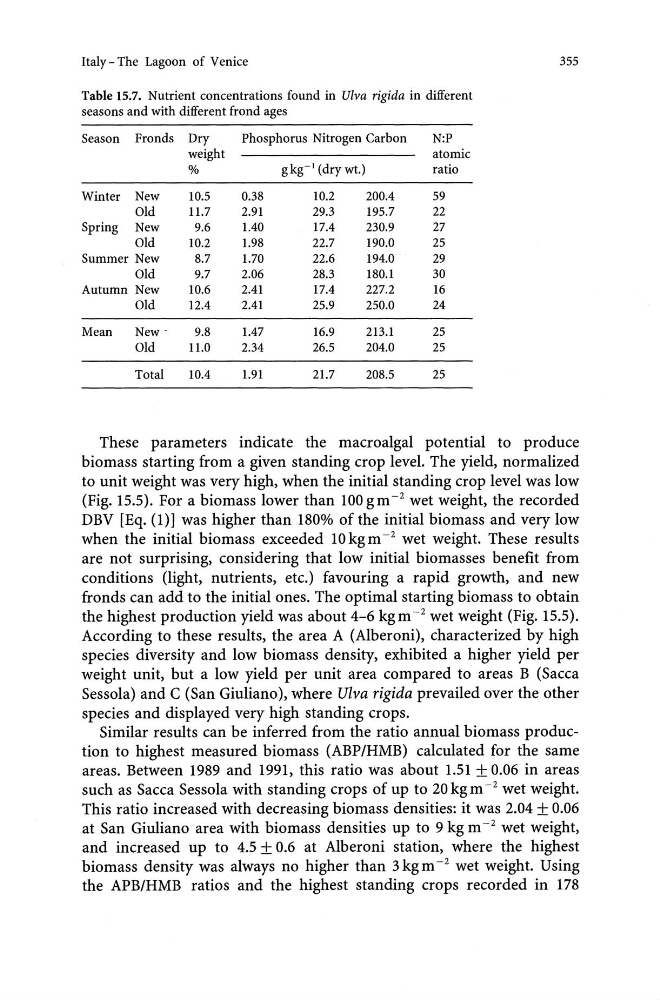
Table 15.7. Nutrient concentrations found in Ulva rigida in different
seasons and with different frond ages
Season Fronds Dry
Phosphorus Nitrogen Carbon
N:P
weight
atomic
%
gkg- 1 (dry wt.)
ratio
Winter New
10.5
0.38
10.2
200.4
59
Old
11.7
2.91
29.3
195.7
22
Spring New
9.6
1.40
17.4
230.9
27
Old
10.2
1.98
22.7
190.0
25
Summer New
8.7
1.70
22.6
194.0
29
Old
9.7
2.06
28.3
180.1
30
Autumn New
10.6
2.41
17.4
227.2
16
Old
12.4
2.41
25.9
250.0
24
Mean
New'
9.8
1.47
16.9
213.1
25
Old
11.0
2.34
26.5
204.0
25
Total
10.4
1.91
21.7
208.5
25
These parameters indicate the macroalgal potential to produce
biomass starting from a given standing crop level. The yield, normalized
to unit weight was very high, when the initial standing crop level was low
(Fig. 15.5). For a biomass lower than 100 gm- 2 wet weight, the recorded
DBV [Eq. (1)] was higher than 180% of the initial biomass and very low
when the initial biomass exceeded 10kgm- 2 wet weight. These results
are not surprising, considering that low initial biomasses benefit from
conditions (light, nutrients, etc.) favouring a rapid growth, and new
fronds can add to the initial ones. The optimal starting biomass to obtain
the highest production yield was about 4-6 kg m -2 wet weight (Fig. 15.5).
According to these results, the area A (Alberoni), characterized by high
species diversity and low biomass density, exhibited a higher yield per
weight unit, but a low yield per unit area compared to areas B (Sacca
Sessola) and C (San Giuliano), where Ulva rigida prevailed over the other
species and displayed very high standing crops.
Similar results can be inferred from the ratio annual biomass production to highest measured biomass (ABP/HMB) calculated for the same
areas. Between 1989 and 1991, this ratio was about 1.51 ± 0.06 in areas
such as Sacca Sessola with standing crops of up to 20 kg m -2 wet weight.
This ratio increased with decreasing biomass densities: it was 2.04 ± 0.06
at San Giuliano area with biomass densities up to 9 kg m -2 wet weight,
and increased up to 4.5 ± 0.6 at Alberoni station, where the highest
biomass density was always no higher than 3kgm- 2 wet weight. Using
the APB/HMB ratios and the highest standing crops recorded in 178
355
Table 15.7. Nutrient concentrations found in Ulva rigida in different
seasons and with different frond ages
Season Fronds Dry
Phosphorus Nitrogen Carbon
N:P
weight
atomic
%
gkg- 1 (dry wt.)
ratio
Winter New
10.5
0.38
10.2
200.4
59
Old
11.7
2.91
29.3
195.7
22
Spring New
9.6
1.40
17.4
230.9
27
Old
10.2
1.98
22.7
190.0
25
Summer New
8.7
1.70
22.6
194.0
29
Old
9.7
2.06
28.3
180.1
30
Autumn New
10.6
2.41
17.4
227.2
16
Old
12.4
2.41
25.9
250.0
24
Mean
New'
9.8
1.47
16.9
213.1
25
Old
11.0
2.34
26.5
204.0
25
Total
10.4
1.91
21.7
208.5
25
These parameters indicate the macroalgal potential to produce
biomass starting from a given standing crop level. The yield, normalized
to unit weight was very high, when the initial standing crop level was low
(Fig. 15.5). For a biomass lower than 100 gm- 2 wet weight, the recorded
DBV [Eq. (1)] was higher than 180% of the initial biomass and very low
when the initial biomass exceeded 10kgm- 2 wet weight. These results
are not surprising, considering that low initial biomasses benefit from
conditions (light, nutrients, etc.) favouring a rapid growth, and new
fronds can add to the initial ones. The optimal starting biomass to obtain
the highest production yield was about 4-6 kg m -2 wet weight (Fig. 15.5).
According to these results, the area A (Alberoni), characterized by high
species diversity and low biomass density, exhibited a higher yield per
weight unit, but a low yield per unit area compared to areas B (Sacca
Sessola) and C (San Giuliano), where Ulva rigida prevailed over the other
species and displayed very high standing crops.
Similar results can be inferred from the ratio annual biomass production to highest measured biomass (ABP/HMB) calculated for the same
areas. Between 1989 and 1991, this ratio was about 1.51 ± 0.06 in areas
such as Sacca Sessola with standing crops of up to 20 kg m -2 wet weight.
This ratio increased with decreasing biomass densities: it was 2.04 ± 0.06
at San Giuliano area with biomass densities up to 9 kg m -2 wet weight,
and increased up to 4.5 ± 0.6 at Alberoni station, where the highest
biomass density was always no higher than 3kgm- 2 wet weight. Using
the APB/HMB ratios and the highest standing crops recorded in 178