

A
Spanish Atlantic Coasts
1974
B
C
o
RIA OF PONTEVEDRA
HIGH LEVEL
_100-500 9 m- 2
_
50-100
0 10 - 50
0<10
LOW LEVEL
A
271
fZ&3 Eutrophic (Ulvaceans)
0
Slightly Disturbed
[ 3 Seriously damaged
l1li Abiotic
1986
B
C
0
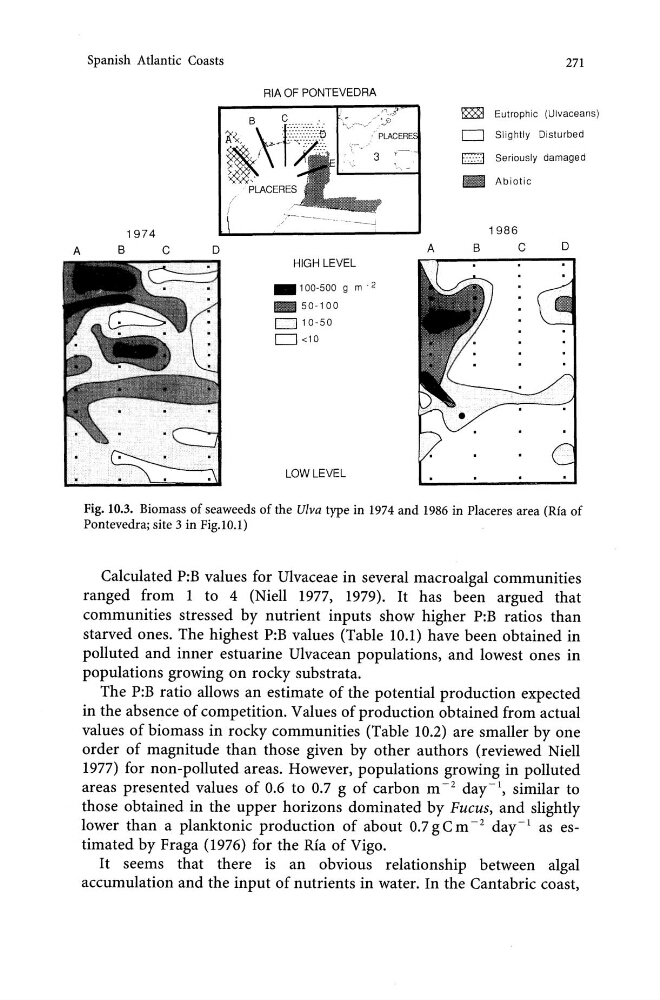
Fig. 10.3. Biomass of seaweeds of the Ulva type in 1974 and 1986 in Piaceres area (Ria of
Pontevedra; site 3 in Fig.l0.l)
Calculated P:B values for Ulvaceae in several macro algal communities
ranged from 1 to 4 (Niell 1977, 1979). It has been argued that
communities stressed by nutrient inputs show higher P:B ratios than
starved ones. The highest P:B values (Table 10.1) have been obtained in
polluted and inner estuarine Ulvacean populations, and lowest ones in
populations growing on rocky substrata.
The P:B ratio allows an estimate of the potential production expected
in the absence of competition. Values of production obtained from actual
values of biomass in rocky communities (Table 10.2) are smaller by one
order of magnitude than those given by other authors (reviewed Niell
1977) for non-polluted areas. However, populations growing in polluted
areas presented values of 0.6 to 0.7 g of carbon m -2 day-I, similar to
those obtained in the upper horizons dominated by Fucus, and slightly
lower than a planktonic production of about 0.7 g C m -2 day-l as estimated by Fraga (1976) for the Ria of Vigo.
It seems that there is an obvious relationship between algal
accumulation and the input of nutrients in water. In the Cantabric coast,
Spanish Atlantic Coasts
1974
B
C
o
RIA OF PONTEVEDRA
HIGH LEVEL
_100-500 9 m- 2
_
50-100
0 10 - 50
0<10
LOW LEVEL
A
271
fZ&3 Eutrophic (Ulvaceans)
0
Slightly Disturbed
[ 3 Seriously damaged
l1li Abiotic
1986
B
C
0
Fig. 10.3. Biomass of seaweeds of the Ulva type in 1974 and 1986 in Piaceres area (Ria of
Pontevedra; site 3 in Fig.l0.l)
Calculated P:B values for Ulvaceae in several macro algal communities
ranged from 1 to 4 (Niell 1977, 1979). It has been argued that
communities stressed by nutrient inputs show higher P:B ratios than
starved ones. The highest P:B values (Table 10.1) have been obtained in
polluted and inner estuarine Ulvacean populations, and lowest ones in
populations growing on rocky substrata.
The P:B ratio allows an estimate of the potential production expected
in the absence of competition. Values of production obtained from actual
values of biomass in rocky communities (Table 10.2) are smaller by one
order of magnitude than those given by other authors (reviewed Niell
1977) for non-polluted areas. However, populations growing in polluted
areas presented values of 0.6 to 0.7 g of carbon m -2 day-I, similar to
those obtained in the upper horizons dominated by Fucus, and slightly
lower than a planktonic production of about 0.7 g C m -2 day-l as estimated by Fraga (1976) for the Ria of Vigo.
It seems that there is an obvious relationship between algal
accumulation and the input of nutrients in water. In the Cantabric coast,