

242
R.L. Fletcher
Lineus ruber
~ '--f'e-IO~-CO-leXb~~deni~=~-5·~~~-~~~~~-~:-:]~[:~:::~:~:::
ffi I « T ubificid spec.
:::;: I!:Ii! ,~ ~Iodoce maculata
81 Eteone longa
~ dense algal cover I
~ Nereis diversicolor - -L _____ ' no algal cover
Pygospio elegans
-~
-I
« Polydora ciliata
~ _________ ]
~ Slreblospio shrubsolii - ~ - - - -----Tharyx marioni
~
~ Cap~ella cap~ta
_ _ _ _____ ___ ~_~~ _____ ~:~~ __ =-:-:::=:J
Ampharete acutifrons
Scolelepis fuliginosa
i1i Manayunkia aestuarina =;:::::::::~::~i~~~~;---!---------====:1
~ Gammarus locusta
~
Carcinus maenas
() i Hydrobia ulvae
ti Littorina saxatilis
en
3 Cerastoderma edule
o
:::;: Abra tenuis
10
100
1000
10 000 100 000
Annual mean numbers of individuals per m 2
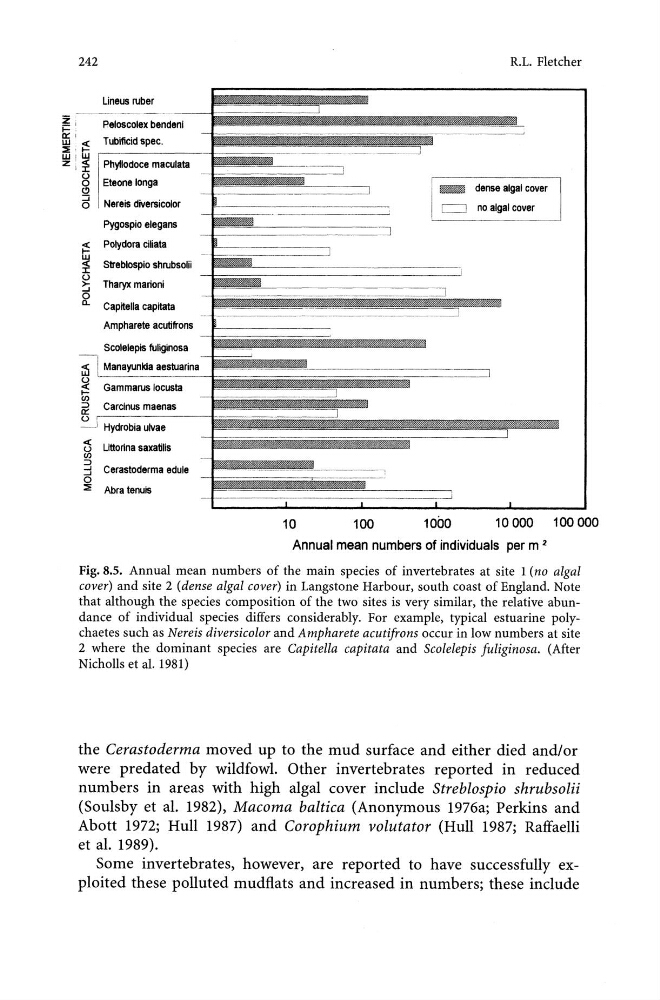
Fig. 8.5. Annual mean numbers of the main species of invertebrates at site 1 (no algal
cover) and site 2 (dense algal cover) in Langstone Harbour, south coast of England. Note
that although the species composition of the two sites is very similar, the relative abundance of individual species differs considerably. For example, typical estuarine polychaetes such as Nereis diversicolor and Ampharete acutifrons occur in low numbers at site
2 where the dominant species are Capitella capitata and Scolelepis fuliginosa. (After
Nicholls et al. 1981)
the Cerastoderma moved up to the mud surface and either died and/or
were predated by wildfowl. Other invertebrates reported in reduced
numbers in areas with high algal cover include Streblospio shrubsolii
(Soulsby et al. 1982), Macoma baltica (Anonymous 1976a; Perkins and
Abott 1972; Hull 1987) and Corophium volutator (Hull 1987; Raffaelli
et al. 1989).
Some invertebrates, however, are reported to have successfully exploited these polluted mudflats and increased in numbers; these include
R.L. Fletcher
Lineus ruber
~ '--f'e-IO~-CO-leXb~~deni~=~-5·~~~-~~~~~-~:-:]~[:~:::~:~:::
ffi I « T ubificid spec.
:::;: I!:Ii! ,~ ~Iodoce maculata
81 Eteone longa
~ dense algal cover I
~ Nereis diversicolor - -L _____ ' no algal cover
Pygospio elegans
-~
-I
« Polydora ciliata
~ _________ ]
~ Slreblospio shrubsolii - ~ - - - -----Tharyx marioni
~
~ Cap~ella cap~ta
_ _ _ _____ ___ ~_~~ _____ ~:~~ __ =-:-:::=:J
Ampharete acutifrons
Scolelepis fuliginosa
i1i Manayunkia aestuarina =;:::::::::~::~i~~~~;---!---------====:1
~ Gammarus locusta
~
Carcinus maenas
() i Hydrobia ulvae
ti Littorina saxatilis
en
3 Cerastoderma edule
o
:::;: Abra tenuis
10
100
1000
10 000 100 000
Annual mean numbers of individuals per m 2
Fig. 8.5. Annual mean numbers of the main species of invertebrates at site 1 (no algal
cover) and site 2 (dense algal cover) in Langstone Harbour, south coast of England. Note
that although the species composition of the two sites is very similar, the relative abundance of individual species differs considerably. For example, typical estuarine polychaetes such as Nereis diversicolor and Ampharete acutifrons occur in low numbers at site
2 where the dominant species are Capitella capitata and Scolelepis fuliginosa. (After
Nicholls et al. 1981)
the Cerastoderma moved up to the mud surface and either died and/or
were predated by wildfowl. Other invertebrates reported in reduced
numbers in areas with high algal cover include Streblospio shrubsolii
(Soulsby et al. 1982), Macoma baltica (Anonymous 1976a; Perkins and
Abott 1972; Hull 1987) and Corophium volutator (Hull 1987; Raffaelli
et al. 1989).
Some invertebrates, however, are reported to have successfully exploited these polluted mudflats and increased in numbers; these include