

The British Isles
40
1:: 30
Ol
.~
c:-c 20
~
co
~ 10
iii
o
South
Lagoon
North
Lagoon
Tolka
South Bay Bull Wall
241
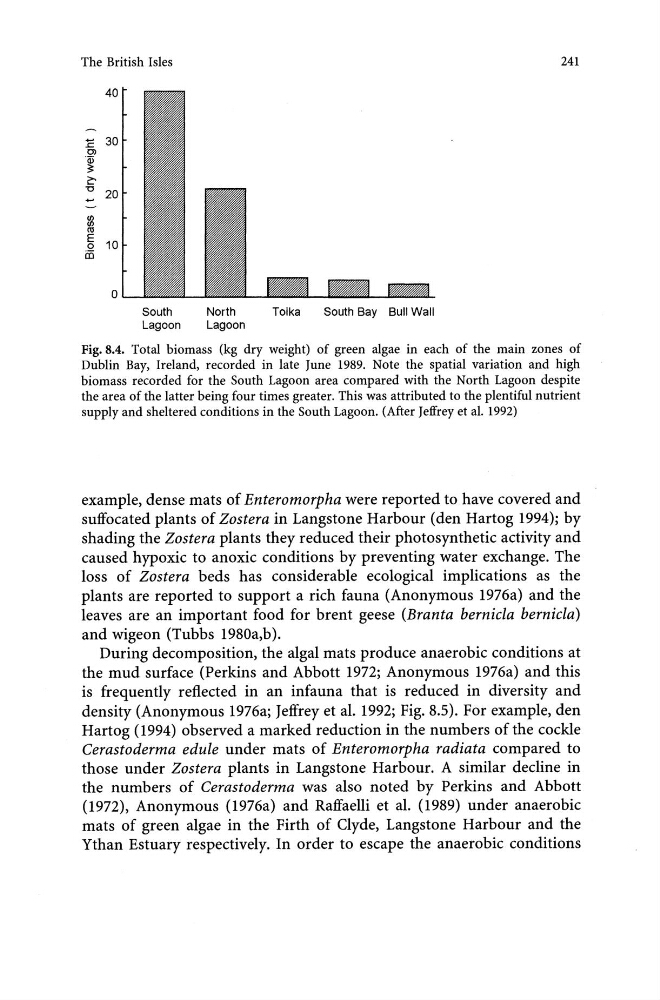
Fig. 8.4. Total biomass (kg dry weight) of green algae in each of the main zones of
Dublin Bay, Ireland, recorded in late June 1989. Note the spatial variation and high
biomass recorded for the South Lagoon area compared with the North Lagoon despite
the area of the latter being four times greater. This was attributed to the plentiful nutrient
supply and sheltered conditions in the South Lagoon. (After Jeffrey et al. 1992)
example, dense mats of Enteromorpha were reported to have covered and
suffocated plants of Zostera in Langstone Harbour (den Hartog 1994); by
shading the Zostera plants they reduced their photosynthetic activity and
caused hypoxic to anoxic conditions by preventing water exchange. The
loss of Zostera beds has considerable ecological implications as the
plants are reported to support a rich fauna (Anonymous 1976a) and the
leaves are an important food for brent geese (Branta bernicla bernicla)
and wigeon (Tubbs 1980a,b).
During decomposition, the algal mats produce anaerobic conditions at
the mud surface (Perkins and Abbott 1972; Anonymous 1976a) and this
is frequently reflected in an infauna that is reduced in diversity and
density (Anonymous 1976a; Jeffrey et al. 1992; Fig. 8.5). For example, den
Hartog (1994) observed a marked reduction in the numbers of the cockle
Cerastoderma edule under mats of Enteromorpha radiata compared to
those under Zostera plants in Langstone Harbour. A similar decline in
the numbers of Cerastoderma was also noted by Perkins and Abbott
(1972), Anonymous (1976a) and Raffaelli et al. (1989) under anaerobic
mats of green algae in the Firth of Clyde, Langstone Harbour and the
Ythan Estuary respectively. In order to escape the anaerobic conditions
40
1:: 30
Ol
.~
c:-c 20
~
co
~ 10
iii
o
South
Lagoon
North
Lagoon
Tolka
South Bay Bull Wall
241
Fig. 8.4. Total biomass (kg dry weight) of green algae in each of the main zones of
Dublin Bay, Ireland, recorded in late June 1989. Note the spatial variation and high
biomass recorded for the South Lagoon area compared with the North Lagoon despite
the area of the latter being four times greater. This was attributed to the plentiful nutrient
supply and sheltered conditions in the South Lagoon. (After Jeffrey et al. 1992)
example, dense mats of Enteromorpha were reported to have covered and
suffocated plants of Zostera in Langstone Harbour (den Hartog 1994); by
shading the Zostera plants they reduced their photosynthetic activity and
caused hypoxic to anoxic conditions by preventing water exchange. The
loss of Zostera beds has considerable ecological implications as the
plants are reported to support a rich fauna (Anonymous 1976a) and the
leaves are an important food for brent geese (Branta bernicla bernicla)
and wigeon (Tubbs 1980a,b).
During decomposition, the algal mats produce anaerobic conditions at
the mud surface (Perkins and Abbott 1972; Anonymous 1976a) and this
is frequently reflected in an infauna that is reduced in diversity and
density (Anonymous 1976a; Jeffrey et al. 1992; Fig. 8.5). For example, den
Hartog (1994) observed a marked reduction in the numbers of the cockle
Cerastoderma edule under mats of Enteromorpha radiata compared to
those under Zostera plants in Langstone Harbour. A similar decline in
the numbers of Cerastoderma was also noted by Perkins and Abbott
(1972), Anonymous (1976a) and Raffaelli et al. (1989) under anaerobic
mats of green algae in the Firth of Clyde, Langstone Harbour and the
Ythan Estuary respectively. In order to escape the anaerobic conditions